
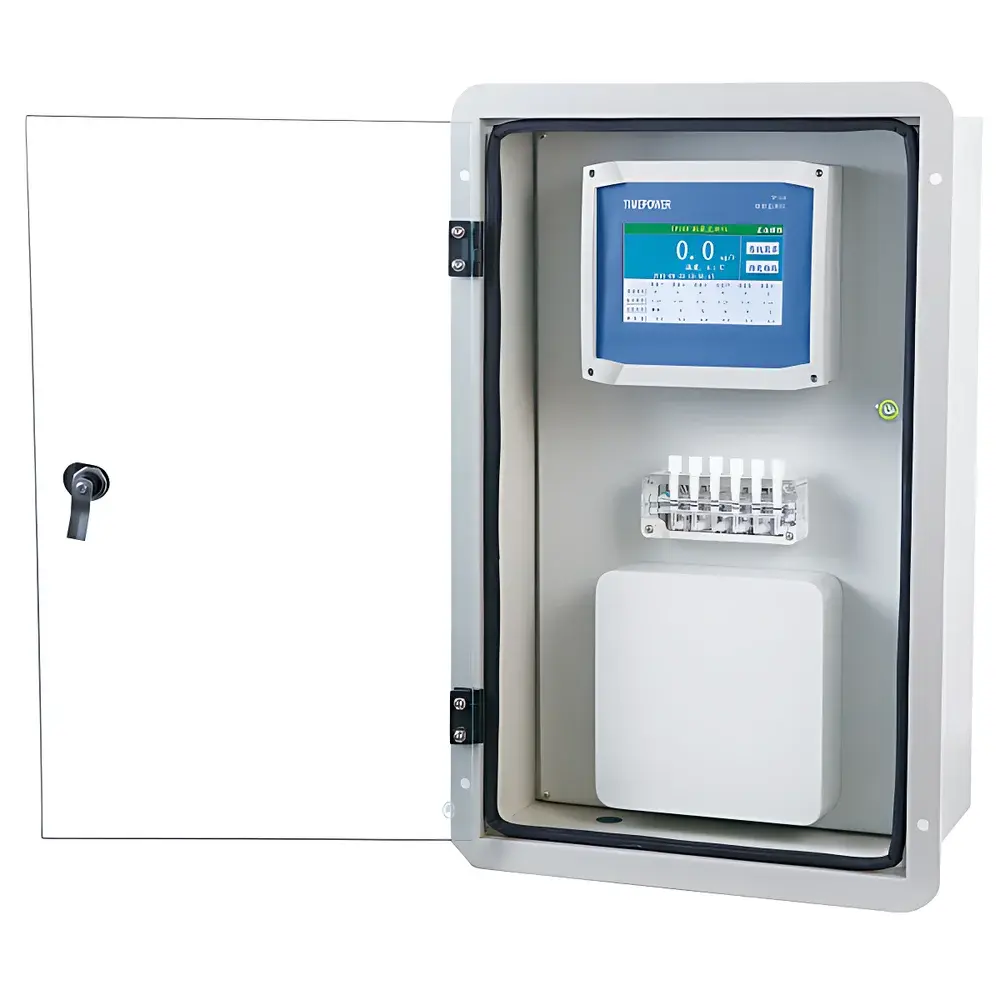
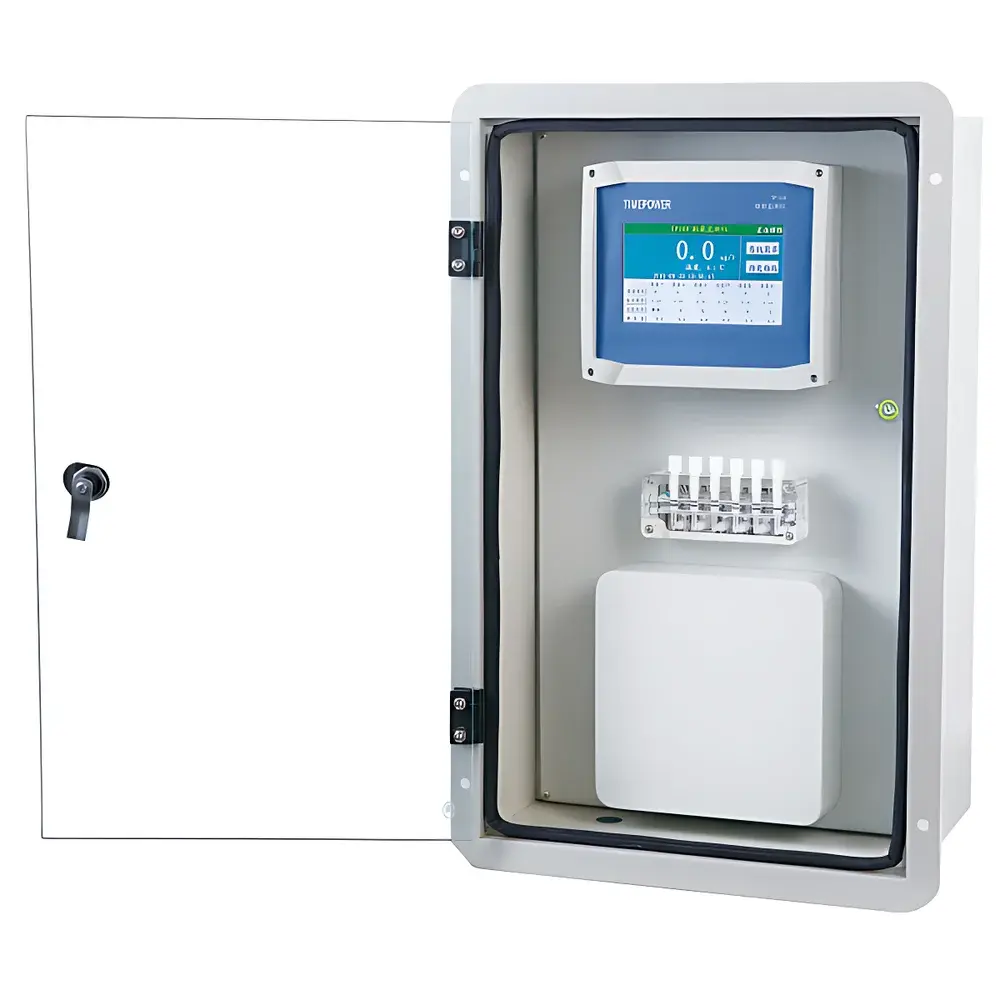
TimePower TP108 Hydrazine Online Analyzer
| Brand | TimePower |
|---|---|
| Origin | Beijing, China |
| Manufacturer Type | OEM Manufacturer |
| Country of Origin | China |
| Model | TP108 |
| Price | Upon Request |
| Measurement Principle | Colorimetric Analysis (p-Dimethylaminobenzaldehyde Reaction in Acidic Medium) |
| Measurement Range | 0.0–100.0 µg/L |
| Display | 7.0-inch Color TFT Touchscreen (Chinese UI) |
| Accuracy | ±2% F.S. |
| Repeatability | ≤±1% F.S. |
| Drift | <±1% F.S./24 h |
| Response Time | <4 min |
| Cycle Time | ~3 min per channel |
| Channels | 1–6 configurable |
| Light Source | Monochromatic Cold LED |
| Valve Actuation | Imported High-Precision Solenoid Valves |
| Calibration | Automated Dual-Point Standard Calibration (User-Defined Interval) |
| Data Storage | 30 days of historical data (timestamped, per channel) |
| Output Signals | Isolated 0–20 mA / 4–20 mA / 0–10 mA (programmable per channel) |
| Alarm Outputs | Independent per-channel alarms (flow loss, upper/lower limit) |
| Sample Flow Rate | 10–40 L/h |
| Sample Temp. | 5–50 °C |
| Sample Particulates | <5 µm, non-colloidal |
| Ambient Temp. | 5–45 °C |
| Ambient Humidity | ≤90% RH (non-condensing) |
| Reagent Consumption | ~3 L/month |
| Power Supply | AC 85–265 V, 45–65 Hz |
| Power Consumption | ≤100 W |
| Dimensions (W×H×D) | 460 × 720 × 280 mm |
| Panel Cutout | 670 × 410 mm |
| Weight | 22 kg |
Overview
The TimePower TP108 Hydrazine Online Analyzer is an industrial-grade, multi-channel photometric analyzer engineered for continuous, unattended monitoring of hydrazine (N2H4) concentration in aqueous process streams. It operates on the well-established colorimetric principle: under controlled acidic conditions, hydrazine reacts quantitatively with p-dimethylaminobenzaldehyde (DMAB) to form a stable yellow azo dye. Absorbance of this complex is measured at a fixed wavelength using a monochromatic cold LED light source and high-stability optical path. Adhering strictly to the Lambert–Beer law, the instrument converts optical density into hydrazine concentration with trace-level sensitivity (0.0–100.0 µg/L). Designed for integration into critical water chemistry control loops—especially in high-purity boiler feedwater systems—the TP108 delivers long-term measurement integrity without operator intervention, making it suitable for compliance-driven environments including power generation, chemical manufacturing, pharmaceutical water systems, and municipal drinking water treatment.
Key Features
- Modular 1–6 channel architecture enables scalable deployment across multiple sampling points while optimizing capital and operational expenditure.
- Imported high-reliability solenoid valves ensure precise, repeatable reagent dosing and sample aspiration—critical for maintaining analytical accuracy over extended service intervals.
- Automated dual-point calibration routine (user-programmable interval) corrects for optical drift and reagent aging, sustaining measurement stability (<±1% F.S./24 h) and minimizing manual maintenance frequency.
- 7.0-inch color TFT touchscreen provides intuitive Chinese-language interface with real-time overlay of up to six channel trends, historical curve comparison, and alarm status visualization.
- Onboard data logger retains 30 days of timestamped measurement records (including absorbance values, calibration logs, and fault events), supporting root-cause analysis and regulatory documentation requirements.
- Robust mechanical design features front-panel cutout mounting (670 × 410 mm), IP54-rated enclosure, and thermal management optimized for ambient operation between 5–45 °C.
Sample Compatibility & Compliance
The TP108 accepts raw or pre-filtered liquid samples meeting defined physical specifications: flow rate 10–40 L/h; temperature 5–50 °C; suspended solids <5 µm with no colloidal content. It is compatible with standard hydrazine reference standards (e.g., 10 µg/mL certified stock solutions) and DMAB-based reagent kits. While not certified to IEC 61508 or SIL-2 out-of-the-box, its architecture supports integration into safety-instrumented systems via hardwired alarm contacts. The analyzer aligns with core water quality monitoring practices referenced in ASTM D129-19 (Standard Test Method for Sulfur in Petroleum Products), ISO 7027 (Water Quality – Determination of Turbidity), and USP (Total Organic Carbon), and its data handling supports GLP/GMP audit trails when paired with validated external SCADA or DCS platforms.
Software & Data Management
The embedded firmware implements deterministic real-time control logic with non-volatile memory for configuration persistence. All calibration parameters, alarm thresholds, output scaling factors, and channel enable/disable states are stored securely and survive power cycles. Current output signals (0–20 mA / 4–20 mA / 0–10 mA) are fully isolated and independently programmable per channel—enabling direct interfacing with PLCs, DCS analog input cards, or automated hydrazine dosing controllers. Event logging includes time-stamped entries for calibration execution, reagent low warnings, flow interruption detection, and out-of-specification measurements. Data export is supported via USB host port (CSV format), facilitating offline trending and QA review. No cloud connectivity or remote access capability is included—ensuring network isolation for secure industrial deployments.
Applications
- Thermal power plants: Continuous monitoring of hydrazine residual in deaerator outlet and boiler feedwater to verify oxygen scavenging efficacy and prevent corrosion under deposits (CUD).
- Fertilizer and ammonia synthesis facilities: Control of hydrazine levels in high-pressure synthesis water circuits where catalytic decomposition must be avoided.
- Pharmaceutical purified water (PW) and water-for-injection (WFI) systems: Verification of hydrazine removal post-pretreatment, particularly when hydrazine-containing antifoams are used upstream.
- Chemical process streams: Monitoring of hydrazine-based reducing agents in metal finishing, electroplating, or catalyst regeneration loops.
- Municipal drinking water treatment: Detection of hydrazine contamination from industrial discharge or accidental spills in source water intake monitoring stations.
FAQ
What is the recommended reagent replacement interval?
Reagents should be replenished approximately every 30 days based on nominal usage (≈3 L/month); actual interval depends on cycle frequency and number of active channels.
Does the analyzer support automatic zero and span calibration?
Yes—user-defined dual-point calibration uses certified low- and high-concentration hydrazine standards to correct both offset and gain drift.
Can historical data be exported for regulatory reporting?
Yes—via USB flash drive in CSV format, including timestamps, channel ID, measured value, and event flags.
Is the display interface available in English?
The standard UI is Chinese-only; English language firmware is available upon special request and validation.
What maintenance tasks require qualified personnel?
Optical path cleaning, DMAB reagent line priming, and internal valve servicing must be performed by trained technicians following the maintenance manual—end users should not open the analyzer housing.
Related Products





