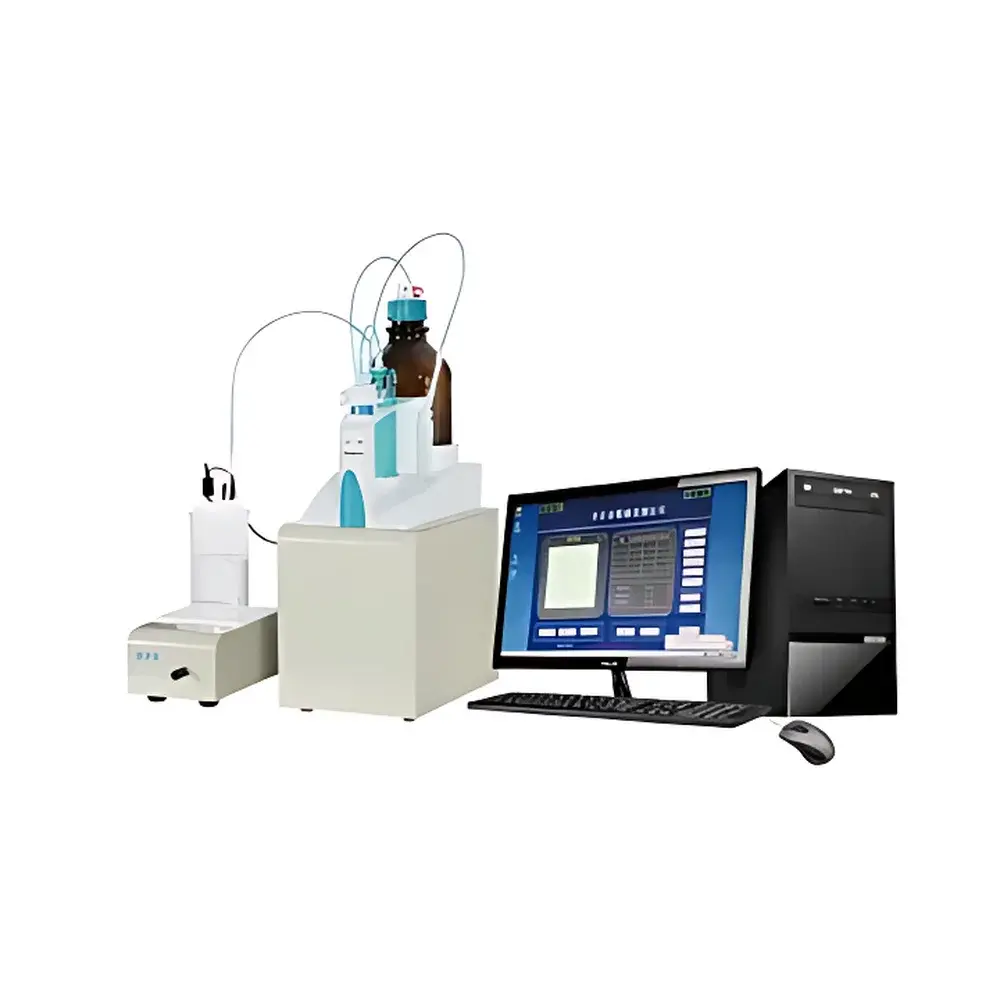
Timepower TP632 Automatic Acid Number Titrator
| Brand | Timepower |
|---|---|
| Origin | Beijing, China |
| Manufacturer Type | Manufacturer |
| Model | TP632 |
| Price | Upon Request |
Overview
The Timepower TP632 Automatic Acid Number Titrator is a precision electrochemical analytical instrument engineered for the accurate and reproducible determination of acid number (AN) in petroleum-based and bio-based liquid samples. It operates on the principle of potentiometric titration—measuring the potential shift across a three-electrode system (glass reference electrode, saturated calomel electrode, and platinum indicator electrode) as standardized potassium hydroxide in isopropanol solution is incrementally delivered into the sample. The instrument continuously records electrode potential versus titrant volume, constructs the first-derivative titration curve, applies digital smoothing algorithms to suppress noise-induced inflection errors, and precisely identifies the equivalence point using adaptive endpoint detection logic. This methodology ensures compliance with ASTM D664, ISO 6618, and GB/T 18609–2001 for acid number determination in lubricants, biodiesel, biodiesel blends (B5–B100), transformer oils, and other hydrocarbon-based fluids.
Key Features
- Potentiometric endpoint detection with dual high-input-impedance channels (Ri ≥ 1 × 10¹² Ω), ensuring stable electrode potential acquisition even in low-conductivity media such as hydrocarbon solvents.
- Three-electrode configuration (glass, calomel, platinum) for enhanced signal fidelity, reduced junction potential drift, and improved robustness against sample color or turbidity interference.
- Integrated fluid handling system featuring automatic rinsing, reagent replenishment, fixed-volume dosing, and programmable purge cycles—minimizing carryover and operator intervention.
- 10 mL precision burette with ±0.1% full-scale accuracy, 0.01 mL minimum dispensing resolution, and consistent delivery time of (60 ± 10) s per full stroke.
- Embedded microcontroller platform based on advanced single-chip architecture—optimized for low power consumption, thermal stability, and real-time data processing without external PC dependency.
- Digital curve smoothing and endpoint correction algorithms that compensate for baseline drift, slow electrode response, and minor titrant decomposition—directly improving repeatability per GB/T 18609–2001 validation requirements.
Sample Compatibility & Compliance
The TP632 is validated for use with transparent to deeply colored petroleum products—including mineral oils, synthetic lubricants, used engine oils, insulating oils, and fatty acid methyl ester (FAME)-based biodiesels—without requiring visual indicators or sample dilution. Its electrochemical detection mechanism eliminates subjectivity associated with colorimetric endpoints. Instrument performance meets the precision criteria defined in GB/T 18609–2001 (relative error ≤ 5% vs. reference method), and supports traceability under GLP-compliant laboratory environments. While not pre-certified for FDA 21 CFR Part 11, its data logging architecture (timestamped raw potential/volume pairs, final AN result, operator ID, and method parameters) provides an auditable foundation for regulated quality control workflows in power generation, refinery QC, and third-party testing laboratories.
Software & Data Management
The TP632’s onboard firmware stores up to 200 complete titration records—including raw mV vs. mL datasets, smoothed derivative curves, calculated acid number (mg KOH/g), standard deviation across replicates, and user-defined metadata (sample ID, batch, analyst). Data export is supported via USB interface in CSV format for integration with LIMS or statistical analysis platforms. All measurements include electronic timestamps and method version identifiers. The system logs operational events (e.g., electrode calibration, reagent replacement, cleaning cycles) to support internal audit trails. No proprietary software installation is required; exported files are natively readable in Excel, MATLAB, or Python-based QA pipelines.
Applications
- Condition monitoring of in-service turbine and transformer oils in electric utilities and industrial plants.
- Quality assurance of virgin and blended biodiesel (ASTM D7467, EN 14214) during production and distribution.
- Routine acid number testing in petroleum refining QC labs for crude distillates, base stocks, and finished lubricants.
- Research applications in fuel oxidation kinetics, additive depletion studies, and degradation modeling in academic and government laboratories.
- Compliance verification for commercial import/export certification per CNCA, AQSIQ, or SGS requirements.
FAQ
What types of electrodes are required for operation?
The TP632 requires a glass pH electrode, a saturated calomel reference electrode (SCE), and a platinum indicator electrode—all included in standard configurations.
Is the instrument compatible with non-aqueous titrations beyond KOH/isopropanol?
It is optimized for KOH in isopropanol per GB/T 18609 and ASTM D664; alternative titrants require method validation and may affect endpoint detection reliability.
How often must the electrodes be calibrated?
Electrode offset and slope verification is recommended before each analytical session or after 8 hours of continuous use; calibration uses two-point buffer standards (pH 4.01 and 7.00 in aqueous solution) followed by solvent equilibration.
Does the system support multi-sample sequential analysis?
Yes—up to 12 samples can be queued with automated rinse-and-fill between runs; sample changer integration is not native but achievable via external robotics I/O signals.
What environmental conditions are required for optimal performance?
Ambient temperature: 5–35 °C; relative humidity ≤ 80% non-condensing; stable bench surface; avoidance of direct sunlight and air drafts to minimize thermal drift in electrode potential.