
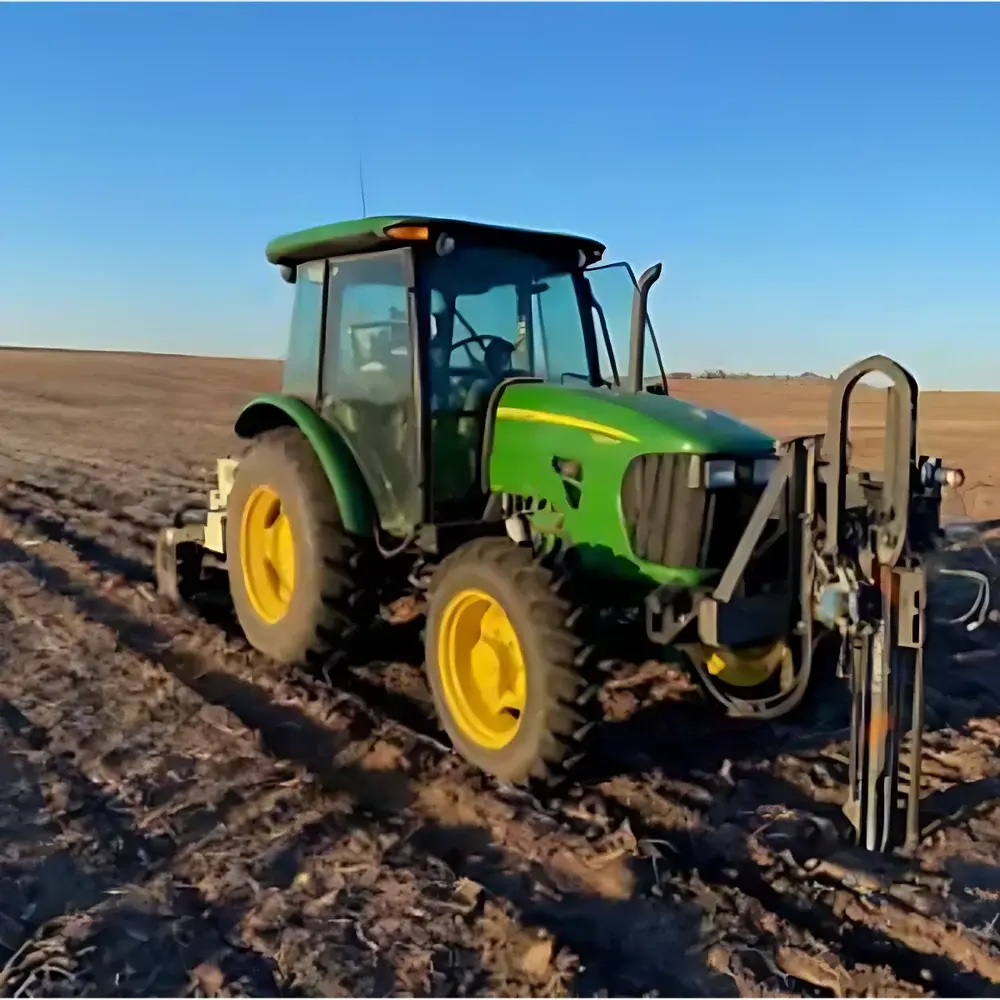
P3500 CoreScan™ Soil Profile Physicochemical Characterization System
| Brand | EcoTech |
|---|---|
| Origin | USA |
| Model | P3500 |
| Sensor Types | EC, VisNIR, Capacitance, Penetrometer |
| Max. Profiling Depth (Auto) | 60 cm |
| Max. Profiling Depth (Manual) | 90 cm |
| Sampling Resolution | 240 data points per insertion |
| Data Acquisition Rate | 1 Hz |
| GPS Integration | Yes |
| Sampling Tube Included | Yes |
| Compliance | ASTM D698/D1557 (soil compaction), ISO 11277 (soil texture), ISO 13879 (EC measurement), USP <1058> (analytical instrument qualification framework) |
Overview
The P3500 CoreScan™ Soil Profile Physicochemical Characterization System is an integrated, field-deployable sensor platform engineered for high-resolution, in-situ characterization of vertical soil profiles. It operates on a multi-sensor fusion principle—combining electrical conductivity (EC), visible and near-infrared (VisNIR) reflectance spectroscopy, capacitance-based dielectric permittivity measurement, and mechanical penetrometry—to deliver co-registered, depth-resolved datasets across standard agricultural and ecological monitoring depths (up to 90 cm). Unlike discrete lab-based assays or single-parameter field probes, the CoreScan™ system captures interdependent physical and chemical properties simultaneously: EC correlates with clay content, cation exchange capacity (CEC), and soluble salt distribution; VisNIR spectral signatures are empirically calibrated against organic matter (OM) and total carbon (TC); capacitance-derived dielectric constants are converted to volumetric water content (θv) using texture-corrected calibration models; and penetrometer resistance (MPa) quantifies mechanical impedance to root penetration—directly informing root zone health and carbon density estimation. The system is designed for reproducible, operator-independent profiling under variable field conditions, supporting standardized soil survey protocols and long-term monitoring frameworks.
Key Features
- Multi-sensor co-location: All four sensors (EC, VisNIR, capacitance, penetrometer) are rigidly aligned within a single probe shaft, ensuring spatially congruent measurements at identical depth increments.
- High-density vertical resolution: Generates 240 discrete, depth-matched readings per core insertion—enabling sub-centimeter stratigraphic differentiation in the 0–60 cm auto-mode range.
- Real-time georeferenced acquisition: Integrated GNSS receiver (sub-meter horizontal accuracy, WAAS-enabled) timestamps and tags each reading with UTM coordinates, enabling GIS-ready output without post-processing alignment.
- Dual-mode profiling: Automated 60 cm depth control (motor-driven insertion with load feedback) and manual 90 cm capability with calibrated depth indexing and sample tube retention.
- Texture-robust moisture sensing: Capacitance module employs frequency-domain oscillation (100 MHz) to minimize dielectric dispersion effects from clay mineralogy and electrolyte concentration—improving θv accuracy across diverse soil classes.
- Field-validated calibration traceability: Factory calibrations follow ISO/IEC 17025-compliant procedures; site-specific VisNIR models can be developed using paired core samples and laboratory reference analysis (e.g., loss-on-ignition, dry combustion).
Sample Compatibility & Compliance
The P3500 CoreScan™ is compatible with mineral soils ranging from coarse sand to heavy clay (USDA texture classes), including saline-alkali and organic-rich histosols (up to 30% OM). It meets requirements for field instrumentation used in USDA-NRCS soil survey workflows, FAO World Reference Base (WRB) classification support, and IPCC Tier 2/3 soil carbon stock change reporting. Data integrity complies with GLP principles: audit trails log operator ID, GPS metadata, sensor diagnostics, and environmental ambient conditions (temperature, humidity) for every profile. Software export formats (CSV, GeoJSON, ESRI Shapefile) support interoperability with QGIS, ArcGIS Pro, and R-based pedometric modeling pipelines. The system conforms to ASTM D698/D1557 for standardized compaction assessment and ISO 11277 for particle-size distribution inference from EC and VisNIR data.
Software & Data Management
The CoreScan™ Control Suite (v4.2+) provides real-time visualization of depth profiles, automatic outlier detection (based on statistical deviation thresholds), and batch processing of multi-site datasets. Raw sensor outputs are stored in HDF5 format with embedded metadata (CF-1.8 conventions), ensuring long-term archival fidelity. The software supports 21 CFR Part 11-compliant user authentication, electronic signatures, and immutable audit logs for regulated applications (e.g., carbon credit verification, remediation monitoring). Export modules generate FAO-compatible Soil Information Sheets and IPCC-compliant carbon stock tables—including bulk density correction factors derived from penetrometer resistance and texture-class interpolation. Cloud synchronization (optional EcoTech Cloud Portal) enables collaborative review, version-controlled calibration updates, and automated report generation aligned with UN SDG 15.3.1 (Land Degradation Neutrality) indicators.
Applications
- Soil carbon stock quantification and temporal monitoring for voluntary carbon markets and national GHG inventories.
- Precision irrigation scheduling via spatially explicit water-holding capacity and saturation deficit mapping.
- Root zone constraint diagnosis—integrating penetrometer resistance with EC and OM gradients to identify compaction layers limiting carbon sequestration potential.
- Post-mining land reclamation assessment, tracking recovery of CEC, OM, and structural stability over time.
- Long-term ecological research sites (LTER) requiring harmonized, cross-platform soil profile datasets compliant with ISRIC WoSIS standards.
- Validation of remote sensing-derived soil property maps (e.g., Sentinel-2, Landsat-Sentinel fusion products) through ground-truth stratified sampling.
FAQ
What depth intervals are used for data collection?
Data are acquired continuously at 1 Hz during insertion, yielding approximately 0.5–1 mm vertical resolution depending on insertion speed; post-processing allows user-defined binning (e.g., 2 cm layers) for statistical aggregation.
Can the VisNIR module be recalibrated for region-specific soil types?
Yes—users may import laboratory-measured OM/TC reference values from paired cores to generate local partial least squares (PLS) regression models within the software.
Is the system suitable for frozen or waterlogged soils?
Penetration is not recommended in saturated or frozen conditions due to mechanical stress on the probe and signal distortion in capacitance/EC readings; optimal operation occurs at field capacity moisture levels.
How is sensor drift managed during extended field campaigns?
Each sensor undergoes pre- and post-campaign validation using NIST-traceable reference standards (e.g., Kaolin clay slurry for EC, quartz sand for penetrometer), with drift correction applied via linear interpolation in software.
Does the system support integration with existing farm management information systems (FMIS)?
Yes—API access and OGC SensorThings API compliance enable direct ingestion into platforms such as Granular, Climate FieldView, and AgriWebb via secure HTTPS endpoints.
Related Products







