
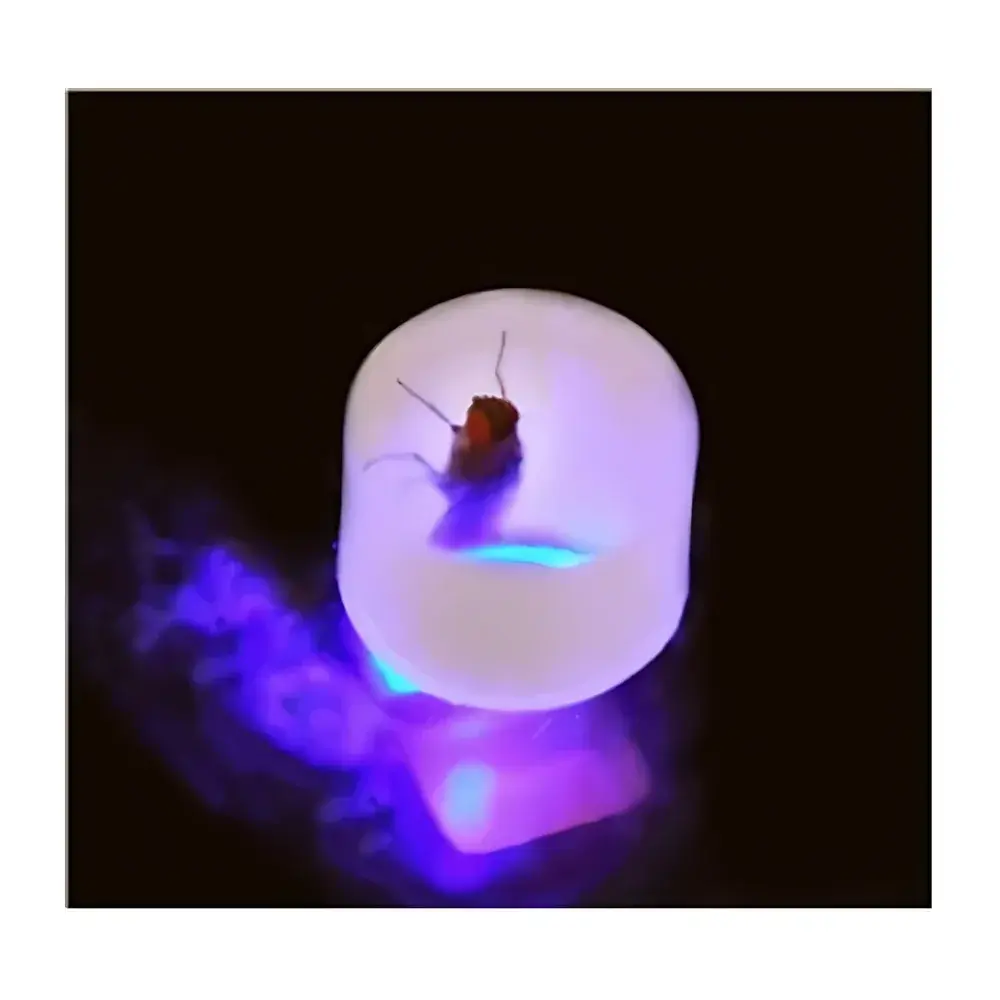
EcoTech Insect High-Throughput Respirometry System
| Brand | EcoTech |
|---|---|
| Origin | Beijing, China |
| Model | Insect High-Throughput |
| Detection Technology | Fluorescence-based Optical Oxygen Sensing |
| Channel Capacity | 96 simultaneous channels |
| Measurement Principle | Non-invasive, real-time O₂ consumption via phase-modulation fluorometry |
| Sample Types | Drosophila melanogaster, insect eggs/pupae, nematodes, soil microarthropods, and other small invertebrates |
| Operating Environment | Compatible with incubators (0–50 °C) and orbital shakers |
| Oxygen Measurement Range | 0–100% O₂ (gas phase) or 0–20 mg/L (aqueous phase) |
| Accuracy | ±0.1% O₂ @ 1% O₂ or ±0.05 mg/L @ 0.44 mg/L |
| Resolution | 0.01% O₂ or 0.005 mg/L |
| Response Time (t₉₀) | <30 s |
| Sampling Frequency | Up to 20 Hz per active channel |
| Integrated Sensors | Temperature (0–50 °C, ±0.5 °C, 0.012 °C resolution), Pressure (300–1100 mbar, ±6 mbar, 0.11 mbar resolution) |
| Power Supply | 5 V DC via USB |
| Dimensions (O₂ Host Unit) | 162 × 102 × 32 mm |
| Weight | 670 g |
| Chamber Material | Sterilizable transparent polystyrene |
| Software Compliance | Audit-trail enabled, timestamped raw data export (CSV, HDF5), supports GLP-aligned experimental metadata tagging |
Overview
The EcoTech Insect High-Throughput Respirometry System is an engineered solution for quantitative, non-invasive measurement of oxygen consumption rates (OCR) in minute invertebrate specimens. It operates on the physical principle of fluorescence lifetime quenching—where molecular oxygen modulates the phase shift and amplitude decay of excited-state fluorophores immobilized on optical fiber tips. This phase-modulation fluorometry technique eliminates photobleaching, drift, and electrochemical interference common in Clark-type electrodes, delivering stable, calibration-resistant O₂ quantification across gas and aqueous phases. Designed specifically for micro-scale respirometry, the system enables parallel assessment of metabolic phenotypes in genetically tractable models (e.g., Drosophila melanogaster), developmental stages (eggs, pupae), and ecologically relevant taxa (nematodes, collembolans, mites). Its compact host unit and modular 96-well respiratory chamber array permit deployment inside precision-controlled environments—including programmable incubators and temperature-regulated shakers—ensuring strict thermal and mechanical standardization during long-term metabolic assays.
Key Features
- 96-channel parallel respirometry architecture with independent optical excitation and signal demodulation per channel
- Fluorescence-based O₂ sensing with no oxygen consumption by the sensor itself—preserving sample integrity over extended measurements
- Integrated high-resolution temperature and barometric pressure sensors enabling real-time compensation of OCR calculations per ASTM E2585-18 and ISO 8692:2012
- Sterilizable, optically transparent polystyrene respiration chambers compatible with autoclaving and ethanol disinfection
- USB-powered operation with low power draw (<2 W), eliminating need for external power supplies or grounding considerations
- Response time (t90) <30 seconds under standard atmospheric conditions—enabling dynamic metabolic profiling during acute stressors (e.g., hypoxia onset, thermal ramping)
- Calibration-free baseline stability supported by factory-traceable reference standards; single-point air-saturation verification sufficient for routine use
Sample Compatibility & Compliance
The system accommodates specimens ranging from 10 µg to 5 mg dry mass—including adult flies, larval instars, diapausing eggs, encysted nematodes, and soil-dwelling microarthropods. Chamber geometry ensures uniform gas exchange while minimizing boundary layer effects. All hardware and firmware comply with IEC 61000-6-3 (EMC emission limits) and IEC 61010-1 (safety requirements for laboratory equipment). Data acquisition software supports ALCOA+ principles: attributable, legible, contemporaneous, original, accurate, complete, consistent, enduring, and available. Audit trails record user actions, parameter changes, and calibration events—meeting FDA 21 CFR Part 11 requirements when deployed in regulated toxicology or pharmacokinetic studies. The system has been validated in peer-reviewed studies aligned with OECD Test Guidelines 211 (Daphnia magna reproduction) and 241 (soil microbial respiration), and supports experimental designs compliant with US EPA OPPTS 850.1010 (invertebrate acute toxicity).
Software & Data Management
EcoTech RespiroSoft™ v4.x provides a dedicated interface for protocol definition, real-time visualization, and post-acquisition analysis. Users configure multi-stage experiments (e.g., baseline → stimulus → recovery) with programmable gas switching logic, temperature ramps, and synchronized logging intervals. Raw phase-shift and intensity data are stored in HDF5 format with embedded metadata (chamber ID, timestamp, ambient T/P, operator ID). Built-in algorithms compute standardized metabolic rates (nmol O₂·h⁻¹·mg⁻¹) using ideal gas law corrections and diffusion-corrected chamber volume parameters. Export modules generate publication-ready CSV files compatible with R (respirometry package), Python (scipy.signal, pandas), and MATLAB. Optional cloud synchronization enables cross-lab dataset harmonization and version-controlled experiment templates—critical for multi-center environmental physiology consortia.
Applications
- Thermal performance curves and Q₁₀ analysis across life stages in climate change physiology
- Sublethal toxicant screening (e.g., neonicotinoids, PFAS) using metabolic depression as an early biomarker
- Energy budget partitioning in symbiont-host systems (e.g., Buchnera-infected aphids)
- Developmental metabolic plasticity in response to maternal environment or nutritional history
- Comparative mitochondrial efficiency across phylogenetically diverse arthropods
- In situ soil microcosm respiration monitoring under controlled redox gradients
FAQ
Can the system measure both gaseous and dissolved oxygen in the same experimental run?
Yes—the optical sensors are chemically identical for gas-phase and aqueous-phase O₂ detection. Switching between media requires only recalibration against known standards (e.g., air-saturated water at defined temperature and salinity) and adjustment of diffusion correction parameters in software.
Is the system suitable for long-term unattended measurements (e.g., 72-hour assays)?
Yes—continuous operation is supported for >120 hours with stable baseline drift <0.02% O₂/h under constant environmental conditions. Internal memory buffers data during transient USB disconnects.
How is chamber-to-chamber variability minimized during 96-well operation?
Each optical channel undergoes individual gain and offset calibration during manufacturing. Real-time pressure/temperature compensation further normalizes inter-channel variance to <±1.2% CV for replicate D. melanogaster samples.
Does the software support integration with third-party environmental controllers (e.g., incubator APIs)?
Yes—RespiroSoft™ exposes RESTful endpoints for bidirectional communication with LabVIEW, Python-based control frameworks, and commercial incubator management systems (e.g., Binder, Memmert).
Are replacement chambers and optical probes supplied with traceable calibration certificates?
All consumables ship with NIST-traceable calibration reports (ISO/IEC 17025 accredited lab), including uncertainty budgets for O₂, temperature, and pressure transducers.
Related Products




