
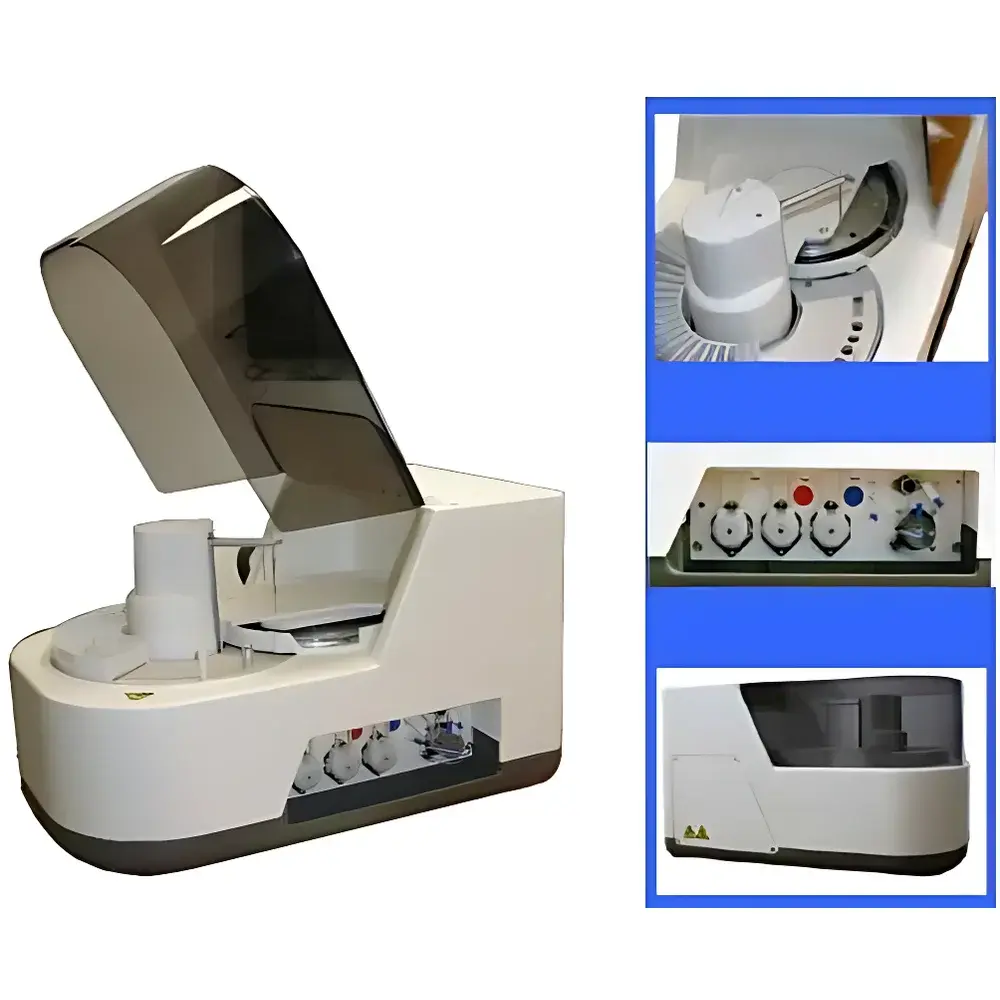
Easychem Junior Compact Automated Discrete Analyzer
| Origin | Sweden |
|---|---|
| Manufacturer Type | Authorized Distributor |
| Origin Category | Imported Instrument |
| Model | Easychem Junior |
| Pricing | Available Upon Request |
Overview
The Easychem Junior Compact Automated Discrete Analyzer is an engineered solution for high-throughput, precise, and flexible wet-chemistry analysis in environmental, agricultural, and quality control laboratories. Based on true discrete (segmented) analysis technology—not continuous flow or segmented flow—it isolates each sample-reagent reaction in individual, temperature-controlled cuvettes, eliminating cross-contamination and enabling method-specific optimization per sample. Unlike flow-based systems requiring extensive line conditioning and wash cycles, the Easychem Junior initiates analysis immediately after startup, with no system equilibration delay. Its core optical detection module employs a thermally stabilized photometer with halogen light source covering UV–vis spectral range (340–880 nm), 10-position interference filter wheel (9 analytical + 1 blank), and fixed 10.0 mm pathlength cuvettes—ensuring high photometric accuracy (±1% OD, 0–2.5 OD; linearity >0.5%; noise <±2 mAbs at 340 nm, 2.5 OD). All reactions occur in disposable Bionex® cuvettes under programmable thermal control (37–50 °C, ±0.1 °C), guaranteeing reproducible kinetics and enzyme-based assay integrity.
Key Features
- True discrete analysis architecture with isolated, single-use reaction cuvettes (96-position carousel)
- Programmable reaction temperature control (37–50 °C, ±0.1 °C) for kinetic and enzymatic assays
- Integrated refrigerated reagent carousel (4–10 °C) with real-time volume monitoring and auto-dilution from stock solutions
- Automated multi-stage dilution: pre-dilution, on-board standard curve generation (up to 16 points), and post-measurement re-dilution for out-of-range samples
- Flexible deck configuration: two interchangeable layouts—10-sample/20-reagent or 20-sample/10-reagent—adjustable via optional conversion kit
- Full QC integration: up to 5 independent QC levels per run, with real-time flagging, automatic graphing, and configurable action logic (e.g., pause, alert, continue)
- Zero-waste optical calibration: automatic zeroing before each measurement cycle using dedicated blank filter position
- Low reagent consumption: typical assay volume ≤ 500 µL per test, minimizing operational cost and hazardous waste generation
- Windows-native software with intuitive workflow builder, audit-trail logging, and full 21 CFR Part 11 compliance readiness (user roles, electronic signatures, change history)
Sample Compatibility & Compliance
The Easychem Junior supports heterogeneous sample matrices without hardware modification—including surface water, wastewater, soil extracts (CaCl₂, KCl, Bray, Olsen, Colwell), plant digests, feed homogenates, and fertilizer solutions. All methods adhere to internationally recognized standard protocols where applicable: ASTM D1253 (residual chlorine), ISO 11905-1 (total nitrogen), ISO 6878 (phosphorus), USP (urea), and EPA Method 353.2 (nitrate/nitrite). The instrument’s modular design allows method validation per GLP and GMP requirements, with full traceability of sample position, reagent lot, calibration history, and operator ID. Built-in humidity and mass correction factors support gravimetric and volumetric normalization for solid-sample analyses (e.g., total Kjeldahl nitrogen in soil).
Software & Data Management
The Windows-based Easychem Control Suite provides complete method development, run scheduling, and data governance. Users define worksheets specifying sample positions, reagent assignments, dilution schemes, QC placement, and calibration parameters—all saved as reusable method templates. Prior to execution, a mandatory “Check & Confirm” sequence verifies reagent availability, cuvette status, temperature stability, and QC configuration. Real-time dashboards display active step, photometric readings, and QC metrics. All raw absorbance data, calculated concentrations, dilution logs, and QC charts are stored in a secure local database. Export options include CSV, Excel (.xlsx), and PDF report generation with customizable headers, footers, and regulatory metadata (e.g., analyst ID, instrument serial number, timestamped audit trail). Software supports automated backup, role-based access control, and optional network deployment for multi-user lab environments.
Applications
The Easychem Junior delivers validated performance across regulated and research-driven workflows: routine nutrient profiling (NH₄⁺-N, NO₃⁻-N, NO₂⁻-N, TK-N, PO₄³⁻-P, TP, Si) in environmental monitoring stations; rapid alkalinity, hardness, and cyanide screening in drinking water labs; speciation analysis (e.g., free vs. total chlorine, Cr⁶⁺ vs. total Cr) per EPA guidelines; and extractable micronutrient quantification (Fe, Mn, Zn, Cu, B) in agronomic soil testing. Its portability (20 kg, 40 × 60 × 38 cm) and low power demand (110–240 VAC, 50/60 Hz) make it suitable for mobile labs, field-deployed monitoring units, and satellite testing facilities with limited infrastructure.
FAQ
What distinguishes discrete analysis from flow injection or segmented flow systems?
Discrete analysis physically separates each reaction in an individual cuvette, enabling independent thermal control, variable incubation times, and zero carryover—critical for multi-parameter environmental panels.
Can the Easychem Junior perform enzymatic or kinetic assays?
Yes—programmable reaction temperature (±0.1 °C) and precise timing control support dehydrogenase, urease, and phosphatase-based methods per ISO and AOAC standards.
Is method validation documentation provided with the system?
Each pre-installed method includes full validation summaries (LOD, LOQ, precision, recovery), reference to primary standards (NIST, CRM), and compatibility notes for matrix-matched calibration.
How is data integrity ensured for regulated environments?
The software supports ALCOA+ principles: attributable, legible, contemporaneous, original, accurate records—with optional 21 CFR Part 11 modules for electronic signatures and audit trails.
What maintenance is required beyond routine cleaning?
No fluidic tubing or valves to replace; only periodic cuvette carousel inspection, optical window cleaning, and refrigerated carousel calibration—typically <1 hour per month.
Related Products







