
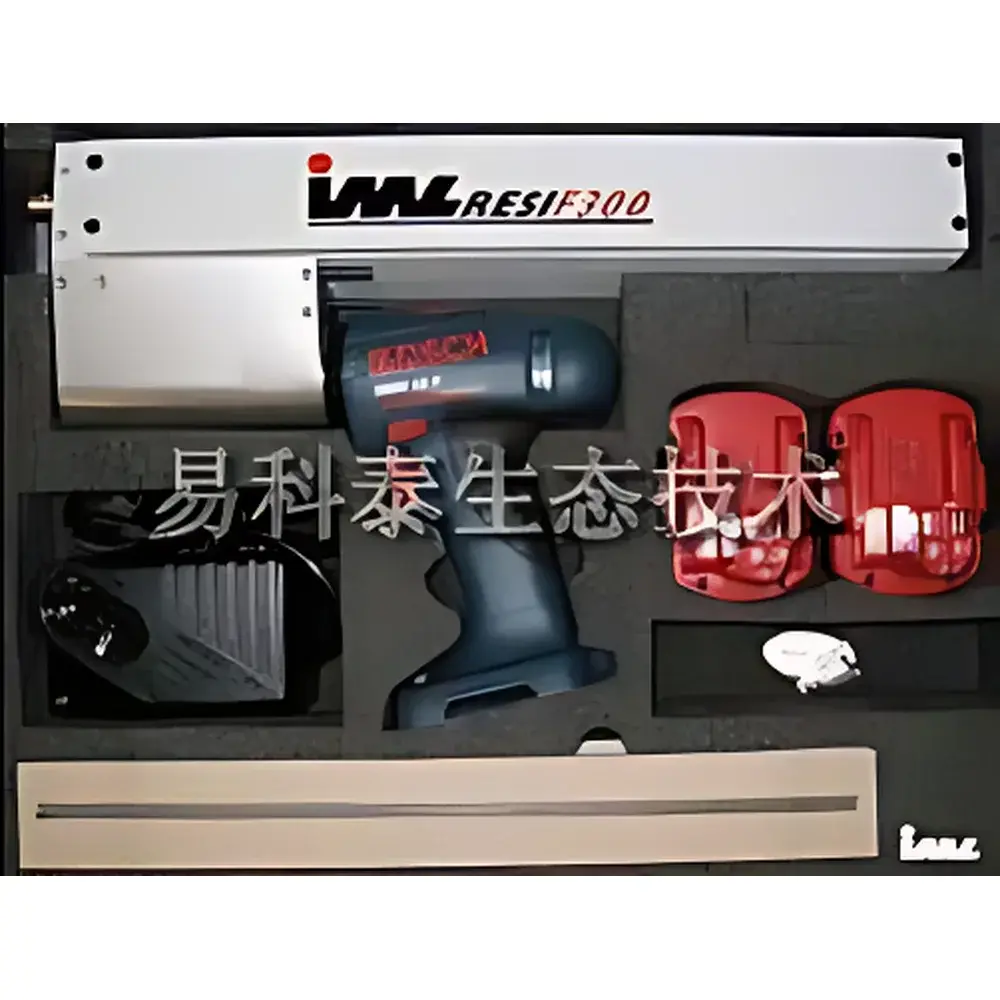
F-Series Portable Tree Micro-Drill Resistograph
| Origin | Germany |
|---|---|
| Manufacturer Type | Authorized Distributor |
| Origin Category | Imported |
| Model | F-Series Portable Tree Micro-Drill Resistograph |
| Pricing | Available Upon Request |
Overview
The F-Series Portable Tree Micro-Drill Resistograph is a field-deployable, battery-powered resistographic instrument engineered for non-destructive assessment of internal wood structure in living trees and standing timber. It operates on the principle of micro-resistography—measuring real-time mechanical resistance encountered by a slender, rotating drill bit (0.9–1.5 mm diameter) as it advances axially into wood tissue at controlled speeds. Variations in drilling torque correlate directly with local density, moisture content, decay presence, void formation, and growth ring boundaries. Unlike destructive coring or sonic tomography, this method preserves structural integrity: the probe extracts minimal biomass, and residual wood fibers are passively reinserted during probe withdrawal, resulting in negligible wound impact (< 2 mm diameter). Designed for arborists, forest pathologists, urban forestry managers, and conservation ecologists, the F-Series delivers quantitative, spatially resolved resistance profiles suitable for longitudinal health monitoring, hazard tree evaluation, and dendrochronological validation.
Key Features
- Battery-operated Bosch power drive unit (12 V NiCd, 1.5 / 2.0 / 2.4 Ah options) enabling cable-free operation in canopy, steep terrain, or remote stands
- Ergonomic drill sleeve with integrated tactile control buttons for on-the-fly speed adjustment (0–50 cm/min) and mode selection
- Real-time analog thermal printing on wax-coated paper tape at 1:1 scale, providing immediate visual interpretation without external devices
- Bluetooth-enabled electronic control unit for wireless data synchronization and firmware updates
- Three probe depth configurations: Standard (300/400/500 mm), Reinforced (130/280/380/480 mm for high-density hardwoods), and Lightweight (300/400 mm)
- High-resolution axial sampling at 0.1 mm increments, ensuring precise delineation of decay margins and growth ring transitions
- Onboard memory capacities: 256 kB (~22 m profile length), 512 kB (~45 m), or 1 MB (~98 m), supporting extended multi-tree surveys per charge
Sample Compatibility & Compliance
The F-Series accommodates live deciduous and coniferous species across diameters ≥15 cm, including but not limited to Quercus spp., Acer spp., Pinus spp., Fagus sylvatica, and Tilia cordata. It complies with DIN EN 1995-1-1 (Eurocode 5) guidelines for in-situ timber assessment and supports documentation requirements under ISO 17225-2 (solid biofuels) and EN 338 (structural timber strength classes). Data acquisition adheres to GLP-aligned traceability standards: each printed strip and digital record includes timestamp, probe ID, operator code, ambient temperature (0–50 °C operational range), and depth calibration metadata. The system meets CE marking requirements for portable electrical equipment (2014/30/EU EMC Directive and 2014/35/EU LVD Directive).
Software & Data Management
Raw resistance profiles are exportable via USB or Bluetooth to the proprietary F-Tools and F-Tools Pro software suites (Windows-compatible). These platforms support spectral smoothing, baseline correction, comparative overlay of multiple profiles from the same trunk section, and semi-automated decay zone quantification using user-defined resistance thresholds. Export formats include CSV (for integration with R, Python, or MATLAB), PDF reports compliant with municipal arboriculture reporting templates, and image-based annotations aligned to GPS-tagged field notes. Audit trails—including parameter changes, calibration events, and user logins—are retained per FDA 21 CFR Part 11 principles where required for municipal or institutional compliance.
Applications
- Hazard tree risk assessment prior to pruning or removal in urban parks and infrastructure corridors
- Longitudinal monitoring of fungal decay progression in heritage trees over multi-year intervals
- Validation of ground-penetrating radar (GPR) or sonic tomography findings through targeted micro-resistographic cross-sectioning
- Non-invasive verification of growth ring count and latewood density patterns for climate reconstruction studies
- Pre-harvest evaluation of stem quality in high-value timber plantations (e.g., veneer-grade walnut or cherry)
- Forensic analysis of mechanical failure points in wind-thrown or lightning-damaged specimens
FAQ
What is the maximum recommended trunk diameter for reliable profiling?
Profiles remain interpretable up to 120 cm DBH when using the Reinforced probe configuration and appropriate speed modulation; beyond this, radial heterogeneity may require orthogonal probe insertion paths.
Does the system require annual recalibration?
No factory recalibration is mandated; however, users must perform daily zero-torque verification using the supplied reference block and log results per internal QA protocol.
Can data be integrated with GIS platforms?
Yes—F-Tools Pro exports georeferenced profile metadata (latitude/longitude, elevation, date/time) compatible with QGIS and ArcGIS via standardized KML or GeoJSON wrappers.
Is the wax paper printout considered an admissible legal record?
Yes—the thermally printed strip constitutes a tamper-evident primary record under EN 14080:2013 Annex A for structural timber inspection documentation.
How does probe diameter affect biological impact on living trees?
All standard probes (0.9 mm, 1.2 mm, 1.5 mm) induce wounds that compartmentalize within 6–12 months per CODIT model; no evidence of pathogen entry or vascular disruption has been observed in peer-reviewed longitudinal studies.





