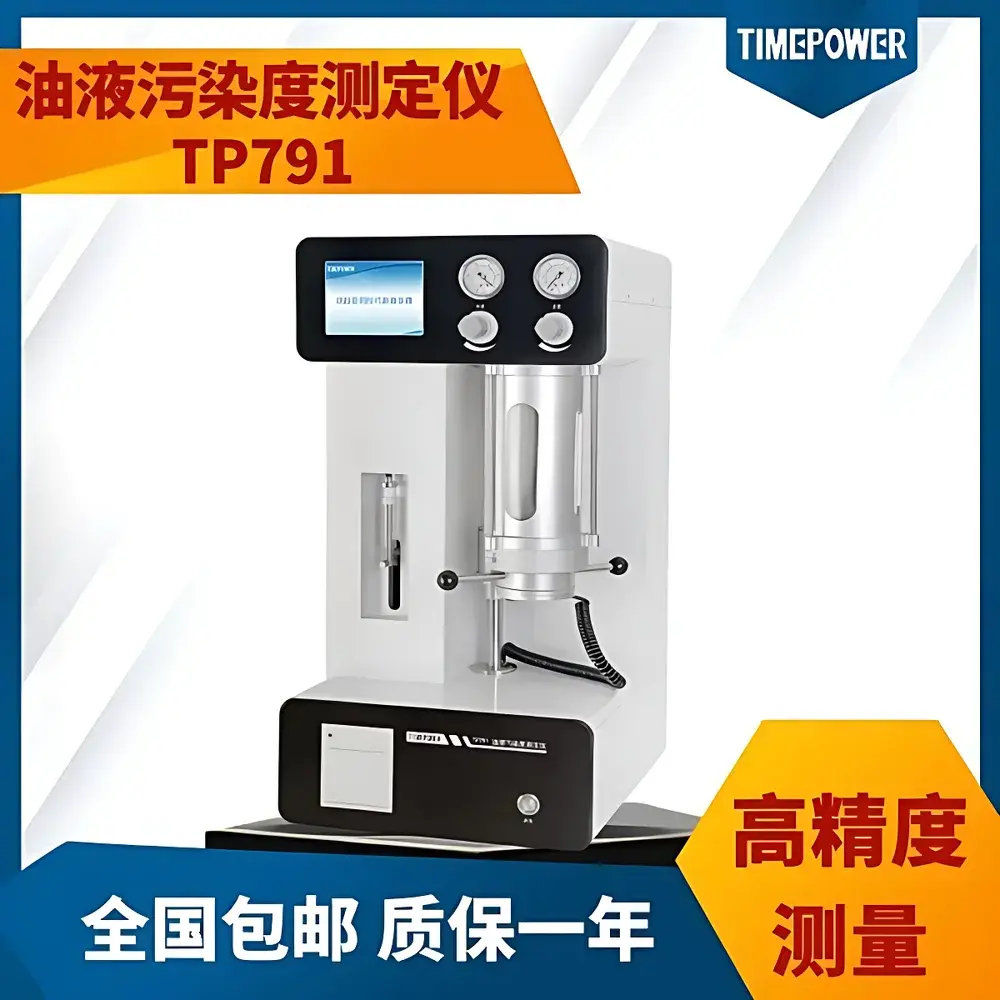
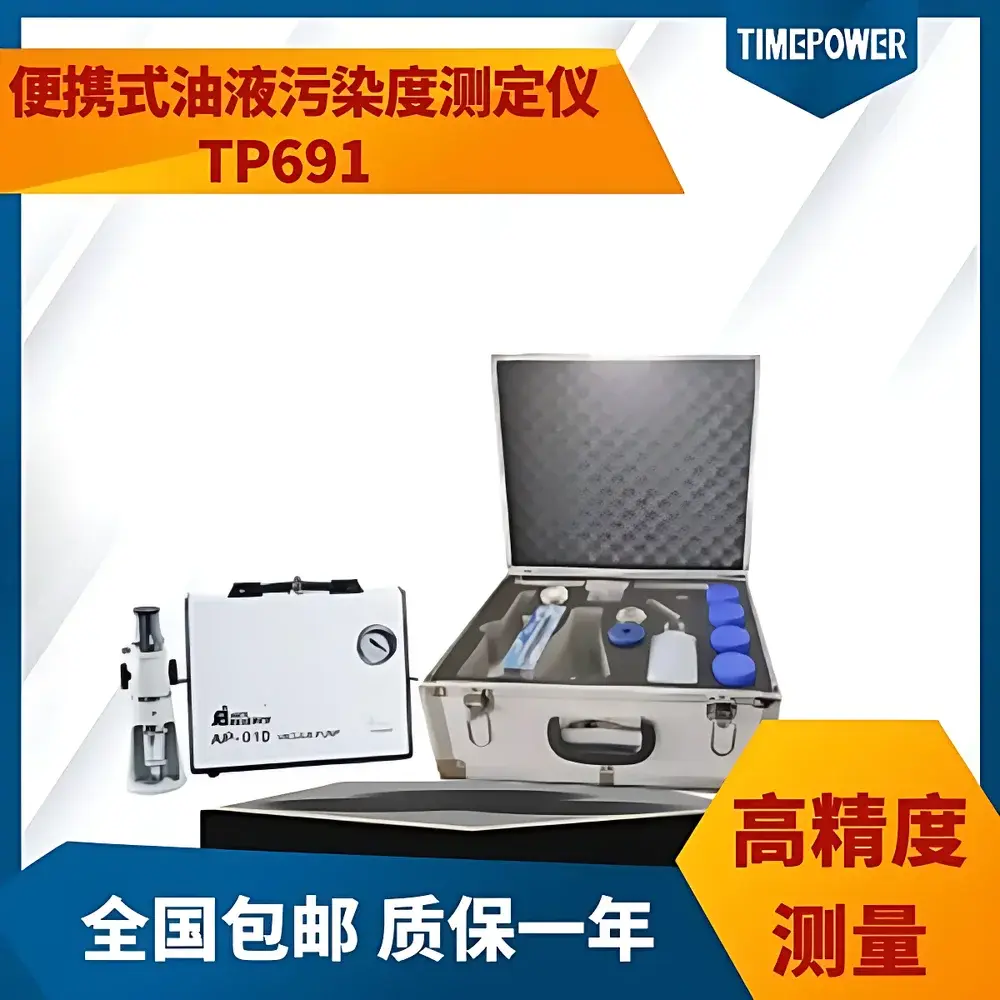
TimePower TP791/TP691 Oil Particle Contamination Analyzer
| Brand | TimePower |
|---|---|
| Origin | Beijing, China |
| Manufacturer Type | OEM Manufacturer |
| Country of Origin | China |
| Model | TP791 / TP691 |
| Pricing | Available Upon Request |
Overview
The TimePower TP791 and TP691 Oil Particle Contamination Analyzers are laboratory- and field-deployable instruments engineered for quantitative assessment of solid particulate contamination in liquid media—primarily hydraulic oils, lubricants, insulating oils (e.g., transformer oil), turbine oils (e.g., steam and gas turbine oils), gear oils, engine oils, aviation kerosene (Jet A-1), water-glycol hydraulic fluids, and other non-aqueous organic liquids including polymer solutions. These analyzers operate on the principle of light extinction (also known as single-particle optical sensing or SPOS), where particles suspended in a precisely metered oil stream pass through a focused laser beam; each particle generates a transient attenuation signal proportional to its cross-sectional area. The system digitizes and classifies these pulses in real time against standardized particle size channels defined by ISO 4406:2021, ISO 11171:2016 (for calibration), and NAS 1638. This enables traceable, repeatable, and metrologically sound reporting of contamination levels in accordance with international fluid cleanliness standards.
Key Features
- Laser-based light extinction detection with high signal-to-noise ratio and low electronic noise floor—ensuring reliable counting down to 4 µm(c) and sizing resolution ≤1 µm increment across calibrated ranges.
- Wide dynamic concentration range: capable of analyzing samples from 20,000 particles/mL without dilution for most common industrial oils (viscosity range: 2–400 cSt at 40 °C).
- Integrated flow control architecture with pressure-regulated syringe pump and temperature-stabilized sample path—minimizing bubble formation and ensuring laminar, pulse-free flow critical for accurate particle enumeration.
- Dual-model configuration: TP791 supports full ISO 4406:2021 coding (e.g., 18/16/13) with ≥24 size channels (4–100 µm); TP691 provides optimized cost-performance for routine NAS 1638 and ISO 4406 compliance with 6 standard channels (5, 10, 15, 25, 50, 100 µm).
- Robust mechanical design with IP54-rated enclosure, ESD-safe fluidic pathways, and chemically resistant wetted materials (316L stainless steel, fused silica flow cell, fluoropolymer seals) compatible with hydrocarbon- and ester-based fluids.
Sample Compatibility & Compliance
The TP791/TP691 platform is validated for use with mineral-based, synthetic, and semi-synthetic oils—including phosphate esters (e.g., Fire-Resistant Hydraulic Fluids), polyalphaolefins (PAOs), and polyol esters—provided viscosity remains within operational limits and no aggressive solvents (e.g., acetone, chlorinated hydrocarbons) are introduced. Sample preparation follows ASTM D7647–19 (Standard Practice for Sampling and Handling of Lubricating Oils for Particle Counting) and ISO 4021:2017 (Petroleum products — Collection of samples from petroleum pipelines and marine vessels). Instrument calibration adheres to ISO 11171:2016 using NIST-traceable latex sphere suspensions; verification is performed per ISO 21501-4:2018 (Particle characterization — Single particle light interaction methods — Part 4: Light extinction). Data output complies with ISO 4406:2021 coding conventions and supports direct integration into asset health monitoring platforms compliant with ISO 55000 series.
Software & Data Management
TimePower Particle Analysis Software (v4.2+) provides instrument control, real-time histogram visualization, automatic ISO/NAS code generation, batch report export (PDF, CSV, XML), and audit-trail-enabled user access logging. The software supports 21 CFR Part 11-compliant configurations—including electronic signatures, role-based permissions, and immutable data archiving—when deployed in regulated environments (e.g., power generation QA labs, aerospace MRO facilities). Raw pulse data and metadata (flow rate, temperature, sample ID, operator, timestamp) are stored in SQLite databases with optional network backup to secure NAS or cloud storage via TLS 1.2–encrypted REST API endpoints. Export formats include ASTM WK-numbered templates and custom-defined reports aligned with internal SOPs.
Applications
- Condition monitoring of hydraulic systems in wind turbines, aircraft landing gear, and heavy mobile equipment.
- Acceptance testing of new oil batches prior to commissioning in transformers and turbine lube systems.
- Root-cause analysis of wear debris patterns in gearboxes and diesel engine crankcase oils.
- Validation of filtration efficiency in offline kidney-loop systems and portable filtration units.
- Quality assurance of dielectric fluids used in high-voltage switchgear and substation equipment.
- Research-grade quantification of insoluble microgels and catalyst residues in polymer processing streams.
FAQ
What particle size standards does the TP791/TP691 support?
The analyzer supports ISO 4406:2021, NAS 1638, SAE AS4059F, and GOST 17216–2018 reporting formats, with size channel definitions traceable to ISO 11171:2016 calibration protocols.
Can the instrument analyze water-contaminated oil samples?
Emulsified water (<500 ppm) does not interfere with particle counting; however, free water or bulk phase separation must be removed prior to analysis to prevent flow instability and optical interference.
Is method validation documentation available?
Yes—TimePower provides IQ/OQ documentation packages, calibration certificates with uncertainty budgets, and application notes aligned with ASTM D6786, ISO 4021, and IEC 60296 for transformer oil applications.
How often does the flow cell require cleaning or replacement?
Under typical industrial use (≤5 samples/day), the fused silica flow cell requires ultrasonic cleaning every 200–300 analyses; service life exceeds 10,000 runs when operated within specified pressure and viscosity limits.
Does the system support remote diagnostics or firmware updates?
Yes—via secure SSH-enabled Ethernet interface; firmware updates are digitally signed and verified before installation to ensure integrity and regulatory compliance.
Related Products