
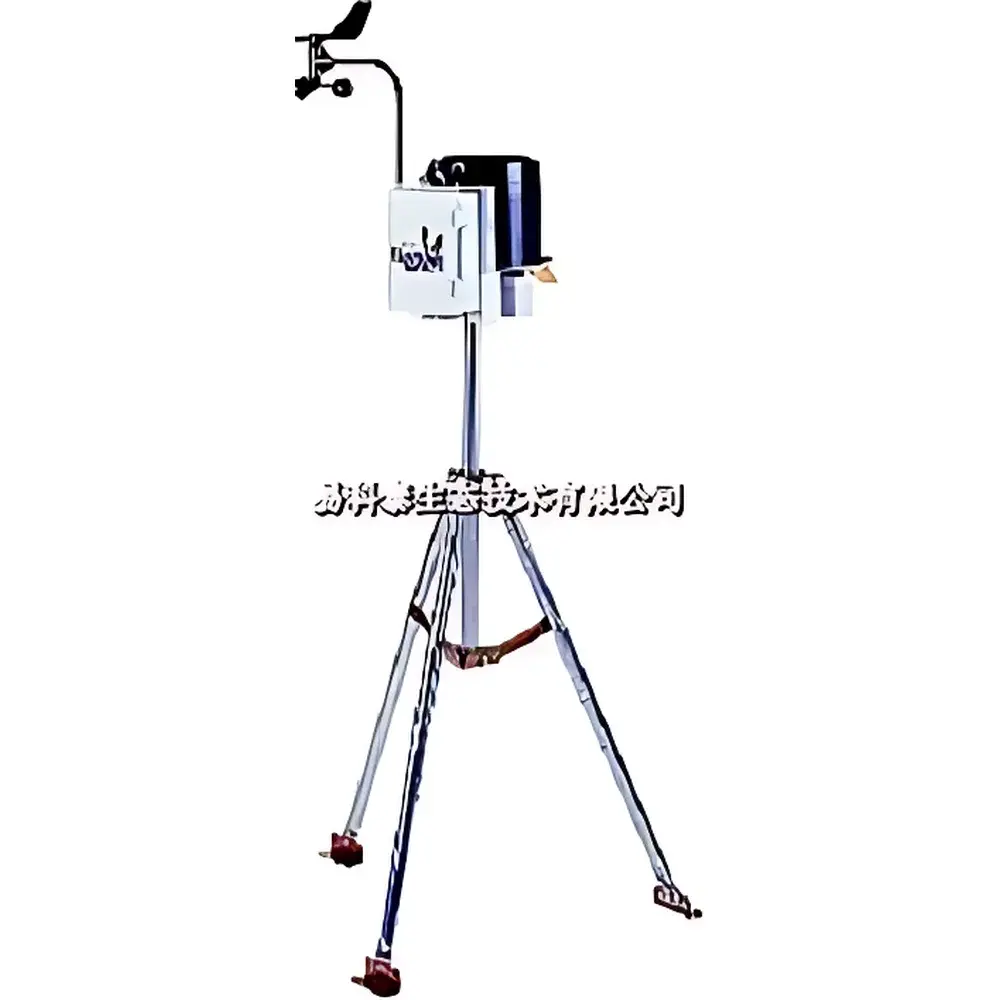
AZWS33 Series Compact Environmental Weather Station
| Origin | USA |
|---|---|
| Manufacturer Type | Authorized Distributor |
| Import Status | Imported |
| Model | AZWS33 Series |
| Price | Upon Request |
| Wind Direction Resolution | 2° |
| Wind Direction Accuracy | ±7° |
| Wind Speed Range | 0–212 km/h |
| Wind Speed Accuracy | ±5% |
| Air Temperature Range | −20°C to +70°C |
| Air Temperature Accuracy | ±0.6°C |
| Relative Humidity Range | 20–100% (at 5–50°C) |
| RH Accuracy | ±3% |
| Dew Point Temperature Range | −73°C to +60°C |
| Dew Point Accuracy | ±2°C |
| Rainfall Resolution | 0.25 mm |
| Rainfall Accuracy | ±2% |
| Solar Radiation Range | 0–1250 W/m² |
| Solar Radiation Accuracy | ±5% |
| Soil Temperature Accuracy | ±0.7°C |
| CO₂ Range | 0–4000 ppm |
| CO₂ Accuracy | ±5% or ±50 ppm (whichever is greater) |
| PAR (Photosynthetic Photon Flux Density) Range | 0–2500 µmol·m⁻²·s⁻¹ |
| PAR Accuracy | ±5% |
| Tripod Material | Galvanized Steel |
| Tripod Height | 152.4 cm |
| Tripod Weight | 5.9 kg |
Overview
The AZWS33 Series Compact Environmental Weather Station is a modular, field-deployable measurement system engineered for long-term, unattended environmental monitoring in agricultural research, ecological field studies, horticultural management, and irrigation scheduling applications. Built on a robust architecture integrating precision analog and digital sensor interfaces, the system employs standardized physical principles—including thermistor-based temperature sensing, capacitive humidity transduction, ultrasonic or cup-and-vane anemometry, tipping-bucket rainfall accumulation, thermopile-based pyranometry, and silicon photodiode-based quantum sensors—to deliver traceable, repeatable environmental data. Each station operates as a distributed sensing node, with sensor outputs digitized and time-stamped by the integrated data logger—ensuring temporal coherence across multi-parameter datasets essential for evapotranspiration (ET₀) modeling, microclimate characterization, and phenological correlation studies.
Key Features
- Modular sensor configuration: Select from six base station variants (AZWS3315WD2–3350WD2), each differing in pre-integrated sensor complement and expansion port count (6–9 configurable analog/digital inputs).
- Integrated data acquisition: The AZWS3345WD2 data logger features non-volatile memory (≥2 MB), programmable sampling intervals (1 min to 24 h), real-time clock with battery backup, and dual-channel RS-232/RS-485 communication.
- Low-power, maintenance-optimized design: Powered by standard alkaline batteries (AA or D-cell depending on configuration); typical operational life exceeds 8 months under default 15-minute logging intervals—eliminating reliance on solar panels or external power infrastructure.
- Ruggedized mechanical construction: Includes galvanized steel tripod (152.4 cm height, 5.9 kg mass), UV-stabilized radiation shield for temperature/humidity sensors, and vehicle-mounting hardware for mobile deployment scenarios.
- Field-ready installation: Supplied with calibrated mounting brackets, leveling bubble, torque wrench, and cable management kit—enabling full system setup by a single technician in under 45 minutes.
Sample Compatibility & Compliance
The AZWS33 Series supports simultaneous measurement of up to 14 environmental parameters, including wind vector components, ambient thermodynamic variables (air temperature, relative humidity, dew point, wind chill), precipitation mass, broadband solar irradiance, photosynthetically active radiation (PAR), soil thermal profile (up to 3 depths), CO₂ concentration, and optional leaf wetness or soil volumetric water content via third-party sensor integration. All core sensors comply with IEC 60751 (Pt100/Pt1000 temperature standards), ISO 7726 (thermal environment instrumentation), and WMO Guide to Meteorological Instruments and Methods of Observation (CIMO Guide, Chapter 12). Data integrity meets GLP-aligned requirements through timestamped records, firmware-level checksum validation, and optional audit-trail-enabled logging modes compatible with FDA 21 CFR Part 11–compliant software workflows when used with SpecWare v5.x or higher.
Software & Data Management
SpecWare™ data acquisition and analysis software provides native support for AZWS33 Series stations, enabling real-time telemetry visualization, remote configuration updates, and automated calibration coefficient management. Data export formats include CSV, NetCDF-4, and XML-compliant ASCII—facilitating ingestion into MATLAB, Python (Pandas/XArray), R, or enterprise GIS platforms (ArcGIS Pro, QGIS). The software implements configurable alarm thresholds, statistical aggregation (min/max/mean/std dev per interval), and ET₀ calculation using FAO-56 Penman-Monteith equations with site-specific elevation, latitude, and albedo inputs. Local data retrieval options include direct USB/serial connection, SD card module (optional), and wireless RF (433 MHz or 900 MHz ISM band) with range up to 1 km line-of-sight.
Applications
- Agricultural research: High-resolution microclimate mapping for crop water stress index (CWSI) derivation, frost risk forecasting, and irrigation decision support systems.
- Ecological monitoring: Long-term phenocam synchronization, eddy covariance tower ancillary data collection, and biodiversity habitat suitability modeling.
- Urban climate studies: Heat island effect quantification, green roof performance evaluation, and stormwater runoff correlation with real-time precipitation intensity.
- Educational fieldwork: Undergraduate atmospheric science labs, environmental engineering capstone projects, and K–12 STEM outreach programs requiring portable, pedagogically transparent instrumentation.
- Regulatory compliance: Supporting Tier 1 ambient air quality monitoring networks where supplemental meteorological data are required under EPA 40 CFR Part 58 Appendix E protocols.
FAQ
What is the maximum number of sensors that can be connected to the AZWS3345WD2 data logger?
The AZWS3345WD2 supports up to nine analog or digital sensor inputs, including both factory-installed and user-added modules.
Can the system operate reliably in sub-zero ambient conditions?
Yes—the air temperature sensor is rated for continuous operation from −20°C to +70°C; battery performance remains stable down to −10°C when using industrial-grade alkaline cells.
Is firmware update capability available remotely?
Firmware updates require local physical access via USB or serial interface; over-the-air (OTA) updates are not supported in current hardware revision.
Does the rain gauge meet WMO accuracy class B specifications?
The tipping-bucket sensor achieves ±2% volumetric accuracy under WMO-defined dynamic test conditions (1–10 mm/h intensity, 0–30°C ambient), satisfying Class B requirements for non-critical operational networks.
How is time synchronization handled across multiple deployed stations?
Each logger maintains internal RTC accuracy of ±1 second per month; synchronized time stamps are enforced during post-hoc data alignment using GPS-derived reference timestamps or NTP servers when connected to networked infrastructure.







