
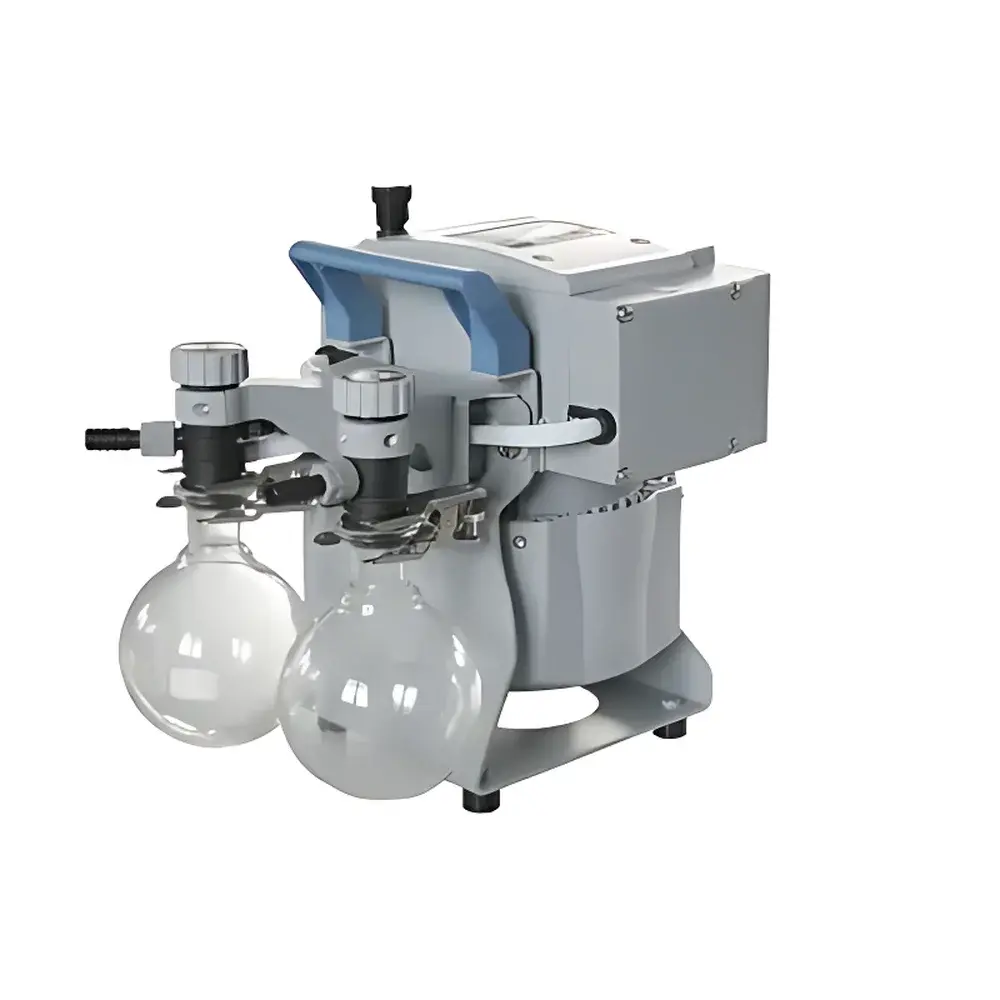
VACUUBRAND MZ 2C NT+2AK Dual-Stage Chemical Vacuum System
| Brand | VACUUBRAND® |
|---|---|
| Origin | Germany |
| Model | MZ 2C NT+2AK |
| Pump Stages | 2/2 |
| Max. Pumping Speed (50/60 Hz) | 2.0/2.3 m³/h |
| Max. Pumping Speed (50/60 Hz) | 1.2/1.4 cfm |
| Ultimate Vacuum (absolute, without gas ballast) | 7 mbar / 5 torr |
| Ultimate Vacuum (absolute, with gas ballast) | 12 mbar / 9 torr |
| Operating Temperature Range | 10–40 °C |
| Storage Temperature Range | −10–60 °C |
| Max. Exhaust Pressure (absolute) | 1.1 bar |
| Inlet Port | DN 10 mm hose nozzle |
| Outlet Port | DN 10 mm hose nozzle |
| Rated Motor Power | 0.18 kW |
| Rated Speed (50/60 Hz) | 1500/1800 min⁻¹ |
| IP Rating | IP 40 |
| Dimensions (L×W×H) | 319 × 243 × 309 mm |
| Weight | 13.6 kg |
| Sound Pressure Level (50 Hz, typical) | 45 dBA |
| ATEX Conformity (230 V only) | II 3G IIC T3 X, Internal Atmosphere Only |
Overview
The VACUUBRAND MZ 2C NT+2AK is a dual-stage, oil-sealed rotary vane vacuum pump engineered for continuous, reliable operation in demanding chemical, biological, and pharmaceutical laboratory environments. It operates on the principle of positive displacement via rotating vanes within an eccentrically mounted rotor chamber, enabling efficient removal of non-condensable gases and low-boiling vapors—including solvents such as acetone, ethanol, ethyl acetate, and dichloromethane—without requiring external cold traps in many routine applications. Designed specifically for integration with vacuum concentrators, gel dryers, filtration manifolds, and rotary evaporators, the system delivers stable vacuum performance across a broad operational range while maintaining high chemical resistance and low vapor backstreaming. Its robust architecture incorporates corrosion-resistant internal components, including fluorocarbon-treated vanes and stainless-steel springs, ensuring long-term stability when exposed to aggressive organic and acidic vapors.
Key Features
- Dual-stage configuration provides enhanced ultimate vacuum capability and improved vapor handling compared to single-stage equivalents.
- Integrated gas ballast valve allows controlled admission of ambient air during compression, enabling effective removal of condensable vapors while preserving ultimate vacuum performance.
- Front-mounted inlet and rear-mounted outlet separation bottles—constructed from borosilicate glass with protective polymer shrouds—capture entrained droplets and particulates, preventing contamination of the pump chamber and minimizing risk of oil emulsification.
- Low-vibration motor and precision-balanced rotor assembly reduce mechanical transmission to the workbench, supporting sensitive instrumentation and improving user comfort in shared lab spaces.
- Quiet operation at 45 dBA (50 Hz, typical) meets stringent acoustic requirements for open-plan laboratories and ISO Class 5–7 cleanroom-adjacent installations.
- IP 40-rated enclosure offers protection against solid objects ≥1 mm and limited ingress of vertically falling water, suitable for standard laboratory ambient conditions.
Sample Compatibility & Compliance
The MZ 2C NT+2AK is compatible with a wide spectrum of volatile and semi-volatile compounds commonly encountered in sample preparation workflows, including but not limited to halogenated hydrocarbons, esters, ketones, and low-molecular-weight alcohols. It is explicitly validated for use with aqueous and mildly acidic or basic solutions where vapor loads remain within specified operational limits. The pump complies with NRTL safety certification standards for both U.S. and Canadian markets and conforms to ATEX Directive 2014/34/EU (Category II 3G, Group IIC, Temperature Class T3, for internal atmosphere only) when supplied with 230 V~ 50–60 Hz input. While not intrinsically safe for Zone 0/1 hazardous areas, its design supports GLP-compliant documentation practices and integrates seamlessly into FDA 21 CFR Part 11–aligned vacuum control systems when paired with appropriate digital controllers and audit-trail-enabled software.
Software & Data Management
As a standalone vacuum source, the MZ 2C NT+2AK does not include embedded firmware or onboard data logging. However, it is fully compatible with third-party vacuum controllers (e.g., VACUUBRAND’s VARIO® series or LabVIEW-compatible PID modules) that support analog voltage or digital RS-232/USB interfaces for real-time pressure monitoring, setpoint regulation, and event-triggered shutdown. When integrated into automated platforms, pump status—such as runtime hours, thermal load indicators, and gas ballast activation—can be recorded alongside process metadata for traceability under ISO/IEC 17025 or GMP Annex 11 frameworks. Routine maintenance logs—including oil change intervals, filter replacement dates, and separation bottle cleaning records—should be retained per institutional SOPs to ensure consistent performance verification.
Applications
- Routine solvent removal in centrifugal vacuum concentrators (e.g., Eppendorf Concentrator Plus, Thermo Fisher Savant SPD)
- High-throughput filtration of cell lysates, protein precipitates, and microbial suspensions using multi-port vacuum manifolds
- Gel drying under controlled vacuum to prevent cracking or distortion of polyacrylamide or agarose matrices
- Supporting short-path distillation and Kugelrohr apparatuses where moderate vacuum (10–50 mbar) suffices
- Pre-evacuation of glove boxes and desiccators prior to inert gas purging
- Assisting freeze-drying pre-treatment steps by removing residual moisture from shelf-cooled samples
FAQ
What types of solvents can be safely handled by the MZ 2C NT+2AK without cold trapping?
It is rated for continuous duty with common low-boiling organics (e.g., diethyl ether, hexane, acetone) up to ~20 g/h total vapor load; higher loads or chlorinated solvents (e.g., chloroform, DCM) require gas ballast engagement and periodic oil changes.
Is the pump suitable for vacuum oven applications?
Yes—provided the oven’s maximum operating temperature does not exceed 40 °C ambient and the system includes an inline particulate trap to prevent dust ingress.
How often should the pump oil be replaced?
Under normal chemical use, replace the oil every 500 operating hours or quarterly, whichever occurs first; more frequent changes are advised when processing halogenated or acidic vapors.
Can the inlet and outlet separation bottles be autoclaved?
No—the glass bottles are borosilicate but the polymer protective sleeves and silicone O-rings are not autoclave-rated; clean with isopropanol and dry thoroughly before reuse.
Does this model support continuous duty cycling?
Yes—its thermally stabilized motor and dual-stage design allow uninterrupted operation for up to 8 hours per session, provided ambient temperature remains within 10–40 °C and ventilation clearance exceeds 10 cm on all sides.



