
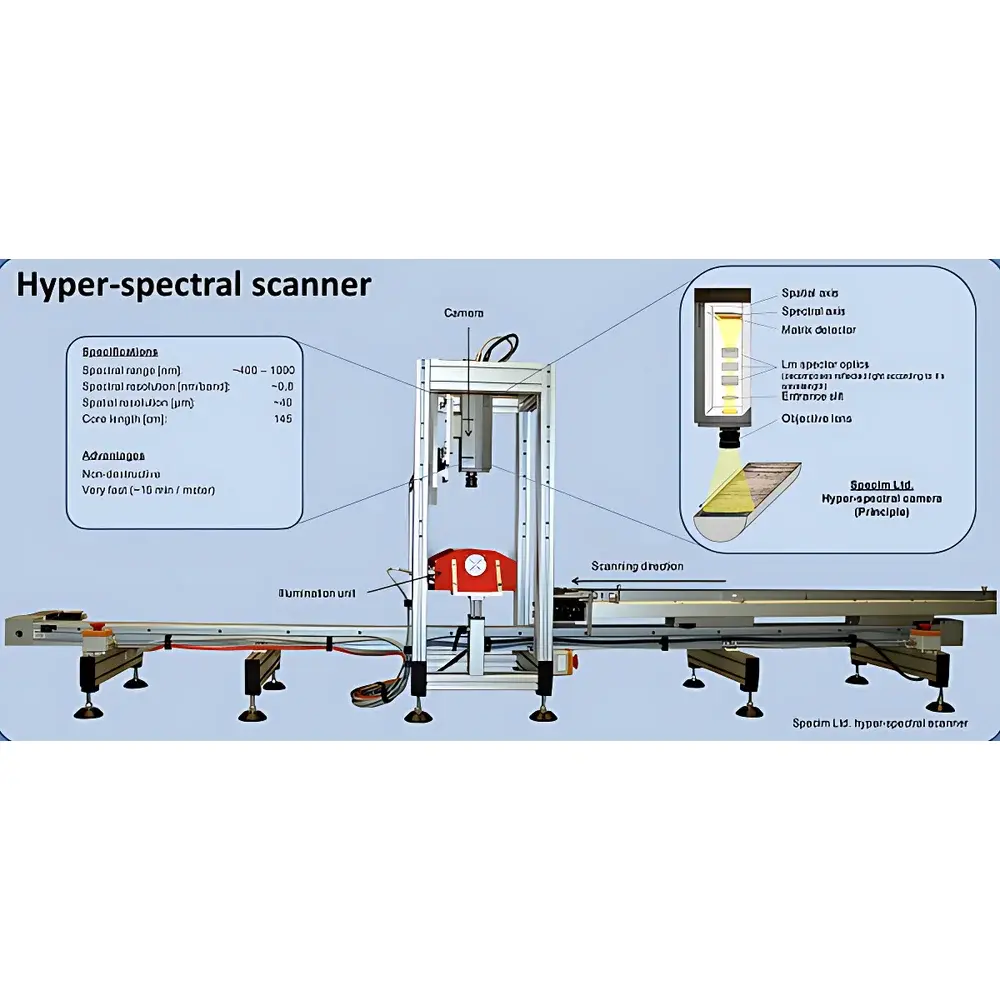
SPECIM SisuSCS Hyperspectral Core Scanning Platform
| Brand | SPECIM |
|---|---|
| Origin | Finland |
| Model | SisuSCS |
| Spectral Range Options | 400–1000 nm (VNIR) or 1000–2500 nm (SWIR) |
| Weight | ~100 kg |
| Application | Single-core scanning for geological and lacustrine sediment cores |
| Compliance | Designed for laboratory-based geoscientific research environments |
Overview
The SPECIM SisuSCS Hyperspectral Core Scanning Platform is an engineered solution for non-destructive, contactless, high-resolution spectral imaging of individual geological and lacustrine sediment cores. Built upon push-broom hyperspectral imaging technology, the system acquires contiguous spectral data cubes (x, y, λ) by translating the core linearly beneath a fixed line-scan sensor. This architecture ensures consistent illumination geometry, minimal motion-induced artifacts, and high spatial-spectral fidelity across the full scan length. The platform operates in two configurable spectral domains: visible-near-infrared (VNIR, 400–1000 nm) with sub-3 nm spectral sampling, and short-wave infrared (SWIR, 1000–2500 nm) with ~6 nm sampling—enabling detection of key mineralogical absorptions (e.g., Fe-bearing oxides, clay hydroxyls, carbonate C–O stretches) and organic functional groups. Its compact footprint (~100 kg total mass) and modular design make it suitable for dedicated geochemical laboratories handling low-to-moderate core throughput (<50 m/month), where integration with existing petrographic, XRF, or µCT workflows is required.
Key Features
- Push-broom imaging architecture with precision linear stage (±1 µm repeatability) and calibrated white reference integration for radiometric stability
- Interchangeable sensor modules: factory-aligned VNIR or SWIR optics, each with integrated thermoelectric cooling and onboard dark current compensation
- Optimized optical path featuring collimated illumination (LED-based, uniformity >95% across FOV) and telecentric imaging lens to minimize perspective distortion on curved core surfaces
- Core-mounting fixture with adjustable clamping pressure and rotational alignment capability (±0.5°) to accommodate irregular core diameters (30–100 mm)
- Real-time preview and spectral quality monitoring via SPECIM’s proprietary IQ software suite, supporting live signal-to-noise assessment and spectral outlier flagging
- Robust mechanical frame constructed from vibration-damped aluminum alloy, compatible with standard optical tables and laboratory anti-vibration mounts
Sample Compatibility & Compliance
The SisuSCS accepts intact, uncut cylindrical cores up to 1.5 m in length and 100 mm in diameter, including split halves, whole-round sections, and epoxy-embedded specimens. It supports both dry and moisture-stabilized samples; optional environmental enclosure kits permit controlled humidity (30–70% RH) and temperature (18–25°C) operation to mitigate spectral drift from hygroscopic mineral phases. While not certified for regulated GMP/GLP production environments, the system meets essential requirements for research-grade geochemical data acquisition under ISO/IEC 17025:2017 clause 7.2.2 (method validation) and ASTM D7777–17 (standard practice for hyperspectral imaging of geological materials). Data provenance is maintained through embedded metadata (timestamp, sensor ID, calibration epoch, stage position) compliant with FAIR principles.
Software & Data Management
Acquisition and preprocessing are managed through SPECIM IQ software (v3.2+), which provides automated flat-field correction, spectral smile/keystone compensation, and on-the-fly reflectance conversion using integrated reference tiles. Processed data are exported in ENVI-compatible BIL format with full header metadata, enabling seamless import into open-source (Python scikit-learn, HyTools) or commercial platforms (ENVI, ERDAS IMAGINE, QGIS with HyperCube plugin). The software includes built-in spectral library matching (USGS, JPL, SPECIM Mineral Library) and PCA-based anomaly detection tools. Audit trails—including user login, parameter changes, and processing history—are logged per scan session in SQLite format, satisfying basic traceability needs for academic and governmental research reporting.
Applications
- High-resolution stratigraphic correlation of lacustrine sediment sequences using spectral endmember mapping of diatomaceous layers, volcanic ash bands, and redox-sensitive iron phases
- Mineralogical zonation in drill core archives (e.g., porphyry Cu systems, banded iron formations), complementing XRD and SEM-EDS with rapid lateral distribution maps
- Organic matter characterization in black shales and coal seams via C–H and O–H absorption modeling in SWIR domain
- Quantitative estimation of hematite/goethite ratios using continuum-removed 860 nm and 920 nm absorption features
- Integration with digital rock physics pipelines: co-registration of hyperspectral reflectance maps with µCT porosity/permeability volumes for multi-modal petrophysical analysis
FAQ
Can the SisuSCS scan partially broken or fractured cores?
Yes—the adjustable clamping system accommodates minor surface irregularities; however, severe fragmentation may require epoxy stabilization prior to scanning to ensure geometric continuity.
Is radiometric calibration traceable to NIST standards?
Factory calibration uses NIST-traceable reflectance standards (Spectralon® 99% and 20%); users are advised to perform quarterly verification using in-lab reference tiles.
What file formats does the system output for downstream machine learning workflows?
Raw and processed data export as ENVI BIL (.hdr/.bil), GeoTIFF (with spectral metadata), and CSV (pixel-wise spectra), all compatible with TensorFlow, PyTorch, and scikit-learn ingestion pipelines.
Does the platform support automated core segmentation based on lithology?
Not natively—but IQ software exports pixel-level spectral vectors that can be imported into unsupervised clustering (e.g., K-means, t-SNE) or supervised classification models trained on ground-truthed core descriptions.
How is spectral data synchronized with positional metadata during scanning?
A high-resolution encoder on the linear stage records absolute position at 10 µm resolution; this is embedded in every spectral line’s header, enabling precise x-coordinate assignment within the final data cube.




