
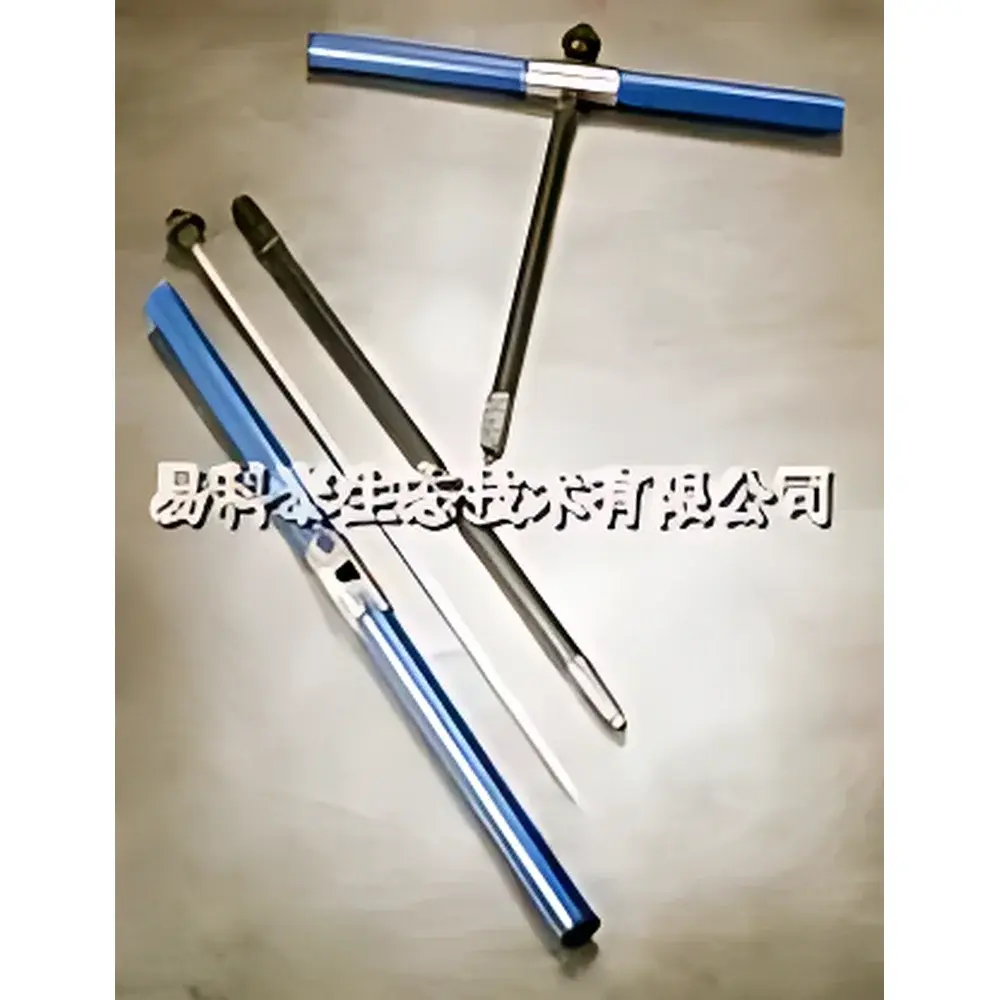
Swedish Forestry Increment Borer – CO Series (e.g., CO200-52, CO500-52, CO800-12)
| Key | Origin: Sweden |
|---|---|
| Type | Import |
| Core Diameter Options | 4.35 mm (0.169″) or 5.15 mm (0.200″) or 12 mm (0.500″) |
| Length Options | 100–800 mm (4″–32″) |
| Standard Configuration | Triple-threaded auger, 5.15 mm diameter |
| Material | High-grade Swedish steel with PTFE coating |
| Compliance | Designed for ISO 7741-1 (Wood — Determination of increment core sampling procedures) |
Overview
The Swedish Forestry Increment Borer – CO Series is a precision-engineered tool for non-destructive dendrochronological and forest health assessment. Based on the classical auger-based core extraction principle, it operates via rotational torque-driven penetration into woody tissue, enabling retrieval of intact, undisturbed increment cores along the radial plane of the trunk. This mechanical sampling method preserves tree viability while delivering morphologically continuous samples suitable for microscopic analysis, stable isotope ratio measurement (δ13C, δ18O), elemental profiling (e.g., Pb, Cd, Ca), and annual ring width quantification. The instrument adheres to internationally recognized field sampling protocols defined in ISO 7741-1 and supports compliance with FAO Forest Resource Assessment (FRA) guidelines and national forest inventory frameworks.
Key Features
- Manufactured from high-carbon Swedish steel with uniform PTFE anti-friction coating—ensuring low-torque insertion, minimal wood fiber shearing, and resistance to corrosion in humid or resinous environments.
- Modular auger design with triple-thread (standard) or dual-thread configurations—optimized for varying wood densities (e.g., softwood vs. hardwood) and reducing core fragmentation during extraction.
- Seven standardized length variants (100 mm to 800 mm) and three core diameter options (4.35 mm, 5.15 mm, and 12 mm)—enabling application-specific selection based on target species, bark thickness, and analytical requirements (e.g., micro-core for radiocarbon dating vs. macro-core for anatomical sectioning).
- Interchangeable sleeve-and-auger assembly—facilitating rapid field maintenance and minimizing downtime during multi-site surveys.
- Ergonomic handle geometry and calibrated torque feedback—reducing operator fatigue during repetitive use across large-scale inventories or long-term monitoring plots.
Sample Compatibility & Compliance
The CO Series borer is validated for use across temperate, boreal, and subtropical forest ecosystems. It successfully extracts coherent cores from species including Picea abies, Quercus robur, Pinus sylvestris, Fagus sylvatica, and Eucalyptus grandis. Cores maintain structural integrity under standard field handling (ambient temperature, ≤85% RH) for up to 72 hours prior to laboratory processing. Instrument design conforms to ISO/IEC 17025-aligned sampling tool validation principles and supports traceable data collection under GLP-compliant forest research protocols. Documentation includes batch-specific material certification and dimensional verification reports per EN 10204 Type 3.1.
Software & Data Management
While the CO Series is a manual field instrument, its output integrates seamlessly into digital forestry workflows. Core metadata—including GPS coordinates, tree ID, DBH, azimuth, height above ground, and borer configuration—is captured via structured templates compatible with ForestML, QGIS, and R packages such as dplR and chron. When used in conjunction with image-based ring-width measurement systems (e.g., WinDENDRO™ or CooRecorder), the consistent core geometry ensures high inter-operator reproducibility (CV < 2.3% across 5 operators, n = 120 cores, tested per ASTM D143 Annex A3). Audit trails for core acquisition are maintained in accordance with FAO FRA metadata standards and support ISO 19115-1 geospatial documentation requirements.
Applications
- Dendrochronological age determination and growth rate modeling for forest stand dynamics analysis.
- Long-term environmental monitoring—detecting historical exposure to heavy metals, acid deposition, or atmospheric pollutants through elemental mapping (LA-ICP-MS) of annual rings.
- Carbon sequestration studies—quantifying biomass accumulation trends using ring-width indices calibrated against allometric equations.
- Climate–growth response analysis—reconstructing past hydroclimatic variability using stable oxygen isotope ratios in cellulose.
- Genetic resource conservation—sampling for ex situ germplasm banks where minimally invasive tissue collection is mandated.
- Arboricultural diagnostics—assessing internal decay, reaction wood formation, or vascular occlusion without felling.
FAQ
What is the maximum recommended drilling depth for the CO800-12 model?
The CO800-12 (800 mm / 32″, 12 mm diameter) is engineered for deep-core sampling in large-diameter hardwoods and conifers; however, optimal performance is achieved within 650–750 mm of penetration due to torque limitations in dense heartwood. For depths exceeding 700 mm, pre-drilling with a pilot hole is advised.
Can the borer be sterilized between trees to prevent pathogen transmission?
Yes—PTFE-coated steel surfaces tolerate ethanol immersion (70%), autoclaving (121°C, 15 min), or hydrogen peroxide vapor treatment without degradation. Disassembly permits full access to auger flutes and sleeve interior.
Is calibration required before field deployment?
No routine calibration is specified, as the instrument functions as a mechanical sampling device. However, users must verify dimensional conformity (core diameter tolerance ±0.05 mm) and thread integrity prior to each survey campaign using certified gauge pins and visual inspection per ISO 9001 clause 7.6.
How does core diameter selection affect analytical resolution?
A 4.35 mm core yields higher radial resolution for micro-anatomical features but limits cross-sectional area for isotopic or elemental analysis. A 12 mm core provides ≥5× greater sample mass, improving signal-to-noise in mass spectrometry, at the expense of increased tree wound size and potential core distortion in low-density species.
Are replacement parts available globally?
Yes—augers, sleeves, and extractor rods are stocked by authorized distributors in North America, EU, Australia, and East Asia, with lead times ≤10 business days. Spare parts carry the same material certification and dimensional traceability as original equipment.






