
Specim PFD VNIR Hyperspectral Imaging System
| Brand | Specim |
|---|---|
| Origin | Finland |
| Model | PFD VNIR |
| Spectral Range | 400–1000 nm |
| Spectral Resolution (FWHM) | 3.0 nm (with 30 µm slit) |
| Spatial Resolution | 1312 pixels (PFD-65-V10E) / 1775 pixels (PFD4K-65-V10E) |
| Frame Rate | up to 150 fps (full frame, 1312 × 768) / up to 100 fps (1775 × 768) |
| Spectral Sampling | 0.78–6.27 nm/pixel (adjustable via binning) |
| Slit Width | 30 µm (optional: 50 or 80 µm) |
| Effective Slit Length | 10.5 mm (PFD-65) / 14.2 mm (PFD4K) |
| Optical Throughput | >50% (polarization-independent) |
| Stray Light | <0.5% (halogen source, 590 nm LPF) |
| Detector | CMOS, 12-bit digital output |
| Pixel Size | 8.0 × 8.0 µm |
| F-number | f/2.4 |
| RMS Spot Size | <9 µm |
| Exposure Time Range | 0.1–100 ms |
| Power Consumption | <5 W |
| Input Voltage | 12 V (OEM), 24 V (integrated kit) |
| Operating Temperature | +5 to +40 °C (non-condensing) |
| Storage Temperature | −20 to +50 °C |
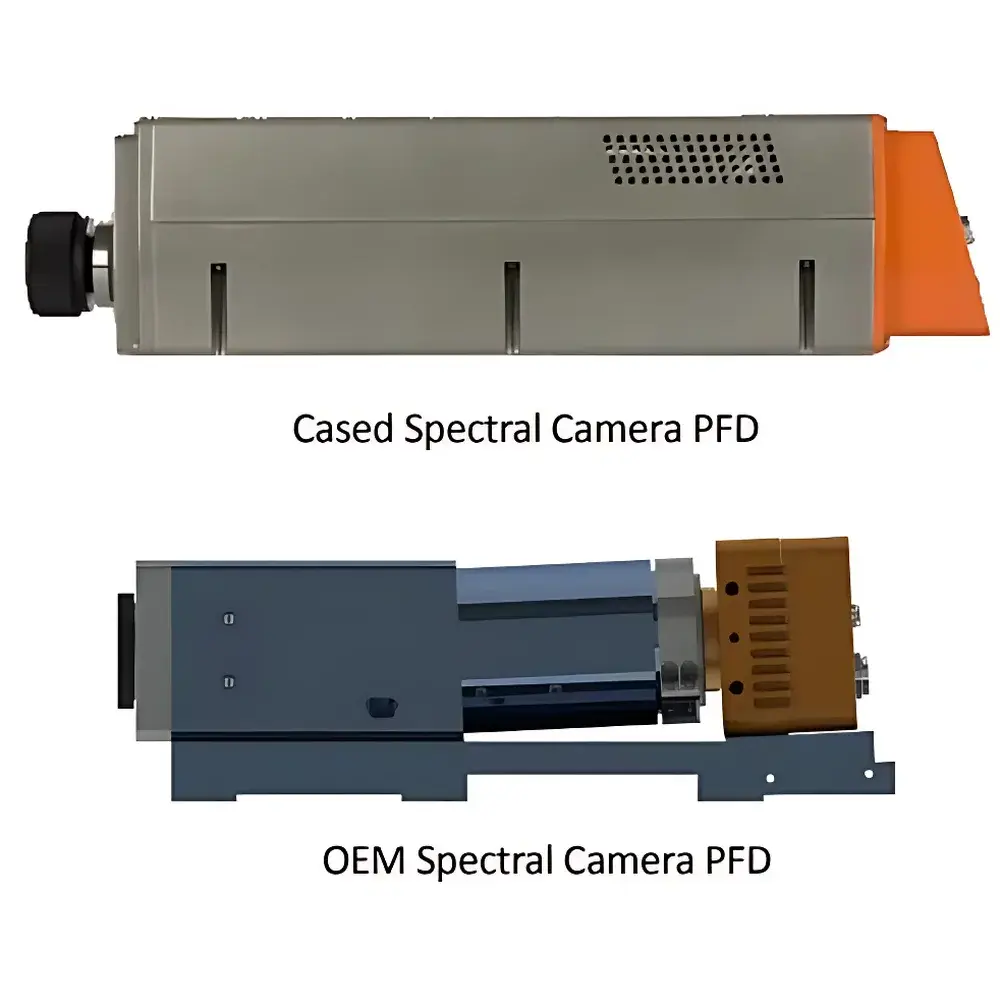
| Dimensions (OEM) | 231 × 80.5 × 78 mm |
| Dimensions (Kit) | 330 × 85 × 90 mm |
| Weight | 1.8 kg (OEM), 2.7 kg (kit) |
| Housing | Anodized aluminum with C-mount lens interface |
| Software Support | LUMO (acquisition, real-time visualization, ENVI-compatible data cube export) |
Overview
The Specim PFD VNIR Hyperspectral Imaging System is a push-broom scanning instrument engineered for high-fidelity spectral-spatial data acquisition across the visible and near-infrared (VNIR) range (400–1000 nm). It integrates the Imspector V10E transmission grating imaging spectrometer with a high-speed CMOS area-scan detector, delivering continuous, contiguous spectral information for every spatial pixel along the line of sight. Unlike snapshot or tunable-filter systems, the PFD employs precise optical dispersion and synchronized linear motion to generate full hyperspectral data cubes—enabling quantitative reflectance analysis, material identification, and spectral unmixing in real-world industrial and scientific environments. Its design adheres to rigorous optical metrology standards, with diffraction-limited performance ensured by high-efficiency transmissive optics, low-aberration lenses, and polarization-insensitive throughput optimization. The system is calibrated for radiometric stability and geometric fidelity, supporting traceable measurements compliant with ISO 17025-accredited laboratory practices when used with NIST-traceable reference sources.
Key Features
- Push-broom architecture with synchronized line-scanning for distortion-free, high-reproducibility data cubes
- Optimized transmission grating spectrometer (Imspector V10E) delivering <3.0 nm FWHM spectral resolution at 30 µm slit width
- High-speed CMOS detector enabling frame rates up to 150 fps (1312 × 768) and 100 fps (1775 × 768), scalable via on-chip binning
- Configurable spectral sampling (0.78–6.27 nm/pixel) and multi-ROI acquisition for adaptive bandwidth selection and dynamic range optimization
- Robust anodized aluminum OEM housing (IP50-rated), C-mount lens interface, and thermal-stable mechanical design for integration into production lines or field-deployable platforms
- Low power consumption (<5 W) and dual-voltage support (12 V DC for embedded integration; 24 V DC for turnkey kits)
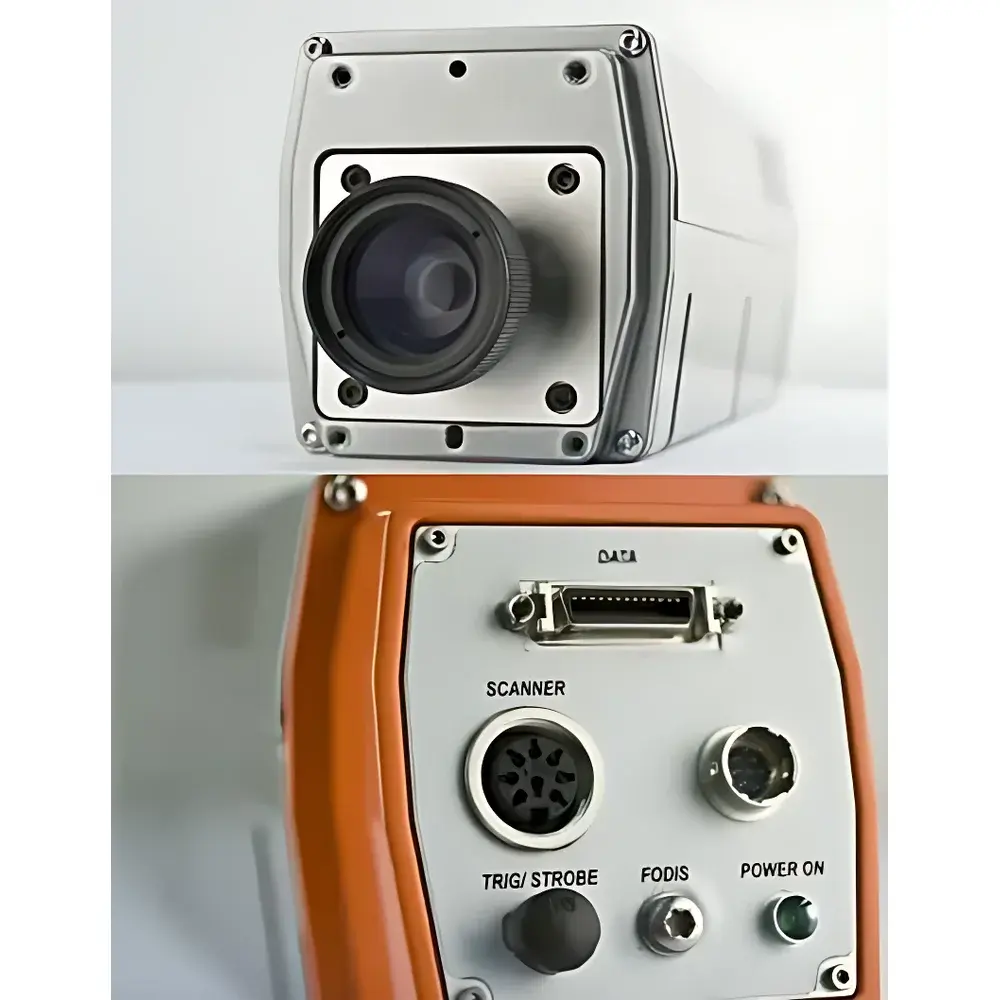
- Real-time exposure control (0.1–100 ms), hardware-triggered acquisition, and CameraLink interface for deterministic synchronization with motion stages or PLCs
Sample Compatibility & Compliance
The PFD VNIR accommodates diverse sample geometries—from static laboratory specimens mounted on X-stage movers to dynamic conveyor-belt materials and outdoor vegetation canopies—via optional mirror scanners or rotary platforms. Its f/2.4 aperture and 50% optical throughput guarantees consistent signal-to-noise ratio (SNR) regardless of sample birefringence or illumination geometry. The system meets key regulatory expectations for analytical instrumentation: its stable calibration protocol supports GLP-compliant documentation, and raw data export in ENVI-compatible format enables audit-ready traceability. When deployed with calibrated reference panels (e.g., Spectralon®), it satisfies ASTM E2758 (Standard Practice for Hyperspectral Imaging Systems Calibration) and aligns with FDA 21 CFR Part 11 requirements for electronic records when integrated with validated LUMO acquisition workflows.
Software & Data Management
LUMO software serves as the primary acquisition and visualization platform for the PFD series. It provides intuitive control over exposure, ROI definition, spectral binning, and hardware triggering—while streaming live preview of spectral profiles and false-color composites. All acquired data are saved as ENVI-standard .hdr/.dat files, ensuring seamless interoperability with industry-standard analysis tools including ENVI, MATLAB, Python (scikit-learn, spectral), and commercial chemometric packages (e.g., Unscrambler X, Pirouette). LUMO supports batch processing, metadata embedding (GPS, timestamp, environmental sensor inputs), and export of reflectance-corrected cubes using user-supplied white/dark reference sequences. For regulated environments, LUMO’s optional audit trail module logs all parameter changes, user actions, and acquisition events—facilitating compliance with ISO/IEC 17025 and GxP validation protocols.
Applications
- Industrial quality control: Real-time detection of foreign material, moisture gradients, chemical contamination, and compositional heterogeneity in food, pharmaceuticals, and recycled plastics
- Agricultural phenotyping: Quantitative assessment of chlorophyll content, water stress indices (NDVI, PRI), and cultivar discrimination in greenhouse and field trials
- Environmental remote sensing: Benthic habitat mapping (e.g., coral reef health assessment), soil organic carbon estimation, and invasive species monitoring
- Forensic and anti-counterfeiting: Spectral fingerprinting of inks, pigments, security threads, and document substrates under non-destructive illumination
- Material science: Thin-film thickness measurement, semiconductor wafer defect classification, and polymer blend homogeneity analysis
- Biomedical research: Ex vivo tissue characterization, wound healing progression tracking, and label-free histopathology screening
FAQ
What spectral calibration options are available for the PFD VNIR?
Factory calibration includes wavelength and radiometric coefficients derived from NIST-traceable sources. Users may perform field recalibration using optional quartz-halogen lamps and certified reflectance standards.
Can the PFD operate in outdoor daylight conditions?
Yes—when paired with appropriate bandpass filters (e.g., 590 nm long-pass) and sun-tracking mounts, the system maintains stray light rejection <0.5% and delivers robust SNR under natural illumination.
Is the CameraLink interface compatible with common frame grabbers?
The PFD implements Base CameraLink (2-tap, 8-bit or 12-bit) compliant with standard CL-1000 or CL-2000 frame grabbers from BitFlow, Euresys, and Teledyne DALSA.
How is spatial resolution affected by lens selection?
Spatial sampling depends on lens focal length and working distance. Standard C-mount lenses (e.g., 25 mm, 50 mm) yield ~0.1–1.0 mm/pixel at typical standoff distances; telecentric or macro lenses enable micron-level resolution for microscopy integration.
Does the system support real-time spectral classification?
While LUMO does not include embedded ML inference, its low-latency data stream allows integration with external edge AI platforms (e.g., NVIDIA Jetson) for GPU-accelerated classification at >60 fps using pre-trained models.



