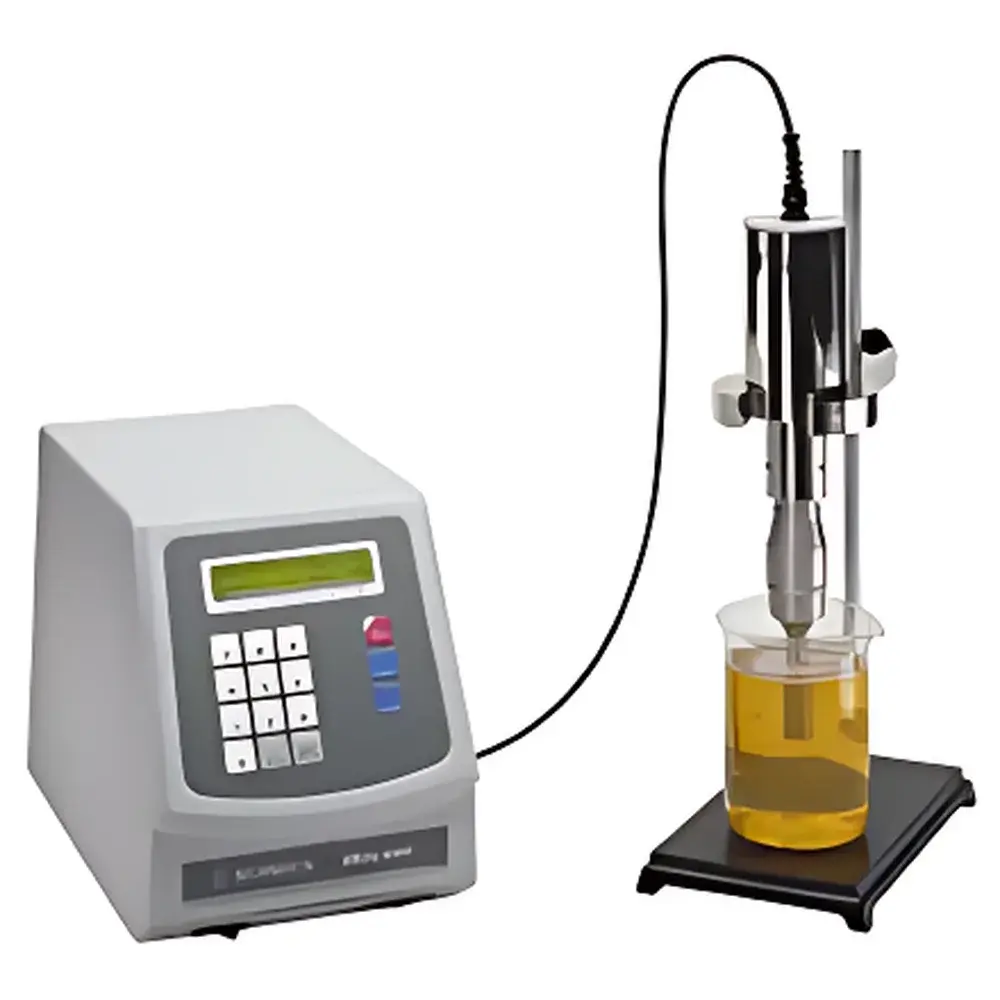
Sonics VCX500 and VCX800 High-Performance Ultrasonic Cell Disruptors
| Brand | Sonics |
|---|---|
| Origin | USA |
| Model | VCX500/VCX800 |
| Output Power | 500 W / 800 W |
| Dimensions (H×W×D) | 235 × 190 × 340 mm |
| Weight | 6.8 kg |
| Timer Range | 1 s – 10 h |
| Pulse Mode | Independent ON/OFF switch |
| Standard Probe | Φ13 mm threaded, replaceable tip, length 138 mm, sample volume 10–250 mL |
| Amplitude | 124 µm (Φ13 mm), 61–89 µm (larger probes) |
| Sample Volume Capacity | 0.01–1000 mL |
| Compliance | CE, UL, RoHS |
| Software Interface | None (standalone microprocessor control) |
Overview
The Sonics VCX500 and VCX800 are high-intensity ultrasonic cell disruptors engineered for reproducible lysis of microbial, mammalian, plant, and tissue samples across research, bioprocessing, and quality control laboratories. These instruments operate on the principle of piezoelectric-driven cavitation: high-frequency acoustic energy (20 kHz nominal) is transmitted via titanium alloy probes into liquid suspensions, generating transient microbubbles that collapse violently—producing localized shear forces, shockwaves, and microstreaming sufficient to disrupt cellular membranes and subcellular structures without significant thermal denaturation when operated under controlled pulse conditions. Designed for scalability—from microliter-scale lysates to liter-volume batch processing—the VCX series delivers stable, calibrated output power (500 W or 800 W net electrical-to-acoustic conversion) with real-time digital monitoring of operational parameters. Their compact benchtop footprint (235 × 190 × 340 mm), lightweight aluminum chassis (6.8 kg), and integrated safety interlocks make them suitable for ISO Class 5–7 cleanrooms, BSL-2 cabinets, and regulated GMP environments where spatial efficiency and process traceability are critical.
Key Features
- Microprocessor-controlled digital interface with backlit LCD display showing real-time amplitude, elapsed time, pulse status, and temperature alerts (when paired with optional external probe)
- Programmable timer (1 second to 10 hours) and independent pulse mode: OFF/ON toggle with ON-duration adjustable in 1-second increments from 1–59 seconds—enabling precise duty-cycle management to minimize sample heating
- Dual-power platform: VCX500 (500 W) optimized for routine lab-scale disruption (e.g., E. coli, yeast, cultured cells); VCX800 (800 W) supports high-viscosity slurries, fibrous tissues, and large-volume homogenization (up to 1 L)
- Modular probe architecture: Threaded Φ13 mm probe (standard, 138 mm length, 124 µm amplitude) with field-replaceable tips; optional interchangeable probes (Φ19 mm, Φ25 mm) engineered for specific volume ranges and amplitude profiles
- Robust titanium alloy horn construction compliant with ASTM F136 standards for biomedical-grade Ti-6Al-4V; all probes undergo ultrasonic fatigue testing and amplitude calibration verification per ISO 17025-accredited procedures
- Integrated overheat protection, automatic shutdown on load mismatch, and audible/visual fault indicators aligned with IEC 61000-6-2 EMC immunity requirements
Sample Compatibility & Compliance
The VCX500/VCX800 accommodate diverse biological matrices—including Gram-positive/negative bacteria, spores, algae, insect cells, primary mammalian cultures, frozen tissue sections, and plant protoplasts—without requiring chemical lysis reagents. Probe selection is empirically matched to sample rheology and volume: Φ13 mm probes deliver maximum amplitude (124 µm) for low-volume, high-sensitivity applications (e.g., nuclear extraction); Φ19 mm and Φ25 mm variants provide broader energy distribution for viscous lysates or particulate suspensions. All systems comply with CE marking (2014/30/EU EMC Directive, 2014/35/EU LVD), UL 61010-1 safety certification, and RoHS 2011/65/EU restrictions on hazardous substances. While standalone operation does not include FDA 21 CFR Part 11-compliant audit trails, the instruments support GLP/GMP workflows when integrated with validated external data loggers and SOP-controlled protocols documented per ISO/IEC 17025.
Software & Data Management
The VCX500/VCX800 operate as autonomous hardware platforms with no embedded operating system or network connectivity. Parameter settings (time, pulse, amplitude level) are stored in non-volatile memory and recalled at power-up. For regulatory traceability, users may connect optional third-party USB data loggers (e.g., Omega OM-DAQPRO-5300) to monitor real-time temperature (via PT100 sensor input) and acoustic output stability. Raw operational logs—including start/stop timestamps, total active sonication time, and cumulative pulse cycles—can be exported as CSV for inclusion in electronic lab notebooks (ELN) compliant with ALCOA+ principles (Attributable, Legible, Contemporaneous, Original, Accurate). Firmware updates are performed locally via proprietary diagnostic port using Sonics-certified service tools.
Applications
- Preparative-scale protein extraction from E. coli BL21(DE3) and inclusion body solubilization
- Nucleic acid isolation for NGS library prep—minimizing shearing through pulsed amplitude modulation
- Subcellular fractionation: mitochondrial and nuclear enrichment from rodent liver homogenates
- Virus-like particle (VLP) release from baculovirus-infected Sf9 cells
- Cell wall disruption in Candida albicans and Aspergillus niger for enzyme activity profiling
- Emulsification of lipid nanoparticles (LNPs) in mRNA vaccine development workflows
- Homogenization of cryo-preserved tumor biopsies prior to proteomic digestion
FAQ
What is the difference between VCX500 and VCX800 in terms of acoustic output capability?
The VCX800 delivers higher net acoustic power (800 W vs. 500 W), enabling shorter processing times for high-density samples and improved energy transfer efficiency in volumes exceeding 500 mL.
Can the VCX series be used for continuous operation without pulsing?
Continuous mode is supported but not recommended for thermally sensitive samples; pulse mode (e.g., 5 s ON / 10 s OFF) is strongly advised to maintain sample temperature below 4 °C during extended runs.
Are Sonics probes autoclavable?
Yes—titanium alloy probes (including threaded Φ13 mm and Φ19 mm variants) are fully autoclavable at 121 °C, 15 psi for 20 minutes; avoid prolonged exposure to strong oxidizers or alkaline solutions above pH 10.
How is amplitude calibrated and verified?
Each probe undergoes factory calibration using laser Doppler vibrometry against NIST-traceable reference standards; amplitude drift is monitored annually via Sonics’ certified service program per ISO/IEC 17025.
Is remote monitoring or Ethernet connectivity available?
No native network interface exists; integration with building management systems or SCADA requires external analog/digital I/O modules and custom middleware configuration.