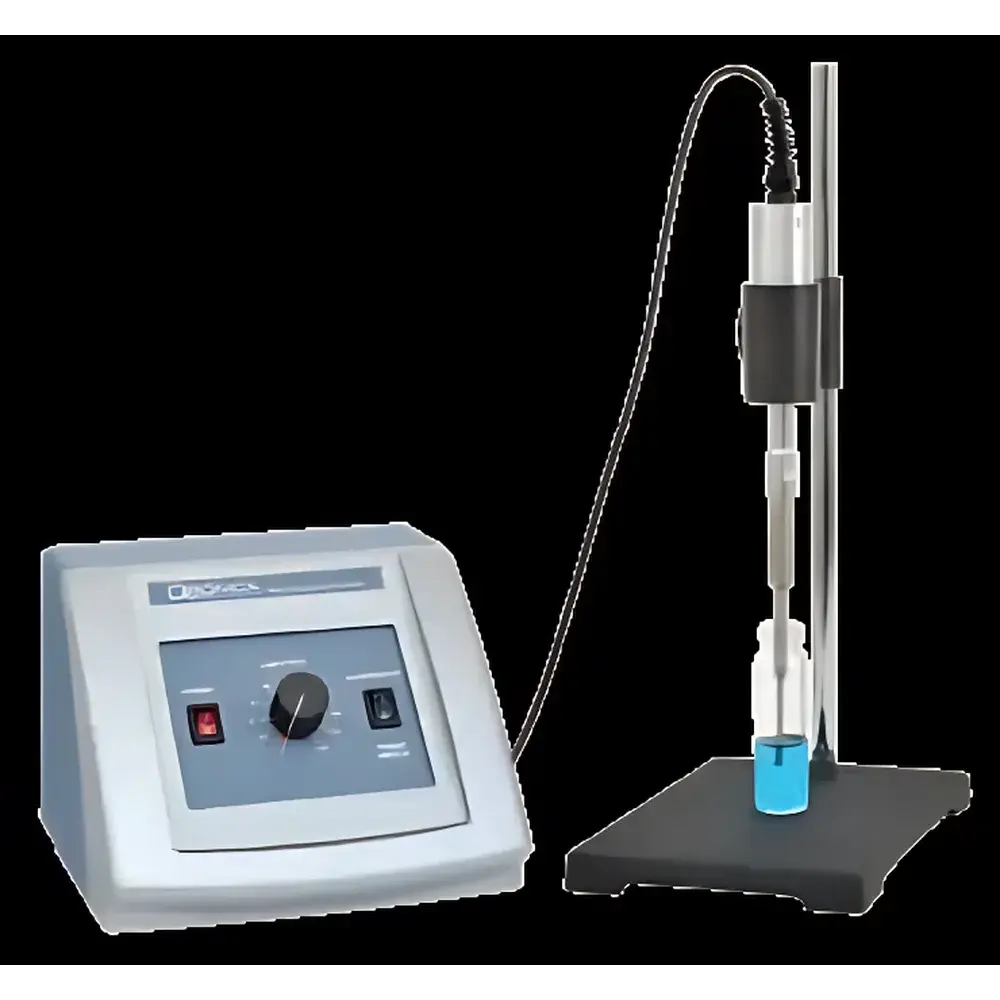
Qsonica Q55 Benchtop Ultrasonic Cell Disruptor
| Brand | Qsonica LLC |
|---|---|
| Origin | USA |
| Model | Q55 |
| Instrument Type | Ultrasonic Cell Disruptor |
| Maximum Output Power | 55 W |
| Operating Frequency | 20 kHz |
| Sample Volume Range | 0.2–50 mL |
| Dimensions (W × D × H) | 20.3 × 19.0 × 14.6 cm |
| Standard Probe | 1/8" (3.2 mm) tapered microtip |
| Optional Probes | 4423 (0.2–5 mL, 2 mm, 200 µm amplitude), 4422 (0.5–15 mL, 3.2 mm, 180 µm), 4435 (5–50 mL, 6.4 mm, 120 µm) |
| Optional Accessory | 432A Acoustic Enclosure (50.8 × 30.5 × 30.5 cm) |
Overview
The Qsonica Q55 Benchtop Ultrasonic Cell Disruptor is an engineered solution for controlled, reproducible sonication in life science laboratories. It operates on the principle of high-intensity ultrasonic cavitation—generating rapid pressure fluctuations in liquid media that induce microbubble formation, growth, and violent collapse. This physical mechanism delivers localized shear forces sufficient to disrupt cellular membranes, solubilize inclusion bodies, fragment chromatin, and disperse nanoparticles without thermal degradation when operated under optimized duty cycles. Designed for benchtop use in molecular biology, protein biochemistry, and quality control environments, the Q55 provides deterministic energy delivery at a fixed frequency of 20 kHz, ensuring consistent acoustic output across repeated runs. Its compact footprint and low power draw (55 W nominal) make it suitable for shared core facilities, teaching labs, and GLP-compliant QC workflows where space, safety, and traceability are prioritized.
Key Features
- Fixed-frequency 20 kHz piezoelectric transducer system with real-time amplitude stability monitoring
- Adjustable amplitude control (10–100% in 1% increments) enabling precise energy modulation for sensitive samples
- Integrated digital timer (0.1–999 s) with automatic shut-off and pulse mode (on/off cycling) for thermal management
- Robust aluminum chassis with vibration-dampened base and non-slip rubber feet for stable operation during extended sonication
- Standard 1/8″ (3.2 mm) titanium alloy probe optimized for volumes from 0.5 to 15 mL; compatible with optional probe configurations for micro- or macro-scale applications
- Optional 432A acoustic enclosure—tested to reduce ambient noise to ≤65 dBA at 1 m—meets OSHA and EU Directive 2003/10/EC requirements for occupational hearing protection
Sample Compatibility & Compliance
The Q55 supports a broad range of biological and synthetic sample matrices, including bacterial and mammalian cell suspensions, tissue homogenates, viral lysates, liposome dispersions, and polymer nanoparticle suspensions. Its non-contact cup-horn configuration (available as accessory) enables processing of BSL-2 agents without probe contamination risk, aligning with CDC/NIH biosafety guidelines. All titanium probes comply with ASTM F136 for surgical-grade implantable material biocompatibility. The instrument’s electrical design conforms to IEC 61010-1 for laboratory equipment safety, while its acoustic enclosure meets ISO 7196:1995 for noise emission classification. When used with validated protocols, data generated on the Q55 may support submissions under FDA 21 CFR Part 11 when integrated into electronic lab notebook (ELN) systems with audit-trail capability.
Software & Data Management
The Q55 operates via front-panel digital interface only—no proprietary software or driver installation required. All operational parameters (amplitude %, duration, pulse ratio, cycle count) are retained in non-volatile memory and displayed in real time. For laboratories requiring full traceability, the device supports external logging via TTL-triggered data acquisition systems (e.g., National Instruments DAQ or LabVIEW). Timestamped run logs—including probe ID, total accumulated sonication time, and thermal sensor feedback (via optional external IR thermometer)—can be exported manually for inclusion in SOP documentation or regulatory review packages. No cloud connectivity or firmware updates are implemented, minimizing cybersecurity exposure in regulated environments.
Applications
- Cell lysis for recombinant protein extraction from E. coli, yeast, and insect cells
- Chromatin shearing in ChIP-seq and ATAC-seq library preparation workflows
- Nanoparticle dispersion and deagglomeration in formulation development (e.g., lipid nanoparticles, polymeric micelles)
- Emulsification of oil-in-water systems for cosmetic and pharmaceutical excipient testing
- Homogenization of tissue biopsies prior to nucleic acid isolation or proteomic analysis
- Disruption of biofilms for antimicrobial efficacy assessment per CLSI M27/M60 standards
FAQ
What is the recommended maintenance schedule for the Q55 transducer and probe?
Inspect probe tip for pitting or erosion before each use; replace if surface irregularities exceed 0.1 mm depth. Clean with 70% ethanol and dry thoroughly. Transducer servicing is recommended every 2,000 operating hours or biannually—whichever occurs first—by an authorized Qsonica service center.
Can the Q55 be used for continuous operation?
No. Continuous sonication exceeds thermal limits of the piezoelectric stack. Pulse mode (e.g., 5 s on / 5 s off) is mandatory for runs exceeding 60 seconds to maintain probe integrity and sample temperature control.
Is calibration traceable to NIST standards?
Amplitude calibration is performed at the factory using laser vibrometry referenced to NIST-traceable accelerometers. A Certificate of Conformance (CoC) with measurement uncertainty budget is supplied with each unit.
Does the Q55 meet GLP requirements for regulated laboratories?
Yes—when operated within defined SOPs, with documented probe history, amplitude verification, and environmental monitoring (temperature, humidity), the Q55 satisfies key GLP elements per OECD Principles of Good Laboratory Practice (ENV/MC/CHEM(98)17).