
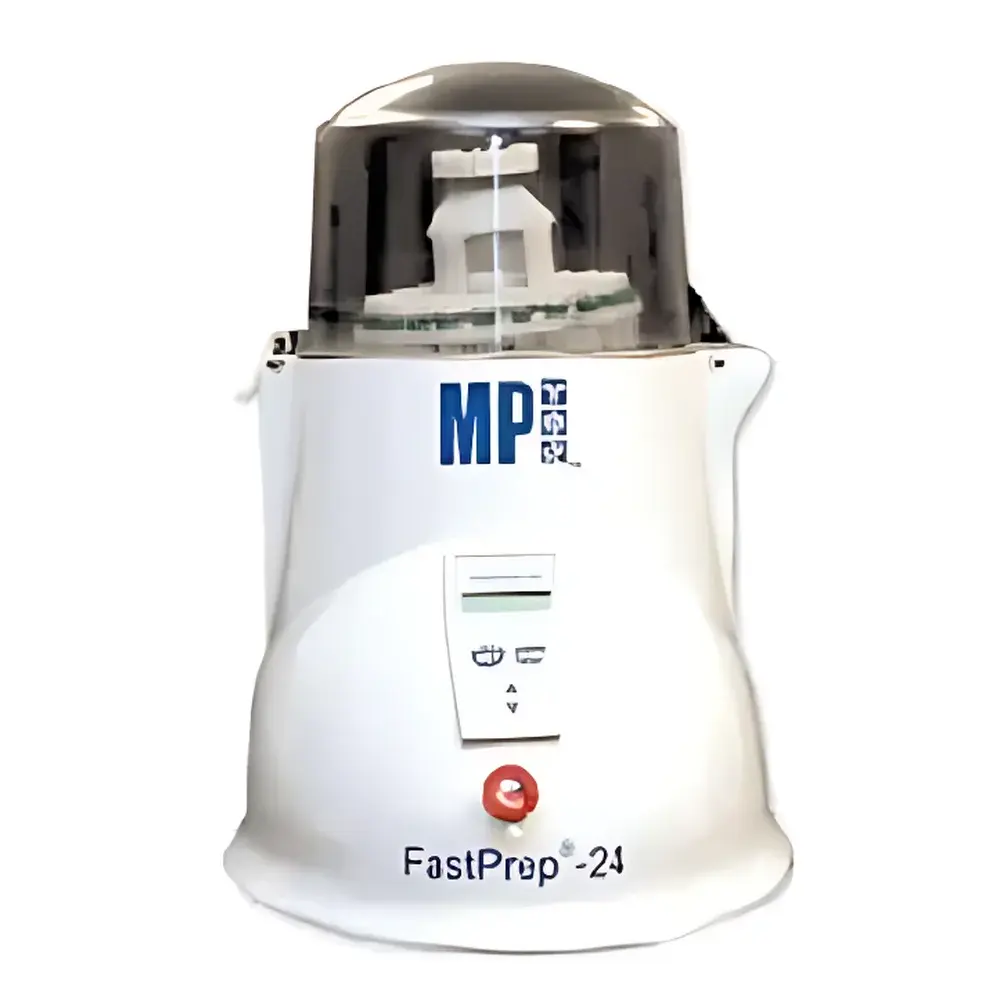
MP FastPrep®-24 Homogenizer
| Brand | MP |
|---|---|
| Origin | USA |
| Model | FastPrep®-24 |
| Instrument Type | Bead-Based Mechanical Homogenizer |
| Dimensions (W×D×H) | 425 × 330 × 270 mm |
| Sample Capacity | 24 × 2 mL tubes (standard) |
| Processing Volume per Tube | 0.5–100 mL |
| Operating Speed Range | 4.0–6.5 m/s (in 0.5 m/s increments) |
| Time Range | 1–60 s (in 1 s increments) |
| Acceleration/Deceleration | ≤2 s to max speed / full stop |
| Cycle Limitation | 60 s run + 60 s cooldown at 6.5 m/s |
| Noise Level | <70 dB(A) |
| Power Supply | 110 V AC, 60 Hz or 230 V AC, 50 Hz, 400 W |
| Operating Temperature | 15–35 °C |
| Storage Temperature | 7–43 °C |
| Safety Certifications | UL, CE |
| Quality Management | ISO 9001:1994 (QMI Certificate #001080) |
Overview
The MP FastPrep®-24 Homogenizer is a high-performance, bead-based mechanical homogenization system engineered for rapid, reproducible lysis of diverse biological samples—including microbial cells, plant tissues, animal organs, soil, fungi, spores, and archived biospecimens. Unlike conventional methods such as mortar-and-pestle grinding, rotor-stator homogenization, or probe sonication—which introduce thermal stress, operator variability, and cross-contamination risks—the FastPrep®-24 employs a patented vertical “figure-eight” oscillatory motion. This motion generates intense, multidirectional kinetic energy transfer between ceramic, silica, or steel beads and sample matrices within sealed, impact-resistant tubes. The result is efficient cell disruption with minimal heat generation (<1 °C temperature rise during standard 40 s cycles), preserving labile biomolecules including intact RNA, native proteins, and high-molecular-weight DNA. Designed for walk-away operation in regulated environments, the system supports GLP-compliant workflows through deterministic timing, speed control, and hardware-integrated safety interlocks.
Key Features
- Patented figure-eight oscillation mechanism ensures uniform, high-energy bead collision across all 24 tube positions—eliminating positional bias and maximizing lysis efficiency for recalcitrant samples (e.g., Gram-positive bacteria, woody plant tissue, fungal cell walls).
- Dual-range programmable control: time (1–60 s, 1 s resolution) and speed (4.0–6.5 m/s, 0.5 m/s increments), enabling method optimization without hardware modification.
- Integrated QuickPrep™ adapter platform accommodates multiple tube formats: 24 × 2 mL (standard), 2 × 50 mL (BigPrep™), 12 × 15 mL (TeenPrep™), 48 × 2 mL (HiPrep™), and cryogenic 24 × 2 mL (CryoPrep™) for sub-zero processing.
- UL- and CE-certified safety architecture includes automatic lid interlock, overheat protection, and vibration-dampened chassis—ensuring compliance with IEC 61000-3-2 (EMC) and IEC 61000-3-3 (voltage fluctuation).
- Minimal maintenance design: no lubricants, belts, or consumable drive components; stainless-steel housing and reinforced polymer base resist corrosion and mechanical fatigue over >10,000 operational cycles.
Sample Compatibility & Compliance
The FastPrep®-24 processes samples across broad biological and environmental categories while maintaining integrity for downstream molecular analysis. Compatible matrices include—but are not limited to—bacterial pellets (including Mycobacterium), yeast spheroplasts, frozen plant leaf tissue, mammalian liver biopsies, soil slurries (up to 20% clay content), and formalin-fixed paraffin-embedded (FFPE) microsections. All protocols align with ISO/IEC 17025:2017 requirements for method validation, and routine use satisfies analytical pre-treatment criteria outlined in USP , CLSI EP17-A2, and ASTM D5673-17 (soil DNA extraction). The closed-tube configuration prevents aerosol generation and meets CDC/NIH BSL-2 containment recommendations for pathogenic sample handling.
Software & Data Management
While the FastPrep®-24 operates via standalone front-panel LED interface (no PC dependency), its parameter settings—time, speed, and cycle count—are logged internally with timestamp and operator ID (via optional RFID badge integration). Audit trails comply with FDA 21 CFR Part 11 requirements when paired with validated LIMS interfaces (e.g., LabWare LIMS v11+, Thermo Fisher SampleManager). Method templates can be exported/imported via USB flash drive in CSV format, supporting version-controlled SOP deployment across multi-site laboratories. No proprietary software licensing or cloud connectivity is required, ensuring data sovereignty and network isolation in secure research environments.
Applications
- Nucleic acid isolation: High-yield, inhibitor-free genomic DNA and total RNA extraction from challenging sources—validated for qPCR, NGS library prep (Illumina, PacBio), and long-read sequencing.
- Proteomics sample prep: Native protein solubilization for 2D-PAGE, LC-MS/MS, and activity assays—preserving post-translational modifications and complex stoichiometry.
- Metagenomic and microbiome studies: Consistent lysis of mixed-species communities in fecal, rhizosphere, and wastewater samples—reducing GC-bias and improving taxonomic coverage.
- Clinical diagnostics: Rapid homogenization of FFPE blocks, blood clots, and biopsy cores prior to automated nucleic acid extraction on platforms such as QIAGEN QIAcube or Roche MagNA Pure.
- Biopharmaceutical QC: Cell pellet disruption for residual host-cell protein (HCP) quantification and plasmid DNA release in upstream process monitoring.
FAQ
What tube types and bead materials are compatible with the FastPrep®-24?
Standard operation uses MP-certified 2 mL lysing matrix tubes containing silica, ceramic, or stainless-steel beads. Custom bead sets (e.g., zirconia for ultra-hard tissues) must be validated for mechanical stability under 6.5 m/s oscillation.
Can the instrument be used for cryogenic homogenization?
Yes—when equipped with the CryoPrep™ adapter and pre-chilled tubes, the system maintains sample temperatures below −20 °C throughout 40 s cycles, suitable for RNase-sensitive applications.
Is method transfer between FastPrep®-24 units reproducible?
Yes—inter-unit coefficient of variation (CV) for lysis efficiency is ≤3.2% (n=12 instruments, same protocol, E. coli K12 lysate), verified per ISO 5725-2:1994.
Does the system require calibration or periodic certification?
No scheduled calibration is mandated; however, annual verification of speed accuracy (±0.1 m/s) and timer fidelity (±0.2 s) is recommended per ISO/IEC 17025 Clause 6.5.2.
How does the FastPrep®-24 compare to rotor-stator homogenizers for viscous samples?
Rotor-stator systems suffer from shear-thinning artifacts and clogging with fibrous or mucilaginous samples; the FastPrep®-24’s bead-based impact lysis avoids viscosity-dependent performance decay and delivers linear scalability from 0.5 mL to 100 mL total volume.



