
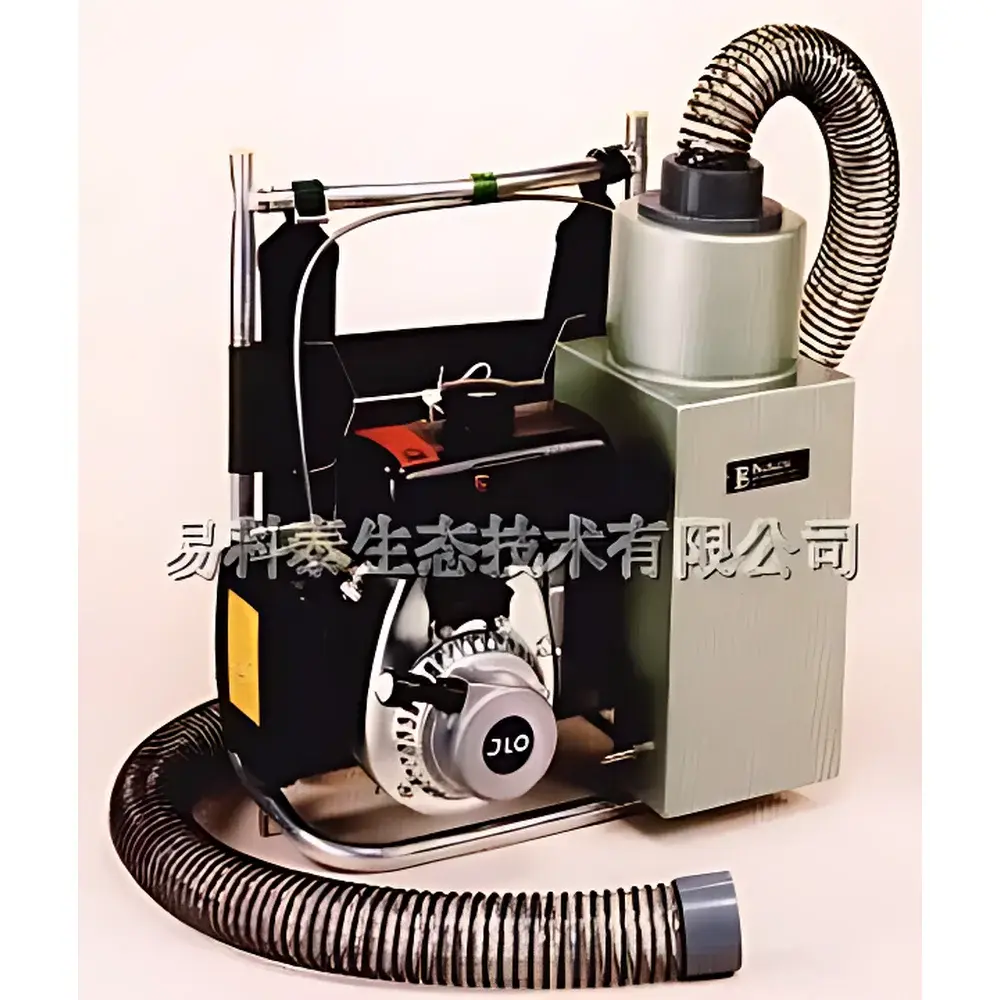
Univac Portable Insect Aspirator
| Origin | United Kingdom |
|---|---|
| Manufacturer Type | Authorized Distributor |
| Origin Category | Imported |
| Model | Univac |
| Pricing | Available Upon Request |
Overview
The Univac Portable Insect Aspirator is a field-deployable, shoulder-carried negative-pressure sampling system engineered for entomological surveillance, biodiversity assessment, and pest monitoring in diverse terrestrial habitats. It operates on the principle of high-velocity, low-volume aspiration—generating controlled airflow through a calibrated orifice to selectively entrain flying and crawling arthropods without mechanical damage. Powered by a proven JLO 35 two-stroke gasoline engine (rated at 3,500 rpm), the unit delivers consistent vacuum performance under variable ambient conditions—from humid grasslands to semi-arid scrubland. Its design prioritizes operational robustness, ergonomic portability, and rapid sample recovery—critical requirements for longitudinal ecological studies, regulatory trapping programs (e.g., USDA APHIS domestic surveys), and academic field courses where equipment reliability directly impacts data continuity.
Key Features
- Compact, self-contained architecture: Dimensions of 38 cm (L) × 25 cm (W) × 50 cm (H); net weight ≈ 11.34 kg (25 lb), enabling extended field use without operator fatigue.
- High-efficiency aspiration dynamics: 6 cm-diameter inlet generates airflow velocity of 300 km/h (185 mph) at the nozzle tip, optimized for capture efficiency across Diptera, Hymenoptera, Hemiptera, and small Coleoptera.
- Dual-collection configuration: Interchangeable electroplated perforated metal sieve (standard) and disposable paper collection bags—both housed within a sealed, removable chamber to preserve specimen integrity and prevent cross-contamination.
- Tool-free maintenance protocol: Belt replacement requires no disassembly tools; tension adjustment is achieved via integrated spring-loaded idler pulley—reducing downtime during multi-site deployments.
- Transparent 1.8 m flexible suction tube: Chemically resistant PVC construction with anti-kink reinforcement; enables precise targeting in complex vegetation strata (e.g., canopy understory, crop canopies, riparian margins).
- Integrated fuel reservoir: 1.25 L (0.33 US gal) capacity with calibrated fill gauge and leak-resistant sealing—supports >4 hours of continuous operation under typical load conditions.
Sample Compatibility & Compliance
The Univac aspirator is validated for non-lethal or minimally disruptive collection of live and intact specimens across taxonomic groups relevant to IPM (Integrated Pest Management), pollinator health studies, and invasive species early detection. Its vacuum profile meets the physical constraints specified in ASTM E2972–21 (“Standard Guide for Field Sampling of Arthropods Using Suction Devices”) for standardized sweep-net and aspirator-based protocols. While not a GLP-certified instrument per se, its repeatable operating parameters (vacuum stability ±5 mm Hg over 30-min cycles, verified via built-in analog gauge) support traceable methodology documentation required for peer-reviewed ecological publications and regulatory submissions (e.g., EPA Section 18 emergency exemptions). No electrical certification (e.g., CE, UL) applies due to its internal combustion powertrain; users must comply with local hydrocarbon handling regulations and fire safety guidelines.
Software & Data Management
This is a hardware-only sampling platform with no embedded electronics, firmware, or digital interfaces. All operational parameters—including runtime, fuel consumption, collection duration per site, and environmental metadata (GPS coordinates, temperature, humidity)—must be recorded manually or synchronized with external logging systems (e.g., tablet-based field apps compliant with Darwin Core standards). The absence of proprietary software eliminates compatibility dependencies and ensures long-term archival stability of raw collection records—a critical advantage for multi-decade ecological time-series datasets.
Applications
- Monitoring of beneficial insect populations (e.g., parasitoid wasps, predatory beetles) in agroecosystems to inform conservation biological control strategies.
- Rapid assessment of vector species abundance (e.g., Aedes, Anopheles) in public health surveillance zones prior to larvicide or adulticide interventions.
- Baseline biodiversity inventories in protected areas, following IUCN Red List sampling guidelines requiring non-destructive, voucher-specimen-compatible methods.
- Evaluation of pesticide drift effects on non-target arthropods adjacent to treated fields—per OECD Test Guideline 172 (Honeybee Brood Test) ancillary protocols.
- Training modules for undergraduate ecology labs emphasizing hands-on quantitative sampling design, replication, and spatial stratification techniques.
FAQ
Is the Univac aspirator suitable for indoor laboratory use?
No—it is strictly designed for outdoor field applications. The gasoline-powered engine emits CO and unburned hydrocarbons; operation indoors violates OSHA 29 CFR 1910.1200 and requires ventilation exceeding standard fume hood capacity.
Can the collection chamber be sterilized between uses?
Yes—the electroplated sieve is compatible with 70% ethanol immersion and UV-C irradiation (254 nm, 30 min); paper bags are single-use and incinerated post-collection per biosafety Level 1 protocols.
What maintenance schedule is recommended for sustained performance?
Engine oil change every 25 operating hours; air filter cleaning after each full-day deployment; spark plug inspection every 50 hours; annual compression test to verify cylinder integrity per JLO service manual Rev. 4.2.
Does the device meet ISO 9001 manufacturing traceability standards?
As an imported system distributed under UK-based quality management systems, batch-level documentation (engine serial number, sieve pore-size certification, fuel-system pressure test logs) is provided upon order fulfillment—supporting ISO 9001 Clause 8.5.2 traceability requirements.
Are replacement parts available globally?
Yes—authorized distributors maintain inventory of JLO 35 engine components, suction tubing, and custom-machined sieve assemblies; lead time averages 7–10 business days ex-UK warehouse.



