
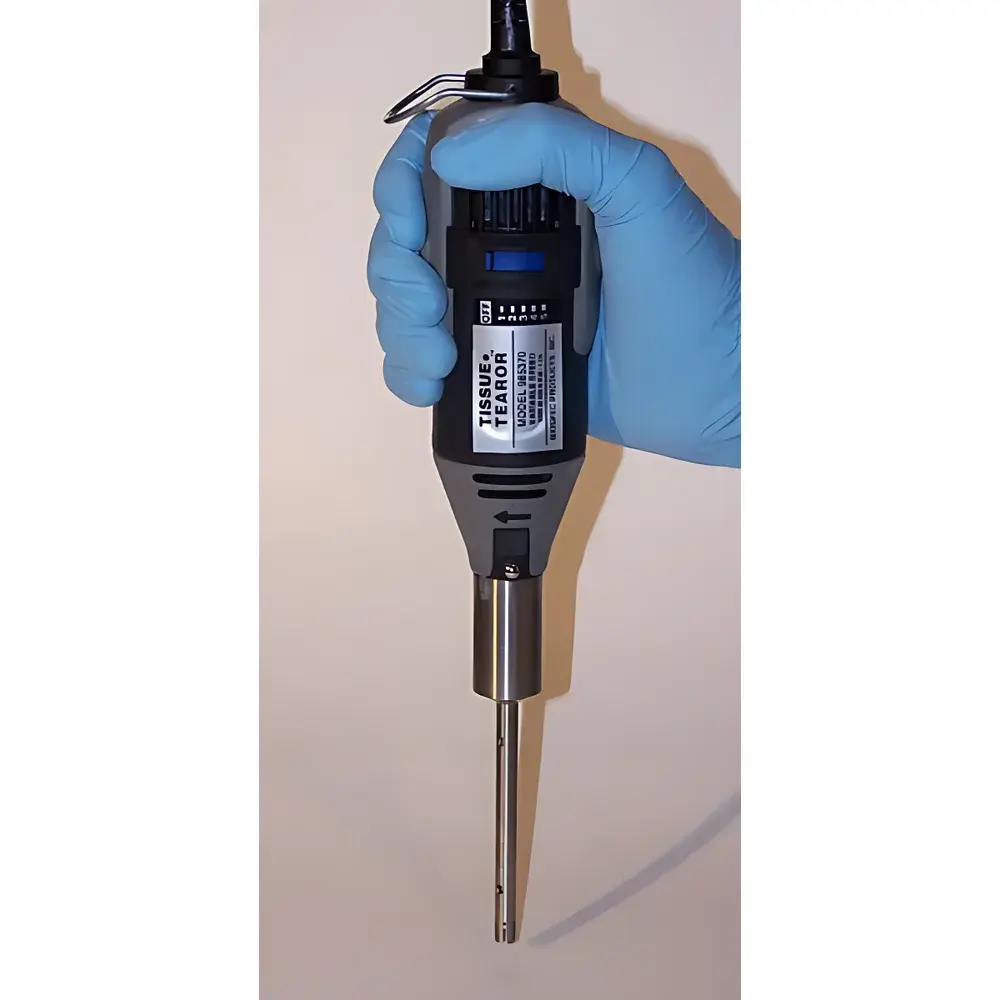
Biospec Tissue-Tearor Handheld Homogenizer
| Brand | Biospec |
|---|---|
| Origin | USA |
| Model | Tissue-Tearor |
| Speed Range | 5,000–35,000 rpm |
| Sample Volume Capacity | 0.2 mL to 1,000 mL |
| Probe Options | 4 standard configurations (4.5 mm, 7 mm, 14 mm diameters |
| Mounting | Handheld or stand-mounted operation |
Overview
The Biospec Tissue-Tearor Handheld Homogenizer is a high-performance, mechanically driven rotor-stator homogenization system engineered for rapid and reproducible disruption of biological tissues, cultured cells, bacteria, yeast, and soft plant materials. Operating on the principle of high-shear mechanical lysis, the device generates intense localized turbulence and cavitation at the probe tip through precise rotation of a stainless-steel rotor within a concentric stator sleeve. This hydrodynamic mechanism ensures efficient cell membrane rupture and subcellular component release while minimizing thermal denaturation when used with appropriate cooling protocols. Designed for flexibility in both benchtop and handheld workflows, the Tissue-Tearor delivers consistent homogenization across a broad dynamic range—from microliter-scale biopsies to liter-volume tissue suspensions—making it a core tool in molecular biology, proteomics, metabolomics, and diagnostic sample preparation laboratories.
Key Features
- Variable-speed control (5,000–35,000 rpm) enables optimization of shear intensity for diverse sample matrices—from fragile primary neurons to fibrous muscle or lignified plant tissue.
- Dual-mode operation: ergonomically balanced for direct handheld use during short-duration processing, or compatible with standard laboratory stands and clamps for extended or high-throughput applications.
- Interchangeable stainless-steel probes engineered for chemical resistance and autoclavability; each probe is precisely calibrated for defined flow dynamics and energy input per unit volume.
- Robust brushless motor architecture ensures stable rotational speed under load, low vibration, and long service life without performance drift over time.
- Integrated thermal management design minimizes heat accumulation during prolonged operation; recommended use with ice-water baths or chilled sample holders for thermolabile analytes.
Sample Compatibility & Compliance
The Tissue-Tearor accommodates a wide spectrum of biological specimens including mammalian tissues (liver, brain, kidney), cultured adherent and suspension cells, Gram-positive and Gram-negative bacteria, fungal mycelia, and soft botanical samples. It is routinely employed in protocols aligned with ISO 17025-accredited laboratories and supports GLP-compliant workflows when integrated with documented operating procedures and maintenance logs. While the instrument itself does not carry CE or FDA 510(k) clearance as a medical device, its probe materials comply with USP Class VI biocompatibility standards, and all wetted components meet ASTM F899 specifications for surgical stainless steel (Type 316). For regulated environments requiring audit trails, integration with LIMS or ELN systems is supported via analog output or external timer-based process logging.
Software & Data Management
The Tissue-Tearor operates as a standalone analog-controlled instrument without embedded firmware or digital connectivity. Speed selection is achieved via a precision potentiometer with tactile feedback and calibrated scale markings, ensuring repeatable settings across operators and shifts. Though no proprietary software is provided, users may implement external validation protocols using calibrated tachometers and documented SOPs to satisfy ISO/IEC 17025 clause 5.5.2 (equipment verification) and FDA 21 CFR Part 11 requirements for manual systems—where handwritten or electronic batch records include operator ID, probe type, speed setting, duration, and sample identification. Probe usage history and sterilization cycles should be tracked manually per institutional biosafety and equipment maintenance policies.
Applications
- Preparation of whole-cell lysates for Western blotting, ELISA, and enzymatic activity assays.
- Routine homogenization of frozen or fresh tissue prior to RNA/DNA extraction—particularly effective for samples resistant to bead-beating or sonication.
- Generation of uniform suspensions for flow cytometry, single-cell sequencing library prep, and microbiological plating.
- Extraction of intracellular organelles (e.g., mitochondria, nuclei) using differential centrifugation following controlled lysis.
- Processing of clinical specimens—including biopsy cores, aspirates, and swab eluates—in diagnostic virology and antimicrobial susceptibility testing pipelines.
FAQ
What is the maximum continuous run time for the Tissue-Tearor at full speed?
Continuous operation at 35,000 rpm is limited to ≤60 seconds per cycle to prevent excessive heat buildup; intermittent duty cycles (e.g., 30 s ON / 30 s OFF) are recommended for extended processing.
Can the Tissue-Tearor be used with corrosive reagents such as phenol-chloroform or strong acids?
Probes are constructed from ASTM F899-compliant 316 stainless steel and resist short-term exposure to common organic solvents and aqueous buffers; however, prolonged contact with halogenated solvents or concentrated mineral acids requires post-use passivation and visual inspection for pitting.
Is probe calibration required before each use?
No factory calibration is needed; however, users must verify probe integrity (no bending, scoring, or stator deformation) and confirm tight rotor-stator coupling prior to operation to ensure consistent shear profiles.
Does Biospec provide validation documentation for GMP environments?
Biospec supplies probe material certifications and mechanical specifications; site-specific IQ/OQ documentation must be developed internally per Annex 15 and WHO TRS 986 guidelines, referencing the device’s operational parameters and maintenance schedule.
How should probe sterilization be performed between samples?
Autoclaving at 121°C, 15 psi for 20 minutes is validated for all standard probes; ethylene oxide or hydrogen peroxide plasma sterilization is acceptable for temperature-sensitive accessories, provided compatibility is confirmed per probe manufacturer guidance.



