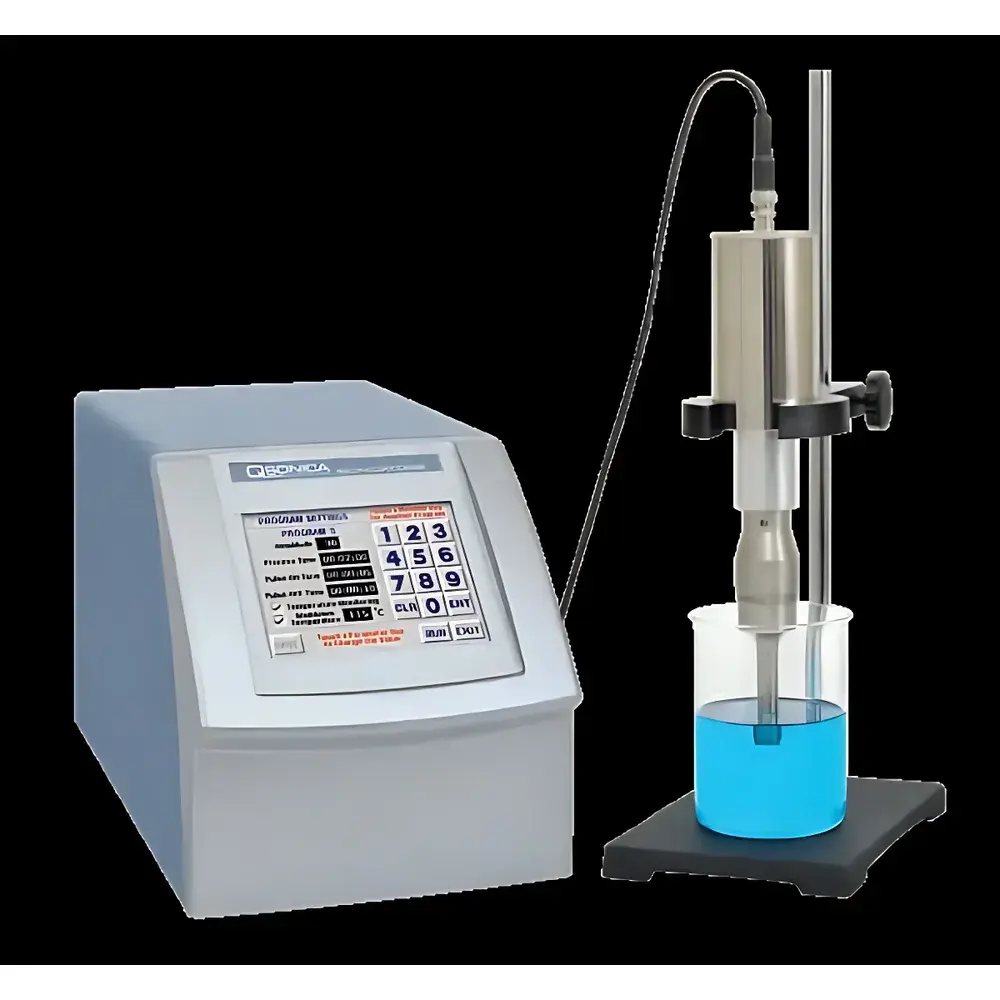
Qsonica Q700 Intelligent Ultrasonic Sonicator
| Brand | Qsonica LLC |
|---|---|
| Origin | USA |
| Manufacturer Type | Authorized Distributor |
| Product Category | Imported Instrument |
| Model | Q700 |
| Instrument Type | Ultrasonic Cell Disruptor |
| Maximum Output Power | 700 W |
| Operating Frequency | 20 kHz |
| Sample Volume Range | 0.1–1000 mL (batch) |
| Dimensions (W × D × H) | 20.3 × 38.7 × 22 cm |
| Programmable Memory Slots | 10 |
| Continuous Operation Time | Up to 72 hr |
| Pulse Duration Range | 1 s – 24 hr |
| Display | Full-color capacitive touchscreen |
| Temperature Monitoring | Real-time probe temperature sensing with thermal protection |
| Amplitude Control Range | 0–100% (digitally regulated, probe-specific calibration) |
Overview
The Qsonica Q700 Intelligent Ultrasonic Sonicator is an engineered solution for high-precision, reproducible ultrasonic energy delivery in life science and bioprocessing laboratories. Based on piezoelectric transduction at a fixed resonant frequency of 20 kHz, the Q700 converts electrical input into controlled mechanical oscillations transmitted through interchangeable titanium alloy probes (horns). This acoustic cavitation-based disruption mechanism generates localized shear forces, microstreaming, and transient hotspots—enabling efficient lysis of bacterial, yeast, mammalian, and plant cells; fragmentation of chromatin and genomic DNA; solubilization of inclusion bodies; and nano-emulsification of lipids or polymers. Unlike analog predecessors, the Q700 employs fully digital signal processing to regulate amplitude in real time—compensating for load impedance shifts caused by sample viscosity, temperature drift, or probe wear—thereby ensuring consistent energy transfer across heterogeneous sample matrices and extended operational cycles.
Key Features
- Fully digital amplitude control (0–100%) with automatic impedance matching for each probe type, eliminating manual tuning and enhancing inter-run reproducibility.
- Capacitive touchscreen interface displaying real-time metrics: applied amplitude (%), delivered power (W), cumulative energy (J), probe temperature (°C), pulse status, and program progress.
- Integrated thermal monitoring system with active overtemperature cutoff (<55 °C probe surface limit) and electronic overload protection to safeguard transducer integrity.
- Programmable workflow support: up to 10 user-defined protocols with nested pulse sequences, dwell times, amplitude ramps, and auto-start triggers—ideal for unattended overnight processing.
- Extended duty cycle capability: continuous operation up to 72 hours with adaptive cooling via internal heat-sink design and optional external recirculating chiller integration (e.g., Qsonica Model 4900).
- Comprehensive probe ecosystem—including tapered, stepped, and microtip configurations—engineered for scalable throughput from sub-microliter volumes (e.g., 0.2 mL PCR tubes) to 20 L/min flow-through applications.
Sample Compatibility & Compliance
The Q700 accommodates diverse biological and synthetic sample formats without cross-contamination risk. Batch-mode compatibility spans suspended cells (E. coli, S. cerevisiae, CHO), tissue homogenates, viscous lysates, and nanoparticle dispersions. Flow-through accessories (Models 4495 and 4583) enable GMP-aligned continuous processing under closed-system conditions. For regulated environments, the instrument supports audit-ready data logging when paired with compliant software (e.g., Q-View v4.x), meeting core requirements of FDA 21 CFR Part 11 for electronic records and signatures—provided timestamped event logs, user authentication, and immutable storage are configured per institutional SOPs. While not certified to ISO/IEC 17025 as a standalone metrological device, its amplitude linearity and thermal stability have been validated per ASTM E2651-20 (Standard Practice for Calibration of Ultrasonic Liquid Processors) using calibrated hydrophones and calorimetric methods.
Software & Data Management
The Q700 operates natively via embedded firmware with local protocol storage and execution. Optional Q-View software (Windows-based) enables remote monitoring, parameter scripting, export of time-stamped CSV datasets (amplitude, power, temperature, duration), and firmware updates via USB or Ethernet. All logged parameters are stored with metadata including operator ID, date/time stamp, probe serial number, and active program ID—facilitating traceability in GLP and GMP workflows. Data exports comply with MIAME and MIAPE reporting guidelines for omics sample preparation documentation. No cloud connectivity or telemetry is enabled by default; all data remains resident on host PC or instrument memory unless explicitly exported.
Applications
- Cell lysis and organelle isolation for proteomics and metabolomics sample prep.
- Chromatin shearing for ChIP-seq and ATAC-seq library construction (replacing enzymatic digestion in some protocols).
- Preparation of immunogenic aggregates in prion research—specifically validated for Protein Misfolding Cyclic Amplification (PMCA) assays per published literature (e.g., J. Virol. 2012;86:1172–1183).
- Nanoparticle synthesis and stabilization: uniform size distribution in liposomal, polymeric, and metallic colloids.
- Homogenization of fibrous or lipid-rich tissues (e.g., adipose, brain, liver) prior to RNA extraction.
- Catalytic activation in sonochemical synthesis—enhancing reaction kinetics in green chemistry applications.
FAQ
Is the Q700 compatible with Good Manufacturing Practice (GMP) environments?
Yes—when used with validated protocols, calibrated probes, and Q-View software configured for 21 CFR Part 11 compliance (audit trail, electronic signatures, data integrity controls), the Q700 meets foundational requirements for equipment qualification in pharmaceutical and biotech manufacturing settings.
Can amplitude be calibrated traceably to SI units?
Amplitude is specified in micrometers peak-to-peak displacement at the probe tip, referenced to NIST-traceable hydrophone measurements per ASTM E2651. Qsonica provides probe-specific calibration certificates upon request.
What safety certifications does the instrument carry?
The Q700 complies with IEC 61010-1:2010 (Safety Requirements for Electrical Equipment for Measurement, Control, and Laboratory Use) and bears CE, UL, and CSA markings for North American and EU markets.
How often should the ultrasonic converter be serviced?
Under normal use (≤8 hrs/day), the piezoelectric converter requires no routine maintenance beyond visual inspection and torque verification of probe mounting every 6 months. Lifetime expectancy exceeds 10,000 operating hours with proper thermal management.
Does Qsonica offer application support for method development?
Yes—Qsonica’s Applications Lab provides free protocol optimization guidance, peer-reviewed reference methods, and technical notes covering >120 sample types, including challenging matrices such as plant cell walls, biofilms, and extracellular vesicles.