
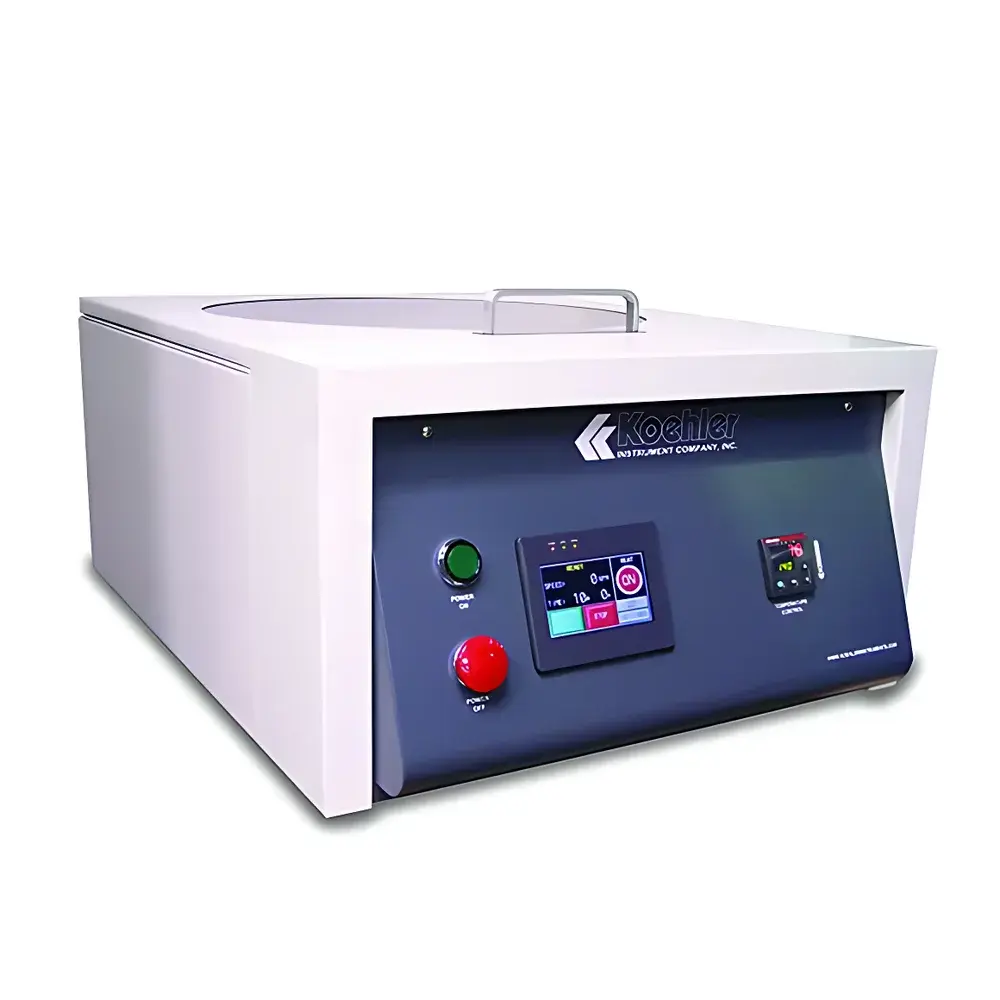
Koehler K60092 Benchtop Centrifuge for Petroleum Sediment and Water Analysis
| Brand | Koehler |
|---|---|
| Origin | USA |
| Model | K60092 |
| Certifications | ASTM D91, D96, D893, D1796, D2273, D2709, D2711, D4007 |
| Max Speed | 2200 rpm |
| Max RCF | 1327 × g (long tube), 1170 × g (short tube), 865 × g (pear-shaped tube) |
| Time Range | 0–999 min |
| Speed Range | 500–2200 rpm |
| Temp. Range | Ambient to 93 °C (digital display) |
| Chamber Dimensions | 78.74 × 65.53 × 36.32 cm |
| Weight | 44.5 kg |
| Power | 220–240 V, 50/60 Hz, single-phase, 5 A |
| Explosion Protection | Class 1, Division 2 |
| Sample Capacity | 4 tubes |
| Control Interface | LCD touchscreen |
| Thermal Insulation | High-efficiency insulation for minimal heat loss |
| Balance System | Automatic rotor balancing |
| Rotor Options | Interchangeable long, short, pear-shaped, and finger-type centrifuge tubes |
Overview
The Koehler K60092 Benchtop Centrifuge is a purpose-engineered analytical instrument designed specifically for petroleum laboratories conducting standardized sediment and water separation tests on crude oil, distillate fuels, biodiesel blends, and lubricating oils. It operates on the principle of controlled centrifugal force application to accelerate phase separation—enabling rapid quantification of suspended solids, insoluble residues, emulsified water, and precipitated contaminants in hydrocarbon-based samples. Unlike general-purpose centrifuges, the K60092 integrates thermal control, explosion-safe architecture, and method-specific rotor configurations to meet the stringent physical and regulatory demands of ASTM test procedures used in refinery QC, fuel specification compliance, and lubricant stability assessment.
Key Features
- Compliance with eight core ASTM standards including D91 (sediment in residual fuel oil), D96 (water and sediment in fuel oils), D893 (insolubles in lubricating oils), D1796 (water and sediment in fuel oils by centrifuge), D2273 (thermal oxidative stability of diesel fuel), D2709 (water and sediment in aviation turbine fuels), D2711 (insolubles in used lubricating oils), and D4007 (water and sediment in residual fuel oils).
- Interchangeable rotor assemblies supporting long, short, pear-shaped, and finger-type centrifuge tubes—each optimized for specific sample geometry and standard-defined settling volumes.
- Precise digital temperature control from ambient up to 93 °C, with real-time monitoring and display via integrated LCD touchscreen interface.
- Programmable acceleration profile, rotational speed (500–2200 rpm), and time duration (0–999 minutes), ensuring repeatability across operator shifts and laboratory sites.
- Class 1, Division 2 hazardous location certification per NEC/UL 840, enabling safe operation in environments where flammable vapors may be present during fuel handling.
- High-efficiency thermal insulation minimizes energy loss and maintains consistent chamber temperature during extended runs—critical for thermally sensitive stability tests such as oxidation-induced sludge formation.
- Top-loading, large-access chamber with automatic dynamic balancing system accommodates four sample tubes simultaneously while maintaining mechanical stability at maximum rated speed.
Sample Compatibility & Compliance
The K60092 is validated for use with petroleum-derived liquids across multiple volatility and viscosity ranges: crude oil fractions, No. 1 and No. 2 distillates, jet fuels (JP-5, JP-8), marine diesel (DMA, DMZ), biodiesel (B5–B20), and mineral- or synthetic-based lubricants. Its rotor geometry and force calibration are traceable to NIST standards and aligned with ASTM-defined tube dimensions and fill volumes. All operational parameters—including temperature ramping, dwell time, and deceleration profiles—are configurable to replicate exact procedural conditions required by ISO 10307-1/-2 (sludge and sediment in residual fuels) and IP 394 (water and sediment in fuel oils). The instrument supports GLP-compliant data integrity through audit-ready event logging and user access controls when integrated into networked lab information systems.
Software & Data Management
While the K60092 operates as a standalone unit with embedded firmware, its touchscreen interface logs all run parameters—including date/time stamp, setpoints, actual measured temperature and speed, elapsed time, and completion status—with non-volatile memory retention. Export functionality supports USB-based transfer of CSV-formatted run records for integration into LIMS or electronic lab notebooks. Optional Koehler LabLink™ software enables remote configuration, centralized method library management, and automated report generation compliant with FDA 21 CFR Part 11 requirements when deployed with electronic signature modules and role-based authentication.
Applications
- Quantitative determination of water and sediment content in aviation turbine fuels per ASTM D2709 and D1796.
- Sediment analysis in residual fuel oils under ASTM D91 and D4007, including hot filtration post-centrifugation.
- Assessment of lubricant degradation via insolubles measurement (ASTM D893, D2711) and demulsibility evaluation (ASTM D1401).
- Stability screening of biodiesel blends using centrifugal separation to detect phase separation and precipitate formation after thermal aging (ASTM D2273).
- Verification of filterability and cold flow properties in low-sulfur diesel formulations prior to field deployment.
- Supporting refinery process troubleshooting by correlating centrifugal sediment yield with upstream desalting efficiency or storage tank contamination events.
FAQ
What ASTM methods does the K60092 support out-of-the-box?
It is factory-configured and validated for ASTM D91, D96, D893, D1796, D2273, D2709, D2711, and D4007—with preloaded method templates accessible via the touchscreen interface.
Can the K60092 operate continuously for extended durations?
Yes—the system includes thermal overload protection and duty-cycle optimized motor cooling, enabling uninterrupted operation for up to 999 minutes per cycle, suitable for overnight stability testing protocols.
Is rotor calibration required before each use?
No—rotor identification is automatic upon insertion; however, periodic verification of speed accuracy and temperature uniformity is recommended per ISO/IEC 17025 internal quality assurance protocols.
Does the instrument meet international electrical safety standards?
Yes—it complies with IEC 61010-1 for laboratory equipment and carries CE marking for EMC and low-voltage directive conformance in addition to UL listing for North American markets.
How is data integrity ensured during regulatory audits?
All parameter changes, start/stop events, and error flags are time-stamped and stored in a tamper-evident log file. When paired with Koehler LabLink™ and configured for 21 CFR Part 11 compliance, it supports electronic signatures, audit trails, and secure user authentication.






