
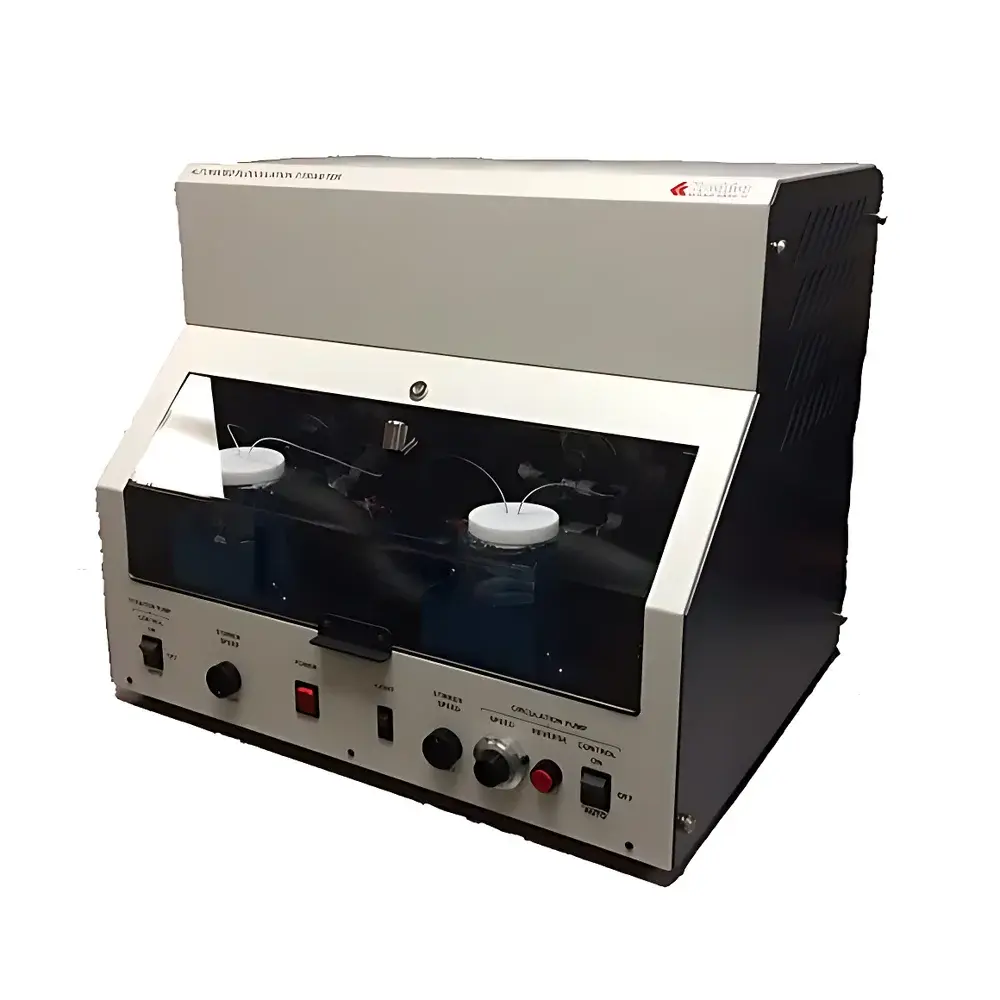
Koehler K47190 Automatic Flocculation Titration Analyzer
| Brand | Koehler |
|---|---|
| Origin | USA |
| Manufacturer Status | Authorized Distributor |
| Origin Category | Imported |
| Model | K47190 |
| Pricing | Upon Request |
| Temperature Range | 20–100 °C |
| Dimensions | 30.5 × 61.0 × 91.4 cm |
| Weight | 18.1 kg |
| Power Supply | 220–240 V, 50/60 Hz, Single-Phase |
Overview
The Koehler K47190 Automatic Flocculation Titration (AFT) Analyzer is a precision-engineered, computer-controlled instrument designed for the quantitative assessment of colloidal stability and compatibility in heavy hydrocarbon systems. It operates on the fundamental principle of controlled solvent-induced asphaltene flocculation—where asphaltene-rich fractions in crude oils, residues, or bituminous materials are solubilized in aromatic solvents (e.g., toluene), then titrated with aliphatic antisolvents (e.g., iso-octane or n-heptane) under precisely regulated thermal conditions. The onset of visible flocculation—detected optically via turbidity or light-scattering thresholds—is recorded as the critical flocculation point. This endpoint serves as the empirical basis for calculating standardized compatibility indices, including the Heithaus parameter (Hi), the n-Heptane Insolubles (nHI), and the Colloidal Instability Index (CII). These parameters are directly traceable to ASTM D6703 (Standard Test Method for Determination of Asphaltene Precipitation Tendency of Crude Oils), ASTM D7060 (Standard Test Method for Determination of Asphaltene Content of Crude Oil by n-Heptane Precipitation), ASTM D7112 (Standard Test Method for Determination of Asphaltene Stability Using the Flocculation Titration Method), and ASTM D7157 (Standard Test Method for Determination of Compatibility of Blended Crudes). The K47190 eliminates manual endpoint detection, operator bias, and thermal drift—ensuring metrological consistency required for refinery process optimization, feedstock blending decisions, and fouling risk mitigation.
Key Features
- Fully automated titration sequence with programmable temperature ramping (20–100 °C) and real-time optical endpoint detection using high-sensitivity photometric sensors.
- Integrated peristaltic dosing system calibrated for precise delivery of antisolvent at sub-milliliter resolution, minimizing reagent waste and improving repeatability.
- Dedicated AFT software suite enabling method storage, multi-step protocol definition, and automatic calculation of Heithaus Hi, CII, and WRI coking index equivalents per ASTM D7157 Annex A1.
- Robust stainless-steel fluid path architecture resistant to aggressive solvents (toluene, n-heptane, iso-octane) and compatible with high-boiling residue samples after appropriate dilution.
- Onboard data logging with timestamped raw turbidity curves, titrant volume vs. optical density profiles, and annotated flocculation onset markers—all exportable in CSV and PDF formats.
- Compliance-ready design supporting audit trails, user access levels, and electronic signature functionality aligned with GLP and internal QA/QC documentation requirements.
Sample Compatibility & Compliance
The K47190 accommodates a broad spectrum of petroleum-derived matrices—including crude oils, vacuum residues, deasphalted oils, oxidized or aged bitumen, cracked feedstocks, and asphalt blends—provided they are first dissolved in toluene at concentrations ranging from 0.5 to 5.0 wt%. Sample preparation follows ASTM D6703 Section 7 protocols, with optional filtration through 0.45 µm PTFE membranes to remove particulates prior to analysis. All reported outputs adhere strictly to the calculation algorithms defined in ASTM D7112 and D7157. Instrument validation includes daily system suitability checks using reference oil blends with certified flocculation thresholds. The analyzer meets electrical safety requirements per UL 61010-1 and electromagnetic compatibility standards per IEC 61326-1. Its operational framework supports integration into laboratory information management systems (LIMS) and satisfies data integrity expectations under FDA 21 CFR Part 11 when configured with appropriate electronic record controls.
Software & Data Management
The Koehler AFT Control Software (v4.2+) provides a Windows-based interface for method development, instrument calibration, and result interpretation. Each assay generates a complete digital dossier containing raw sensor output, derivative curve analysis, flocculation threshold interpolation (first inflection point of d(OD)/dV), and final compatibility metrics. All data files include embedded metadata: operator ID, sample ID, date/time stamp, ambient lab temperature, and instrument firmware version. Audit trail functionality logs every user action—including method edits, calibration events, and report exports—with immutable timestamps. Data export options include CSV (for statistical analysis in JMP or Minitab), XML (for LIMS ingestion), and secure PDF reports bearing digital watermarks and electronic signatures. Optional IQ/OQ documentation packages are available to support installation qualification and operational qualification under ISO/IEC 17025-accredited laboratories.
Applications
- Refinery crude assay and blend compatibility screening to prevent asphaltene precipitation during distillation, desalting, or storage.
- Quantitative prediction of coke formation tendency in delayed cokers and FCC feedstocks via WRI coking index derivation.
- Quality control of bitumen modifiers and polymer-modified asphalts where colloidal stability affects long-term pavement performance.
- Research into solvent-assisted enhanced oil recovery (EOR) mechanisms involving asphaltene destabilization thresholds.
- Supporting API gravity and SARA (Saturates, Aromatics, Resins, Asphaltenes) fraction correlation studies requiring reproducible flocculation endpoints.
- Process troubleshooting in hydrotreating units where unexpected fouling correlates with shifts in feedstock compatibility indices.
FAQ
What ASTM standards does the K47190 fully support?
The instrument is validated for ASTM D6703, D7060, D7112, and D7157—including all procedural steps from sample dissolution to endpoint determination and Heithaus parameter calculation.
Can the K47190 analyze undiluted heavy residues?
No—samples must be dissolved in toluene per ASTM D6703 Section 7; typical concentrations range from 0.5 to 5.0 wt% to ensure optical clarity and reproducible titration kinetics.
Is temperature control independent for sample and titrant reservoirs?
Yes—the K47190 features dual-zone Peltier temperature regulation: one for the sample cell (±0.1 °C accuracy) and another for the antisolvent reservoir to prevent vapor pressure fluctuations during delivery.
Does the system require external PC integration for operation?
No—the analyzer includes an embedded industrial-grade controller with touchscreen interface; however, full software functionality (reporting, method libraries, LIMS export) requires connection to a Windows PC running Koehler AFT Control Software.
How is calibration verified between analyses?
System suitability is confirmed before each batch using a NIST-traceable reference oil blend; the software flags deviations exceeding ±0.05 mL titrant volume from historical mean as out-of-trend and prompts recalibration.





