
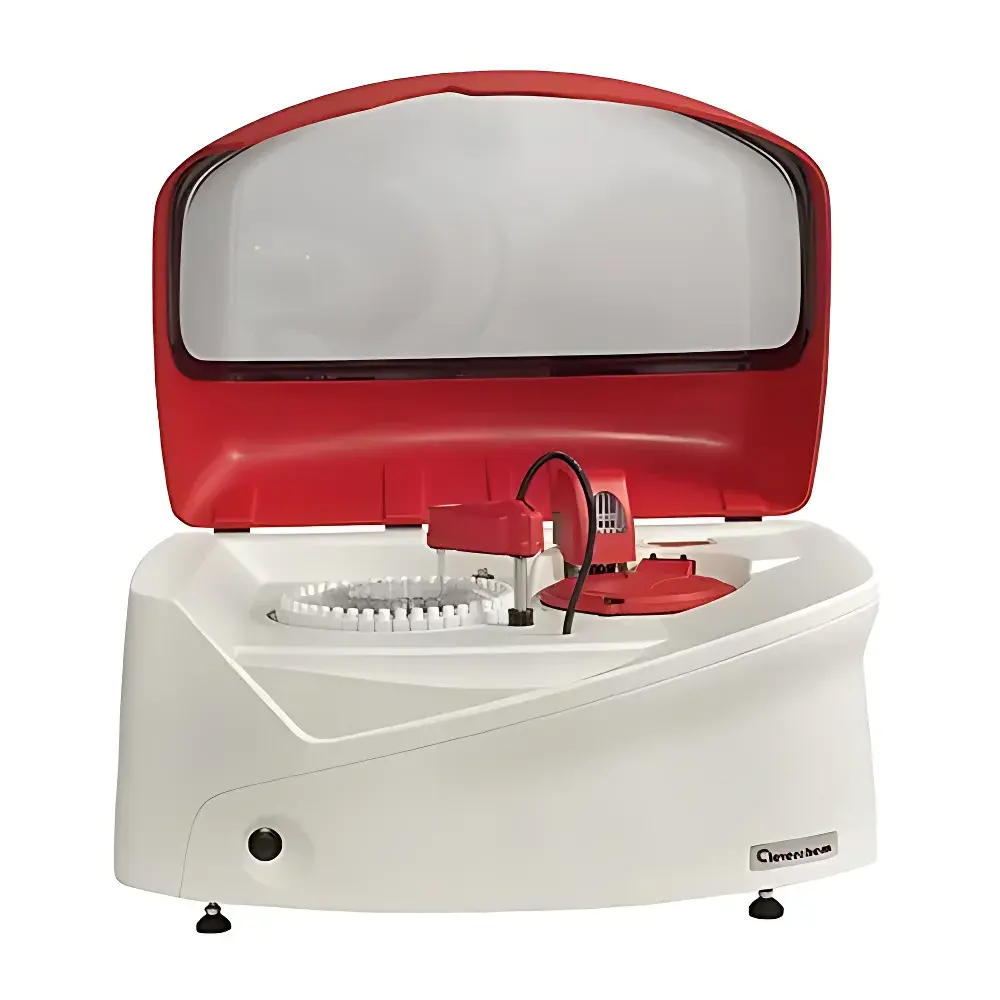
DeChem-Tech CleverChem 300 Fully Automated Wet-Chemistry Water Quality Analyzer for Petrochemical Applications
| Brand | DeChem-Tech |
|---|---|
| Origin | Germany |
| Model | CleverChem 300 |
| Instrument Type | Laboratory-Based Wet-Chemistry Analyzer |
| Detection Capability | Multi-Parameter |
| Analysis Speed | Up to 300 samples/hour |
| Sample Volume Range | 1–900 µL (1 µL increment) |
| Reagent Volume Range | 1–450 µL (1 µL increment) |
| Sample Positions | 49 per removable tray |
| Reagent Positions | 31 |
| Cuvette Capacity | 64-position rotating cuvette carousel |
| Reaction Temperature Control | Ambient to 49.6 °C (standard assay temp: 38.0 ± 0.1 °C) |
| Optical System | Dual-beam photometry with 24-bit digital detector |
| Wavelength Range | 340–880 nm |
| Filter Wheel | 9 measurement + 1 reference filter positions |
| Absorbance Linearity | 0.0001–3.5000 Abs |
| Absorbance Resolution | 0.0001 Abs |
| Cuvette Cleaning | 7-step automated protocol |
| Auto-Dilution | Up to 100× |
| Low-Volume Alerts | Sample & reagent level monitoring enabled |
| Compliance | Methods aligned with ISO, US EPA, and GB standards |
Overview
The DeChem-Tech CleverChem 300 is a fully automated discrete wet-chemistry analyzer engineered for high-throughput, trace-level determination of inorganic and low-molecular-weight organic analytes in complex petrochemical and industrial water matrices. It implements segmented-flow photometric analysis—precisely replicating manual colorimetric protocols under computer-controlled fluid handling—where target analytes react with specific reagents to form stable chromophores. The resulting absorbance intensity, measured at user-selected wavelengths between 340 nm and 880 nm, is quantitatively correlated to concentration via pre-established calibration curves. Unlike continuous-flow systems, the CleverChem 300 employs discrete cuvette-based reaction vessels, enabling independent thermal control, precise timing of reaction kinetics, and elimination of cross-contamination between samples. Its architecture supports method validation per ISO 8466-1, US EPA Methods 353.2, 365.2, 365.4, and Chinese national standards (e.g., HJ 636–2012 for TN, HJ 637–2012 for TP), making it suitable for regulatory-compliant environmental monitoring laboratories operating under GLP or ISO/IEC 17025 frameworks.
Key Features
- Fully automated discrete analysis workflow: sample aspiration, reagent addition, mixing, timed incubation, optical measurement, and multi-stage cuvette cleaning—all executed without manual intervention.
- High-precision microfluidics: 1 µL resolution for both sample and reagent dispensing ensures exceptional repeatability and minimizes reagent consumption (typically 1/20–1/30 of conventional manual methods).
- Dual-beam photometric detection with 24-bit digital resolution and 0.0001 Abs sensitivity, supporting linear dynamic range from 0.0001 to 3.5000 Abs across nine programmable wavelength channels plus one dedicated reference channel.
- Thermally stabilized reaction environment: Peltier-controlled cuvette heating module maintains temperature within ±0.1 °C at standard assay setpoint (38 °C), critical for kinetic consistency in ammonia, nitrate, and phosphate determinations.
- Intelligent error handling: real-time monitoring of sample/reagent volume levels, waste container fill status, wash solution availability, and mechanical fault diagnostics—including auto-pause and alert generation via software interface.
- Scalable throughput: up to 300 determinations per hour with parallel processing capability across multiple parameters per sample, enabled by configurable method sequencing and automatic filter wheel positioning.
Sample Compatibility & Compliance
The CleverChem 300 is validated for direct analysis of raw and treated industrial waters—including boiler feedwater, cooling tower blowdown, refinery process water, municipal wastewater effluents, and landfill leachates—without requiring offline pretreatment in most cases. Matrix tolerance is enhanced through on-board dilution (up to 100×) and programmable reaction delay intervals to accommodate interfering species (e.g., turbidity, high chloride, or suspended solids). Method protocols are traceable to internationally recognized references: total nitrogen (TN) by alkaline persulfate digestion and UV spectrophotometry (ISO 11905-1); orthophosphate by ascorbic acid/molybdate reduction (ISO 6878); ammonia by salicylate-hypochlorite reaction (ISO 7150-1); and hexavalent chromium by diphenylcarbazide complexation (ISO 11334). All assays comply with data integrity requirements outlined in FDA 21 CFR Part 11 when operated with audit-trail-enabled software configuration.
Software & Data Management
The CleverChem Control Software provides a Windows-native interface (compatible with Windows 7/10/11, 64-bit) supporting multilingual operation (English and Chinese localized menus). It enables full method development—including step-by-step protocol scripting, temperature ramp profiles, kinetic curve acquisition, and multi-point calibration curve fitting with polynomial or linear regression options. Each analytical run generates timestamped, user-attributed raw absorbance data, processed concentration values, QC flagging (e.g., out-of-range blanks, drift alerts), and electronic signatures compliant with ALCOA+ principles. Export formats include CSV, Excel (.xlsx), and XML for seamless integration into LIMS platforms via ODBC or HL7 interfaces. Audit trails record all parameter modifications, calibration events, and user logins, satisfying GLP/GMP documentation requirements.
Applications
The CleverChem 300 delivers quantitative results for over 20 priority water quality parameters relevant to petrochemical operations and environmental compliance: total nitrogen (TN), total phosphorus (TP), ammonium (NH₄⁺), nitrate (NO₃⁻), nitrite (NO₂⁻), orthophosphate (PO₄³⁻), silicate (SiO₂), sulfate (SO₄²⁻), sulfide (S²⁻), chloride (Cl⁻), hexavalent chromium (Cr⁶⁺), total phenols, iron (Fe), zinc (Zn), potassium (K⁺), and fluoride (F⁻). Its robustness extends to challenging matrices such as high-salinity produced water, biologically active cooling circuits, and chemically dosed boiler systems—where interference resistance, thermal stability, and reagent economy are essential for long-term operational reliability.
FAQ
Does the CleverChem 300 support method validation according to ISO/IEC 17025?
Yes—the instrument’s documented uncertainty budgets, calibration traceability to NIST-certified standards, and built-in QC routines (blanks, duplicates, spikes, CRMs) fulfill clause 7.7 requirements for method validation and verification.
Can third-party or domestic reagents be used without compromising performance?
Absolutely—reagent compatibility has been verified across multiple supplier portfolios; no proprietary chemistry locks are enforced, enabling full cost control and supply chain flexibility.
Is remote monitoring and troubleshooting supported?
The system supports secure remote desktop access and diagnostic log export, allowing technical support teams to assess instrument status, review error codes, and verify method execution logs without on-site presence.
How is carryover minimized during high-concentration sample analysis?
The 7-step cuvette cleaning sequence—including acid rinse, deionized water flush, ultrasonic agitation, and air-drying—reduces carryover to <0.05% for Cr⁶⁺ and NH₄⁺ across concentration gradients spanning four orders of magnitude.
What maintenance intervals are recommended for routine operation?
Daily: waste container emptying and external wipe-down; Weekly: tubing inspection and cuvette carousel lubrication; Quarterly: photometer lamp output verification and pipetting accuracy check using gravimetric calibration protocol.
Related Products







