
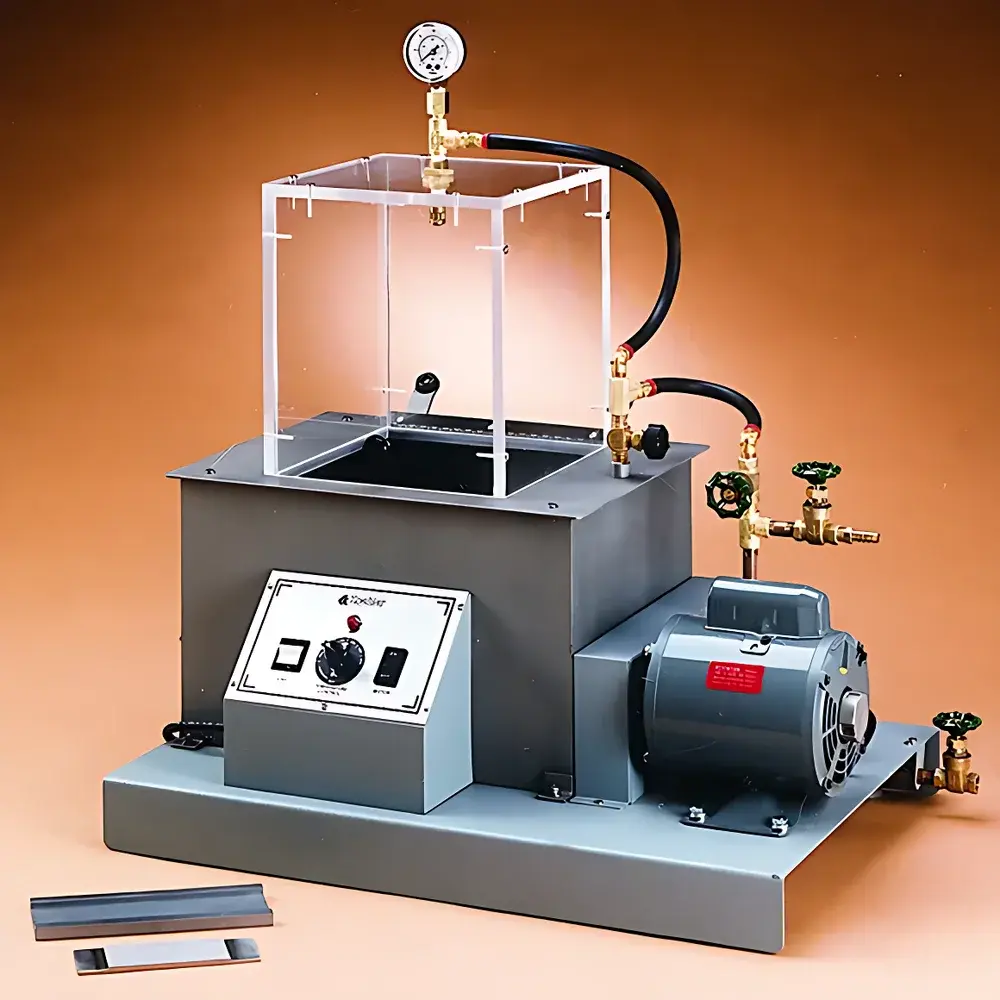
Koehler K18295 Water Spray Resistance Tester for Greases
| Brand | Koehler |
|---|---|
| Origin | USA |
| Model | K18295 |
| Compliance | ASTM D4049, SH/T 0643 |
| Drive Motor | 1/3 HP, 1725 rpm |
| Temperature Accuracy | ±0.5 °C |
| Pressure Range | 0–60 psi (0–414 kPa) |
| Water Reservoir Capacity | 8 L |
| Spray Duration | 5 min at 40 psi (276 kPa) |
| Dimensions | 74 × 46 × 85 cm |
| Weight | 49.9 kg |
| Power Supply | 220–240 V, 50 Hz, Single Phase, 6.8 A |
| Independent Temperature Monitoring | Reservoir & Spray System |
| Spray Chamber | Recessed Lid Design to Prevent Leakage |
Overview
The Koehler K18295 Water Spray Resistance Tester is a precision-engineered laboratory instrument designed to quantitatively evaluate the water resistance of lubricating greases under controlled hydrodynamic stress. It operates on the principle of standardized impingement testing, where a defined high-pressure water spray is directed perpendicularly onto a grease-coated stainless-steel substrate maintained at a specified temperature. The test directly measures the mass loss of grease after a fixed 5-minute exposure, expressed as weight percent loss — a critical parameter correlating with grease adhesion strength, film integrity, and real-world performance in wet or high-humidity operating environments. This method is grounded in fundamental tribological and interfacial science: the ability of a grease to resist displacement by turbulent water flow reflects its structural stability, base oil viscosity index, thickener network cohesion, and metal-surface affinity. As such, the K18295 serves not only as a compliance tool but also as a functional benchmark for grease formulation development and quality assurance in OEM and refinery laboratories.
Key Features
- Fully compliant with ASTM D4049 and SH/T 0643 test protocols — enabling direct comparability across global lubricant specifications and regulatory submissions.
- Integrated dual-zone temperature control system: independent monitoring and stabilization of both the 8-liter thermostatic water reservoir and the pressurized spray delivery path, ensuring thermal consistency throughout the 5-minute test cycle.
- High-fidelity pressure regulation architecture: includes a 1/3 HP positive-displacement pump, calibrated 0–60 psi analog pressure gauge, precision bypass valve, drain valve, and hardened stainless-steel high-pressure fluid circuitry — delivering stable 40 psi (276 kPa) spray pressure with minimal fluctuation.
- Ergonomically engineered spray chamber with recessed lid design to contain overspray and prevent leakage, minimizing operator exposure and maintaining laboratory environmental integrity.
- Robust mechanical construction: heavy-gauge steel frame, corrosion-resistant internal components, and vibration-damped mounting — optimized for long-term repeatability in high-throughput QC environments.
Sample Compatibility & Compliance
The K18295 accommodates standard ASTM-compliant stainless-steel test panels (typically 100 mm × 150 mm × 1.6 mm), coated uniformly with 0.5 g ± 0.05 g of grease per test. It supports all NLGI-grade greases, including lithium, calcium, polyurea, and complex-soap formulations, as well as specialty greases containing solid lubricants (e.g., MoS₂, graphite) or synthetic base oils. Test results are traceable to NIST-traceable calibration standards for pressure and temperature. The instrument’s design and operational protocol align with GLP (Good Laboratory Practice) requirements for data integrity, and its documented methodology supports audit readiness for ISO/IEC 17025-accredited laboratories. While not a regulated medical device, its output is routinely referenced in API RP 541, DIN 51825, and JIS K 2220 specifications for industrial grease qualification.
Software & Data Management
The K18295 is a manually operated, hardware-integrated benchtop system without embedded digital controllers or proprietary software. All operational parameters — temperature setpoints, pressure readings, timing intervals, and post-test gravimetric measurements — are recorded externally using laboratory-standard practices. Users maintain full control over documentation workflows, enabling seamless integration into validated LIMS (Laboratory Information Management Systems) or ELN (Electronic Lab Notebook) platforms. For laboratories requiring 21 CFR Part 11 compliance, the instrument supports audit-trail-enabled data capture via external calibrated balances (e.g., METTLER TOLEDO XSR series) and time-stamped digital logbooks. Calibration certificates for the pressure gauge and temperature sensors are provided upon installation and recommended annually per ISO/IEC 17025 Clause 6.5.
Applications
- Quality control of finished grease batches prior to release, verifying conformance to OEM specifications for automotive wheel bearings, chassis lubrication, and marine applications.
- Comparative evaluation of thickener systems during R&D — e.g., assessing how aluminum complex vs. lithium-12-hydroxystearate thickeners influence water washout resistance.
- Stability assessment of greases exposed to thermal aging or oxidative stress, where water spray loss trends correlate with degradation of soap fiber morphology.
- Supporting failure analysis investigations involving premature bearing corrosion or lubricant depletion in humid service conditions.
- Third-party certification testing for ISO 6743-9 (lubricants for rolling bearings) and DIN 51502 classification reporting.
FAQ
What is the primary output metric generated by this instrument?
The instrument yields the percent weight loss of grease after 5 minutes of standardized water spray exposure — reported as “Water Spray Resistance (% Loss)” per ASTM D4049 Section 10.
Does the K18295 include automated data logging or PC connectivity?
No — it is a stand-alone electromechanical tester. All measurements (mass before/after, temperature, pressure, time) must be manually recorded; however, its analog interface ensures compatibility with external digital acquisition systems.
Can the test temperature be adjusted beyond the standard 25 °C or 75 °C specified in ASTM D4049?
Yes — the thermostatic reservoir and spray path support user-defined setpoints between 20 °C and 80 °C, provided the selected temperature is documented and justified per internal SOP or customer specification.
Is routine calibration required for pressure and temperature sensors?
Yes — annual calibration against NIST-traceable references is recommended; calibration intervals may be shortened based on usage frequency and internal QA policies.
What maintenance is required to ensure long-term accuracy?
Monthly inspection of O-rings and spray nozzles, quarterly cleaning of the water reservoir and filtration of recirculated water, and biannual verification of pump output and pressure regulator response.





