
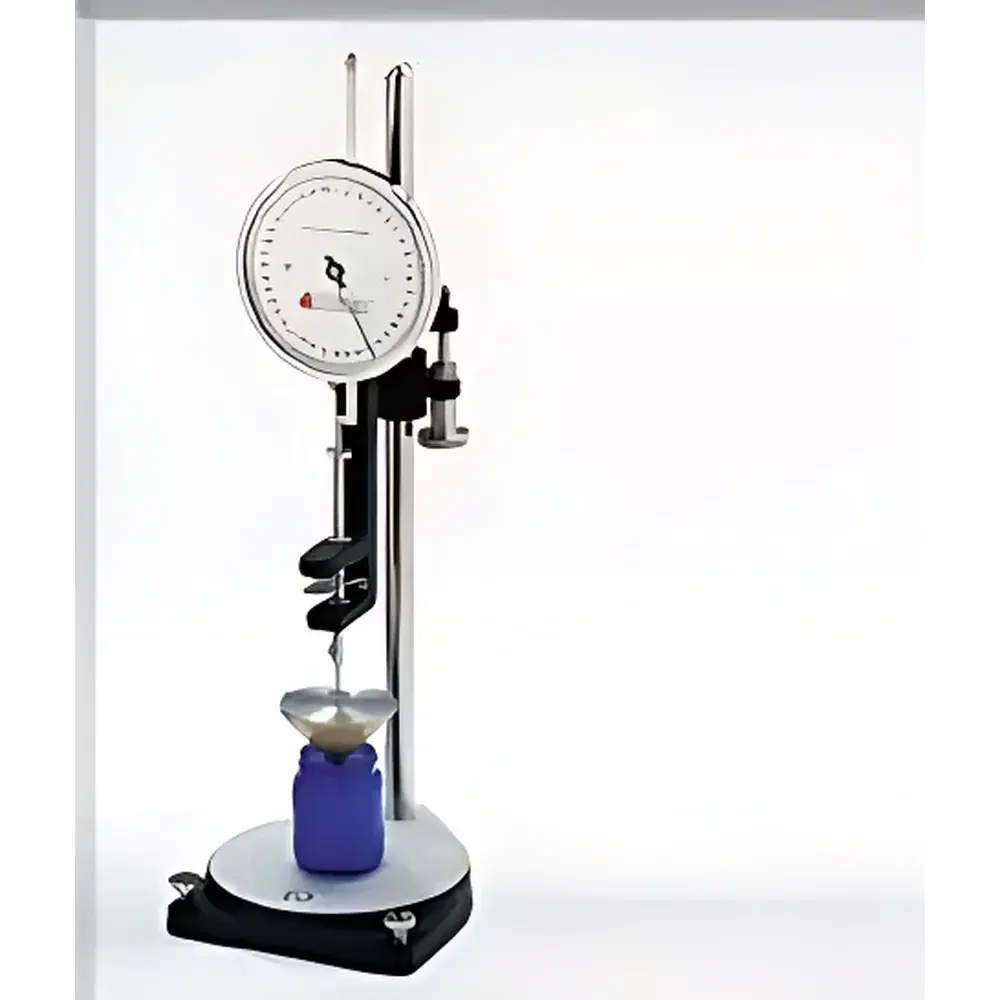
Koehler K19500 Penetration / Cone Penetration Tester
| Brand | Koehler |
|---|---|
| Origin | USA |
| Model | K19500 |
| Penetration Range | 0–62.0 mm (0–620 penetration units) |
| Resolution | 0.1 mm (1 unit = 0.1 mm) |
| Dimensions | 15 × 15 × 46 cm |
| Net Weight | 5.4 kg |
| Shipping Weight | 6.8 kg |
| Compliance | ASTM D5, D217, D937, D1321, D1403, D2884, D4950 |
Overview
The Koehler K19500 Penetration / Cone Penetration Tester is a precision-mechanical instrument engineered for standardized consistency and hardness evaluation of semi-solid and viscous materials. It operates on the fundamental principle of gravitational penetration: a standardized needle or cone is allowed to descend under its own weight (or with added mass per test method) onto a conditioned sample surface for a defined duration—typically 5 seconds—after which the depth of penetration is measured in tenths of a millimeter (0.1 mm increments), reported as “penetration units.” This gravimetric displacement measurement provides a direct, repeatable index of material resistance to deformation under controlled thermal and mechanical conditions. Designed for compliance with over 25 international standards—including ASTM, ISO, IP, DIN, and military specifications—the K19500 serves as a primary reference instrument in petroleum laboratories, QC/QA facilities, and R&D centers evaluating bitumen, lubricating greases, waxes, cosmetics, food gels, clays, and pharmaceutical ointments.
Key Features
- Robust cast-iron base frame with integrated leveling bubble and adjustable leveling screws ensures precise vertical alignment and coaxial needle descent—critical for reproducible results across ASTM D217 and ISO 2137 protocols.
- Manually operated release mechanism with zero-backlash engagement guarantees consistent drop initiation and eliminates operator-induced timing variance.
- High-contrast analog scale graduated from 0 to 620 units (0–62.0 mm), calibrated to NIST-traceable reference standards; scale is mounted on a rigid aluminum column to minimize parallax and thermal drift.
- Interchangeable penetration probes: ASTM D217-compliant cone (30° apex, 0.375″ diameter base) for greases; ASTM D5/D1321-standard needle (2.5 mm diameter, 100 g total mass) for asphalt and petroleum products; optional cones available for soil and food applications (e.g., AOCS Cc 16-60).
- Sample stage accommodates standard 55 mm or 70 mm diameter metal or glass containers; depth-of-penetration stop prevents overtravel and protects probe integrity.
- No electrical components or software dependency—ideal for field deployment, hazardous environments, or GLP-regulated labs requiring audit-trail simplicity.
Sample Compatibility & Compliance
The K19500 supports testing of heterogeneous semi-solids across multiple industries without modification. In petroleum applications, it quantifies consistency of NLGI-grade greases (ASTM D217), penetration grade of asphalt binders (ASTM D5), and congealing point of waxes (ASTM D937). In food science, it evaluates firmness of margarines and shortenings (AOCS Cc 16-60, AACC 58-14); in cosmetics, it assesses viscosity stability of creams and ointments (ISO 2137, NFT 60-119). All test procedures adhere strictly to the referenced standards’ requirements for specimen conditioning (temperature equilibration time, container geometry, probe geometry, load mass, dwell time), ensuring data compatibility with regulatory submissions and inter-laboratory round-robin studies. The instrument’s mechanical architecture inherently satisfies FDA 21 CFR Part 11 “non-electronic record” criteria and requires no validation documentation beyond initial calibration verification.
Software & Data Management
As a fully manual, analog instrument, the K19500 generates no electronic data stream and does not incorporate onboard memory, USB ports, or software interfaces. Results are recorded manually into laboratory notebooks or LIMS-compatible spreadsheets using standardized test forms aligned with ASTM E177 and ISO/IEC 17025 documentation practices. Calibration certificates (traceable to NIST SRM 2460/2461) and annual verification logs constitute the full metrological record. For labs implementing digital workflows, Koehler recommends pairing the K19500 with third-party digital calipers (e.g., Mitutoyo Absolute Series) and validated Excel-based templates compliant with 21 CFR Part 11 signature and audit-trail requirements.
Applications
- Petroleum: Bitumen penetration grading (ASTM D5), grease consistency classification (ASTM D217), wax congealing point (ASTM D937), and sealant flow resistance (ASTM D1403).
- Food & Agriculture: Margarine spreadability (AOCS Cc 16-60), chocolate tempering assessment (AACC 58-14), and gelatin bloom strength correlation.
- Pharmaceuticals & Cosmetics: Ointment base characterization (USP ), cream firmness profiling (NFT 60-123), and emulsion stability screening.
- Geotechnical & Materials Science: Clay consistency indexing (FTM 791-311), polymer gel modulus estimation (ISO 2137), and adhesive tack evaluation (DIN 51804).
FAQ
Does the K19500 require electrical power or compressed air?
No. It is a purely gravity-driven mechanical tester with no motors, solenoids, or pneumatic components.
Can the K19500 be used for both needle and cone penetration tests?
Yes. It accepts interchangeable ASTM-compliant needles (for asphalt, waxes) and cones (for greases, clays) via standardized mounting threads.
Is calibration traceable to national standards?
Yes. Koehler provides NIST-traceable calibration certificates with each unit, referencing SRM 2460 (Standard Penetration Reference Material) and SRM 2461 (Cone Penetration Standard).
What maintenance is required?
Annual verification of scale linearity and probe geometry; periodic cleaning of guide rods and lubrication of release mechanism with silicone-free grease per Koehler Technical Bulletin TB-K19500-01.
Is the K19500 suitable for ISO/IEC 17025-accredited laboratories?
Yes. Its mechanical design, documented calibration hierarchy, and adherence to standardized test procedures satisfy Clause 6.4 (Equipment) and Clause 7.7 (Ensuring Validity of Results) of ISO/IEC 17025:2017.





