
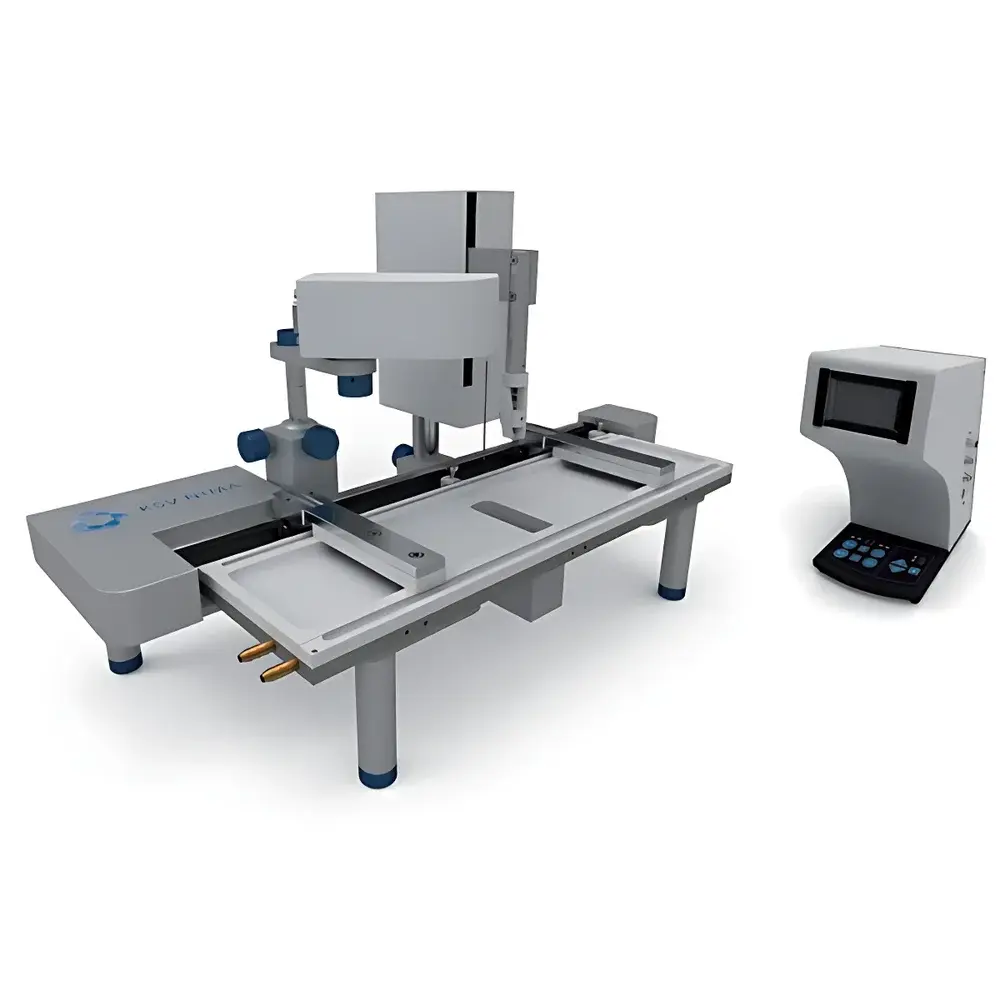
KSV NIMA KN2006 Dual-Trough Alternating Langmuir-Blodgett Trough Analyzer
| Brand | KSV NIMA |
|---|---|
| Origin | Finland |
| Manufacturer Type | Original Equipment Manufacturer (OEM) |
| Category | Imported Instrument |
| Model | KN2006 Dual-Trough Alternating |
| Voltage | 100–240 VAC, 50–60 Hz |
| Trough Surface Area | 587 cm² × 2 |
| Internal Trough Dimensions | 782 × 75 × 5 mm (L × W × H) × 2 |
| Barrier Speed | 0.1–200 mm/min |
| Barrier Speed Accuracy | ±0.1 mm/min |
| Surface Pressure Range | 0–300 mN/m (Pt plate), 0–1000 mN/m (Pt rod) |
| Balance Max Load | 1 g |
| Balance Positioning | XYZ adjustable (360° rotation, 110 mm X, 45 mm Y/Z) |
| Sensor Resolution | 0.1 μN/m |
| Wilhelmy Plate Standard | W19.62 × H10 mm, compliant with EN 14370:2004 |
| Subphase Volume per Trough | 1400 mL |
| Dipper Well Geometry | Semi-circular, radius 75 mm, depth 74 mm |
| Max Substrate Size | 3 × 30 × 50 mm |
| Deposition Speed | 0.1–85 mm/min |
| Trough Material | Solid-sintered, pore-free PTFE with integrated water-jacket interface |
| Frame Height Adjustment | 33 mm |
| Modular Interface Ports | pH probe, syringe injection, stirring, BAM/PM-IRRAS/ISR coupling |
Overview
The KSV NIMA KN2006 Dual-Trough Alternating Langmuir-Blodgett Trough Analyzer is an engineered platform for the precise formation, thermodynamic characterization, and controlled vertical deposition of monolayers at air–water or liquid–liquid interfaces. Based on the classical Langmuir–Blodgett (LB) technique, it enables quantitative surface pressure–area (π–A) isotherm acquisition and reproducible layer-by-layer assembly of amphiphilic molecules, nanoparticles, nanowires, graphene derivatives, and biomimetic lipids. The system operates on the principle of interfacial confinement: insoluble surfactants or functional nanomaterials spread on an aqueous subphase form a two-dimensional gas-like film that transitions through liquid-expanded (LE) and liquid-condensed (LC) phases into a solid-like monolayer upon lateral compression by hydrophobic barriers. Surface pressure—defined as the reduction in surface tension due to molecular packing—is measured in real time using Wilhelmy plate or rod tensiometry, conforming to ISO 6889 and EN 14370:2004 standards. The KN2006’s dual-trough architecture supports alternating deposition protocols, allowing sequential transfer of two distinct monolayers onto a single substrate—critical for constructing asymmetric heterostructures, biofunctional bilayers, or gradient multilayer architectures.
Key Features
- Modular dual-trough design with independent barrier control, enabling synchronized or asynchronous compression of two separate monolayers on shared or isolated subphases.
- High-fidelity surface pressure sensing: platinum Wilhelmy plates (standard W19.62 × H10 mm) deliver resolution down to 0.1 μN/m; optional Pt rods extend dynamic range to 1000 mN/m for highly cohesive films.
- PTFE monoblock trough construction—solid-sintered, pore-free, chemically inert, and fully autoclavable—eliminates adhesive joints and prevents subphase leakage or contamination.
- XYZ-adjustable microbalance with 360° rotational freedom and fine-positioning stages ensures optimal probe alignment and minimizes mechanical drift during long-duration isotherms.
- Integrated thermal management: aluminum baseplate with external recirculating chiller interface (not included) enables stable subphase temperature control from 5 °C to 60 °C (±0.1 °C).
- Dual-mode barrier actuation: symmetric compression (standard) or single-barrier operation for anisotropic film studies; barriers machined from hydrophilic Delrin® to enhance monolayer stability, with optional PTFE variants for hydrophobic systems.
- Quick-release trough mounting system with precision leveling feet—enables sub-second trough exchange and optical alignment for in situ microscopy or spectroscopy.
Sample Compatibility & Compliance
The KN2006 accommodates a broad spectrum of LB-active materials including phospholipids (DPPC, DSPC), fatty acids (stearic, palmitic), block copolymers, conjugated polymers, carbon nanotubes, exfoliated graphene oxide, quantum dots, and protein–lipid hybrids. Substrates up to 3 × 30 × 50 mm (thickness × width × length) are compatible with vertical dipping—glass, silicon wafers, ITO-coated slides, mica, and gold-coated quartz are routinely used. All wetted components comply with USP Class VI biocompatibility requirements. System architecture supports GLP/GMP-aligned workflows: audit-trail-capable software logging (optional), full traceability of calibration events, and hardware-level safety interlocks (mechanical limit switches, overtravel protection). Conforms to IEC 61010-1 for laboratory electrical safety and CE marking for EMC and low-voltage directives.
Software & Data Management
Control and analysis are performed via KSV NIMA’s proprietary TroughMaster™ v5.x software, a Windows-based application supporting real-time π–A isotherm acquisition, barrier speed ramping, multi-step deposition scripting, and automated cycle sequencing for alternating-layer protocols. Data export is native to ASCII, CSV, and Excel formats; metadata embedding includes timestamp, operator ID, ambient conditions, and instrument configuration. Software modules integrate with third-party analytical tools: PM-IRRAS polarization control, BAM frame synchronization, and ISR viscoelastic parameter extraction. Optional 21 CFR Part 11 compliance package provides electronic signatures, role-based access control, and immutable audit trails—validated for regulated pharmaceutical and biomedical R&D environments.
Applications
The KN2006 serves as a foundational tool in interfacial soft matter science. In biomembrane research, it models lipid raft formation, peptide insertion kinetics, and drug–membrane partitioning under physiologically relevant ionic strength and pH (via integrated subphase injection ports). For functional nanomaterials, it enables controlled stacking of conductive or photonic layers—e.g., graphene–porphyrin heterojunctions for organic photovoltaics or TiO₂–dye assemblies for dye-sensitized solar cells. In colloid and interface science, it quantifies surfactant critical micelle concentration (CMC), mixed monolayer phase behavior, and nanoparticle interfacial rheology (when coupled with KSV NIMA’s ISR module). Industrial applications span anti-reflective coatings, corrosion-inhibiting films, biosensor transducer layers, and stimuli-responsive thin-film actuators.
FAQ
What distinguishes the KN2006 from single-trough LB systems?
The dual-trough configuration enables true alternating deposition—two independent monolayers can be compressed and transferred in sequence without manual trough replacement, reducing experimental variability and enabling precise stoichiometric control in heteromultilayer architectures.
Can the system operate under controlled humidity or inert atmosphere?
Yes—enclosure compatibility kits (optional) allow integration with gloveboxes or environmental chambers; subphase degassing ports support O₂-free or CO₂-equilibrated conditions for oxidation-sensitive films.
Is calibration traceable to national standards?
Wilhelmy plate calibration is performed using certified reference weights (ISO/IEC 17025-accredited lab); surface pressure verification uses standard stearic acid isotherms with published transition points (e.g., LE–LC at ~12 mN/m, collapse at ~55 mN/m).
How is temperature uniformity maintained across both troughs?
Each trough features independent water-jacketed baseplates connected to a dual-channel recirculating chiller; thermal mapping confirms ≤0.3 °C spatial gradient across full 587 cm² surface area.
What maintenance is required for long-term sensor stability?
Platinum probes require weekly cleaning in piranha solution (H₂SO₄:H₂O₂ 3:1) followed by DI water rinse and nitrogen drying; PTFE troughs are cleaned with ethanol and UV-ozone treatment—no lubricants or adhesives are used in the mechanical assembly.



