
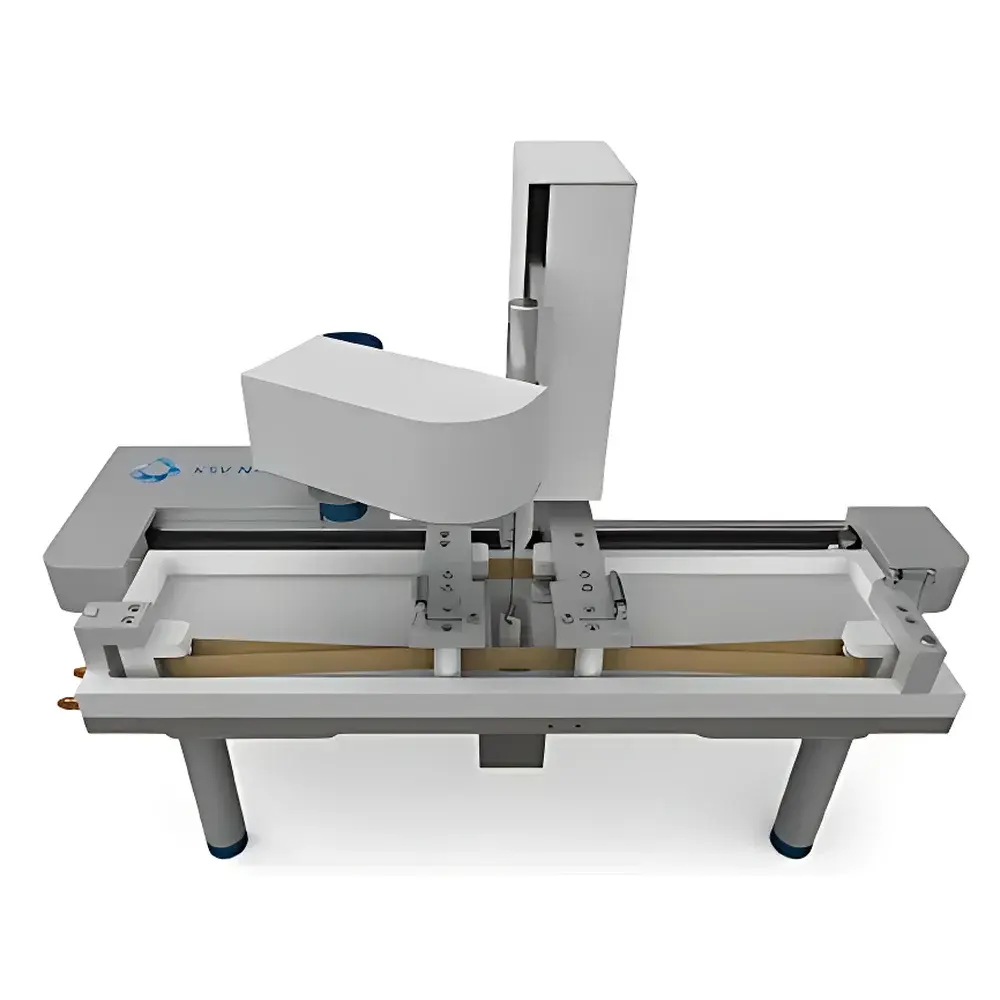
KSV NIMA Ribbon-Type Langmuir Trough Analyzer
| Brand | KSV NIMA |
|---|---|
| Origin | Finland |
| Manufacturer Type | Original Equipment Manufacturer (OEM) |
| Import Category | Imported Instrument |
| Model | Ribbon-Type Langmuir Trough |
| Measurement Range | 0–300 mN/m (Pt plate), 0–1000 mN/m (Pt rod) |
| Surface Area (Expanded) | 148.4 cm² |
| Surface Area (Compressed) | 40.5 cm² |
| Trough Dimensions (L×W×H) | 358 × 90 × 10 mm |
| Barrier Speed | 0.1–270 mm/min |
| Speed Accuracy | ±0.1 mm/min |
| Force Resolution | 0.1 μN/m |
| Balance Load Capacity | 1 g |
| Wilhelmy Plate | Pt, W19.62 × H10 mm (EN 14370:2004 compliant) |
| Subphase Volume | 322 mL |
| Power Supply | 100–240 VAC, 50–60 Hz |
Overview
The KSV NIMA Ribbon-Type Langmuir Trough Analyzer is a precision-engineered surface science instrument designed for the controlled formation, compression, and physicochemical characterization of monolayers at air–water or liquid–liquid interfaces. Unlike conventional barrier-driven Langmuir troughs, this system employs a continuous, vertically immersed ribbon mechanism to confine and uniformly compress amphiphilic films—enabling higher surface pressures, improved lateral homogeneity, and enhanced molecular packing density. The ribbon design eliminates edge effects and mechanical hysteresis associated with sliding barriers, resulting in superior reproducibility in surface pressure–area (π–A) isotherms. It operates on the fundamental principle of interfacial thermodynamics: insoluble surfactants, lipids, polymers, nanoparticles, or nanosheets spread as two-dimensional gases on the subphase surface; upon compression, they undergo phase transitions—from gaseous (G) to liquid-expanded (LE), liquid-condensed (LC), and ultimately solid-like (S) states—each identifiable by distinct slopes and inflection points in the π–A curve. This enables quantitative analysis of molecular area, collapse pressure, compressibility modulus, and phase coexistence behavior under controlled temperature and environmental conditions.
Key Features
- Ribbon-based compression architecture providing uniform, symmetric, and hysteresis-free monolayer confinement—eliminating shear-induced film disruption common in sliding-barrier systems.
- Modular, open-frame construction with XYZ-adjustable microbalance (360° rotational, 110 mm X, 45 mm Y/Z travel) and integrated safety limit switches for operator protection and experimental repeatability.
- Chemically inert, solid-sintered PTFE trough body with leak-proof, glue-free design; features dual overflow channels, quick-release mounting, and compatibility with interchangeable functional troughs (e.g., LB deposition wells, temperature-controlled variants).
- High-resolution Wilhelmy plate tensiometry (0.1 μN/m resolution) using EN 14370:2004-compliant platinum plates (standard W19.62 × H10 mm); optional probes include miniaturized Pt plates, liquid–liquid Pt plates, filter paper, and Pt rods (up to 1000 mN/m range).
- Integrated subphase temperature control via external recirculating bath interface (aluminum baseplate with thermal coupling ports); level calibration facilitated by adjustable leveling feet—removable for microscopy integration.
- Standardized mounting interfaces for in situ optical and electrochemical characterization: PM-IRRAS, BAM, ISR, SPOT, QCM-D, and SPR-compatible alignment without realignment.
Sample Compatibility & Compliance
The KSV NIMA Ribbon-Type Langmuir Trough supports a broad spectrum of interfacial materials—including phospholipids (DPPC, DSPC), fatty acids, block copolymers, graphene oxide dispersions, carbon nanotubes, quantum dots, peptide amphiphiles, and hybrid organic–inorganic nanoparticles. Its PTFE construction ensures chemical resistance across pH 2–12 subphases and compatibility with organic solvents (chloroform, chloroform/methanol mixtures) used in spreading. All mechanical and sensor components conform to CE marking requirements. Surface pressure measurements adhere to ISO 4311 (determination of surface tension by the Wilhelmy plate method) and ASTM D971 (standard test method for interfacial tension of oil against water). The system architecture supports GLP/GMP-aligned workflows through audit-trail-capable software logging (see Software section), and its modular design facilitates validation per FDA 21 CFR Part 11 when paired with compliant data acquisition modules.
Software & Data Management
The KSV NIMA Trough Control Software (v5.x) provides real-time isotherm acquisition, automated compression/expansion cycles, multi-step ramp protocols, and synchronized data export in ASCII/CSV formats. It supports time-resolved surface pressure monitoring during kinetic experiments (e.g., polymerization, enzyme reactions) and integrates seamlessly with third-party instruments via TTL triggers and analog I/O. Raw force and position data are timestamped with microsecond precision; all parameter changes (speed, target pressure, dwell time) are logged with user ID and system metadata. For regulated environments, optional 21 CFR Part 11 compliance packages include electronic signatures, role-based access control, and immutable audit trails—validated for use in pharmaceutical formulation development and biomaterial certification studies. Exported datasets are fully compatible with OriginLab, MATLAB, and Python-based analysis pipelines for compressibility modulus (Cs⁻¹ = −A(dπ/dA)), phase transition identification, and thermodynamic modeling.
Applications
- Biomembrane modeling: Quantitative assessment of lipid–protein interactions, antimicrobial peptide insertion, cholesterol-mediated domain formation, and drug–membrane partitioning kinetics.
- Functional nanomaterial assembly: Controlled organization of graphene derivatives, MXenes, and plasmonic nanoparticles into ordered 2D arrays for optoelectronic and sensing applications.
- Interfacial catalysis & biosensing: Immobilization of enzymes, antibodies, or DNA aptamers on monolayer templates; real-time monitoring of binding events via surface pressure shifts.
- Colloid & formulation science: Stability evaluation of Pickering emulsions, foam films, and surfactant mixtures; determination of critical aggregation concentrations (CAC) and interfacial rheology (when coupled with KSV NIMA ISR).
- Advanced thin-film fabrication: Preparation of Langmuir–Blodgett (LB) multilayers with sub-nanometer thickness control for organic transistors, photovoltaic active layers, and corrosion-resistant coatings.
FAQ
Can the ribbon-type trough be retrofitted onto existing KSV NIMA Langmuir or LB systems?
Yes—mechanical and electrical interfaces are standardized across KSV NIMA platforms; trough exchange requires only tool-free disassembly of the current trough and installation of the ribbon module, typically completed in under 15 minutes.
What subphase temperature range is achievable with external bath integration?
Using standard recirculating chillers/heaters (e.g., Julabo F25), the subphase temperature can be stabilized between 5 °C and 60 °C with ±0.1 °C stability over 24 hours.
Is the system compatible with aggressive solvents such as hexane or THF?
The PTFE trough body is chemically resistant to most organic solvents; however, prolonged exposure to fluorinated solvents (e.g., FC-72) or strong oxidizers (e.g., piranha solution) is not recommended and may compromise long-term seal integrity.
How is surface pressure calibration verified?
Calibration is performed using certified reference standards (e.g., pure water at 20 °C, π = 72.75 mN/m) and validated via repeated Wilhelmy plate immersion depth checks; drift is monitored daily using zero-force baseline verification.
Does the system support automated Langmuir–Blodgett transfer?
Yes—the ribbon-type Langmuir trough is fully compatible with KSV NIMA LB deposition modules (e.g., KN 1008), enabling vertical, horizontal, and Y-type transfer with programmable speed, dwell time, and pressure feedback control.



