
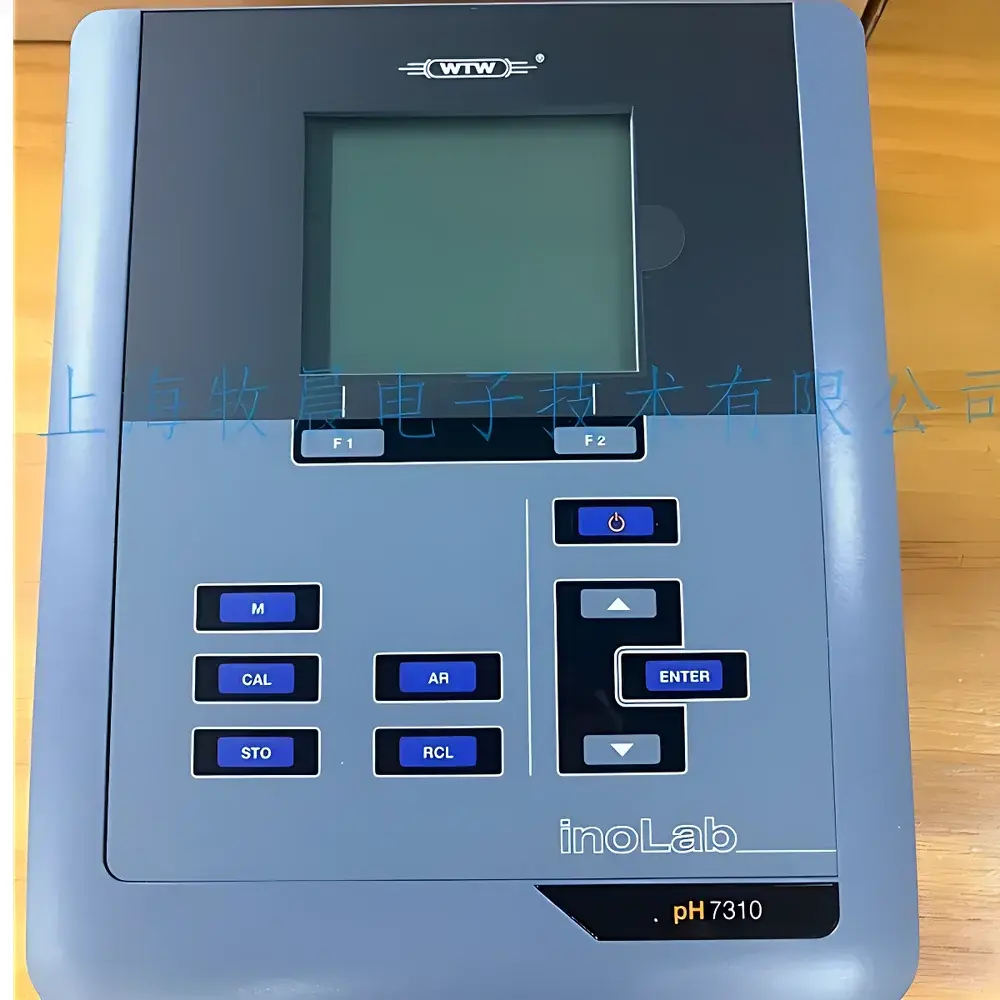
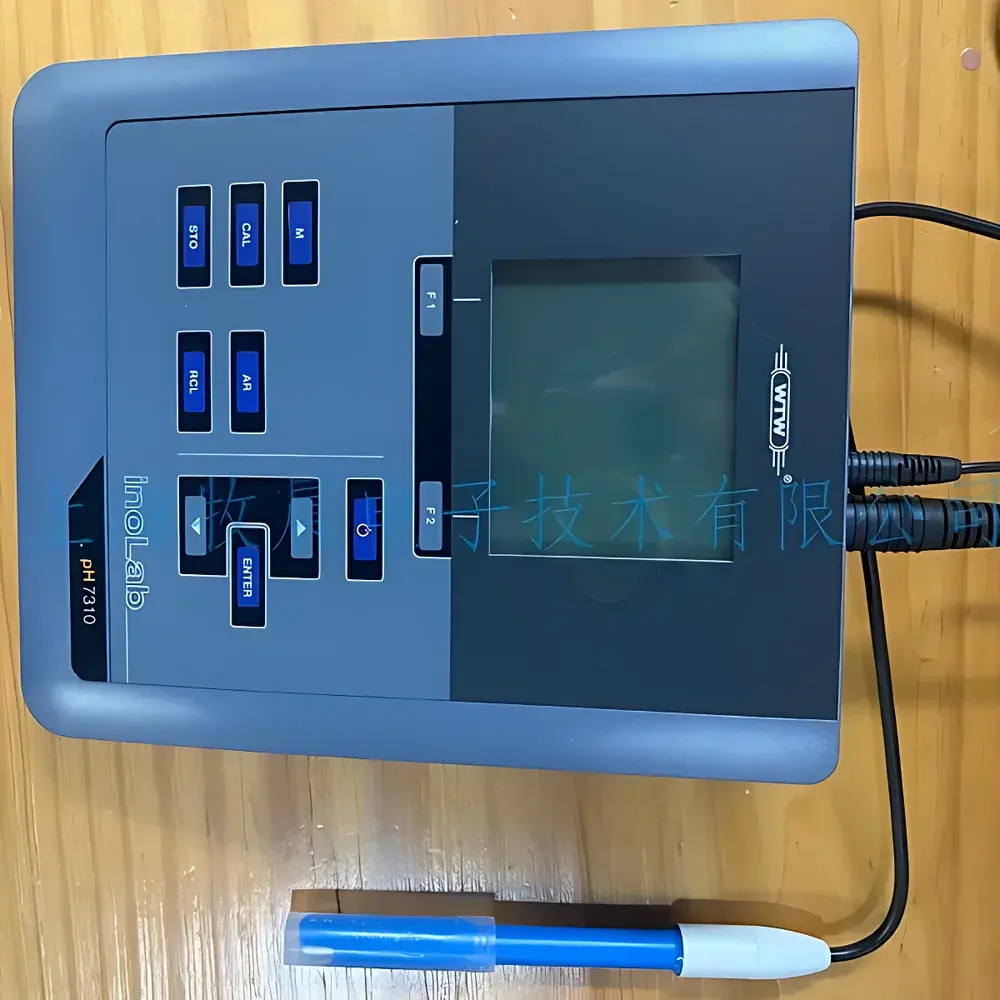
WTW inoLab® pH 7310 Benchtop pH/ORP Meter
| Brand | WTW |
|---|---|
| Origin | Germany |
| Model | pH 7310 |
| Instrument Type | Benchtop |
| Parameter Type | Single-Parameter (pH/ORP) |
| Measurement Range | −2.000 to +19.999 pH |
| Resolution | 0.001 pH (selectable down to 0.01 or 0.1) |
| Accuracy | ±0.005 pH (at 25 °C, with calibrated electrode) |
| ORP Range | −2500 to +2500 mV |
| ORP Resolution | 1 mV |
| ORP Accuracy | ±1 mV |
| Temperature Range | −5.0 to +105.0 °C |
| Temp. Resolution | 0.1 °C |
| Temp. Accuracy | ±0.1 °C |
| Calibration | Automatic 1–5-point pH calibration with slope and offset validation |
| Data Storage | 500 manual + 5000 automatic records |
| Interface | USB 2.0 (cable length up to 3 m) |
| Compliance | GLP-compliant documentation, AQA (Analytical Quality Assurance), ISO/IEC 17025-supportive data traceability |
| Power | 4×AA alkaline batteries (≈1000 h operation, no backlight) or universal 100–240 VAC / 9 VDC adapter |
| Enclosure Rating | IP43 |
| Operating Temperature | +5 to +55 °C |
| Storage Temperature | −25 to +65 °C |
| Dimensions (pH 7310) | 240 × 190 × 80 mm |
| Weight | 0.8 kg |
Overview
The WTW inoLab® pH 7310 is a precision benchtop pH and ORP meter engineered for routine and regulated laboratory environments where traceable, reproducible electrochemical measurements are essential. Based on potentiometric measurement principles—using high-impedance input circuitry (≥1013 Ω) and low-drift reference junctions—the instrument delivers stable, noise-resistant readings across the full pH range (−2.000 to +19.999) and extended redox potential range (−2500 to +2500 mV). Its design integrates core requirements of modern quality management systems: real-time electrode diagnostics, continuous measurement control (CMC), and automated calibration validation per IUPAC and DIN EN ISO 3696 guidelines. Unlike portable or entry-level meters, the pH 7310 embeds GLP/GMP-aligned data governance directly into its firmware architecture—ensuring every measurement carries immutable metadata (date/time stamp, operator ID, sensor serial number, calibration history, and environmental temperature).
Key Features
- GLP-Compliant Documentation Architecture: All measurements—including manual entries, auto-log sequences, and calibration events—are timestamped, user-ID tagged, and stored with full sensor identification (electrode serial number entry supported). Data export via USB adheres to CSV RFC 4180 format for seamless ingestion into LIMS or statistical analysis platforms.
- Continuous Measurement Control (CMC): Dynamically monitors electrode response slope and asymmetry potential during operation; issues visual alerts when measured values fall outside validated calibration bounds—reducing risk of out-of-spec reporting without manual intervention.
- Multi-Resolution pH Display & Adaptive Calibration: Supports selectable resolution (0.001 / 0.01 / 0.1 pH) matched to application needs. Automatic 1–5 point calibration includes slope calculation, zero-point offset verification, and residual error reporting per point—fully compliant with ASTM D1293 and USP .
- Integrated Data Logger: Configurable logging interval (1 s to 24 h); stores up to 5000 auto-recorded values with synchronized temperature compensation. Internal clock maintains accuracy within ±1 min/month (battery-backed).
- Robust Electrical Design: Input impedance >1013 Ω minimizes loading effects on high-resistance glass electrodes; shielded analog front-end suppresses EMI in shared lab environments. Dual power options (battery or AC adapter) ensure uninterrupted operation during validation protocols.
Sample Compatibility & Compliance
The inoLab® pH 7310 interfaces with all standard BNC-terminated pH and ORP electrodes—including double-junction, gel-filled, and refillable reference types—as well as temperature probes meeting DIN EN 60751 Class B specifications. It supports aqueous, low-ionic-strength, and mildly non-aqueous samples (e.g., ethanol/water mixtures ≤30% v/v) when paired with appropriate electrodes. The device meets electromagnetic compatibility (EMC) requirements per EN 61326-1:2013 and safety standards per EN 61010-1:2010. Its firmware implements audit-trail functionality aligned with FDA 21 CFR Part 11 (when used with validated PC software such as MultiLab Importer), supporting electronic signatures, change history, and read-only archive exports.
Software & Data Management
Data transfer occurs exclusively via standardized USB 2.0 interface (no proprietary drivers required); exported .CSV files include columns for timestamp (ISO 8601), measured value, unit, temperature, electrode ID, calibration status, and operator code. The optional MultiLab Importer software (Windows-compatible) enables batch import into Excel, automatic generation of calibration reports, and trend visualization of electrode drift over time. For regulated labs, the system supports integration with third-party LIMS via ODBC or REST API wrappers—provided by certified WTW integration partners. All stored data remains accessible even after firmware updates; no cloud dependency or vendor lock-in is imposed.
Applications
This instrument serves as a primary measurement platform in environmental testing labs (e.g., wastewater pH profiling per EPA Method 150.1), pharmaceutical QC (buffer preparation verification, dissolution media monitoring), food & beverage process control (fermentation pH tracking, rinse water validation), and academic research requiring long-term stability studies. Its extended pH range accommodates aggressive alkaline cleaners (e.g., NaOH solutions up to 1 mol/L) and acidic etchants (e.g., HNO3 baths), while ORP capability supports disinfection efficacy assessment (chlorine, ozone, peracetic acid) per AOAC and EN 13624 protocols.
FAQ
Does the pH 7310 support automatic temperature compensation (ATC)?
Yes—it accepts input from integrated or external Pt1000 temperature sensors and applies Nernstian correction in real time using the built-in thermistor algorithm per DIN 19263.
Can calibration data be exported separately from measurement logs?
Yes—calibration events are stored as discrete records with full metadata and can be filtered and exported independently via USB.
Is the device suitable for use in humid or splash-prone lab environments?
With its IP43-rated enclosure, the pH 7310 resists vertically falling drops and limited dust ingress—making it appropriate for general wet-lab benches but not for direct washdown or fume hood interiors.
What happens if the battery dies mid-measurement?
All unsaved data is retained in non-volatile memory; the instrument resumes operation with full context upon power restoration—no data loss occurs.
How does CMC differ from traditional calibration alarms?
CMC continuously evaluates electrode performance *between* calibrations using real-time slope deviation and junction potential shift—not just endpoint tolerance—providing predictive maintenance insight rather than reactive flagging.





