
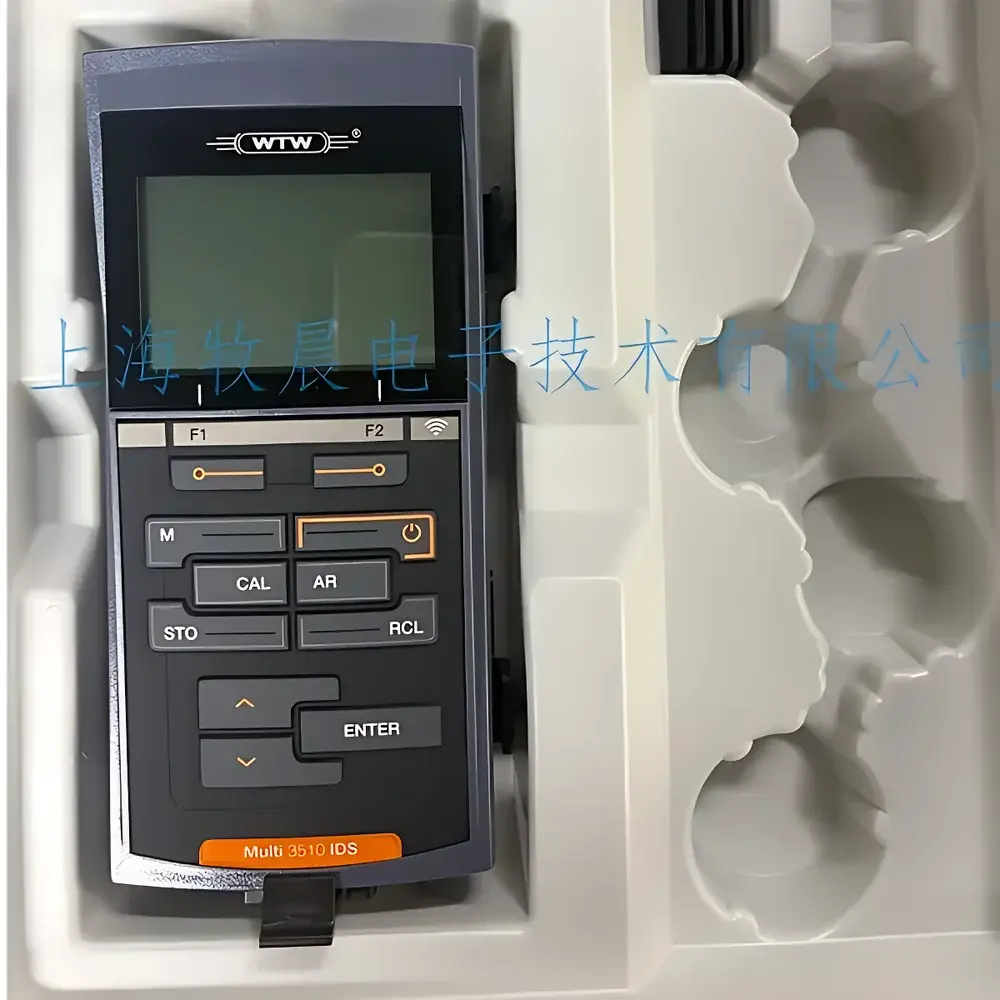
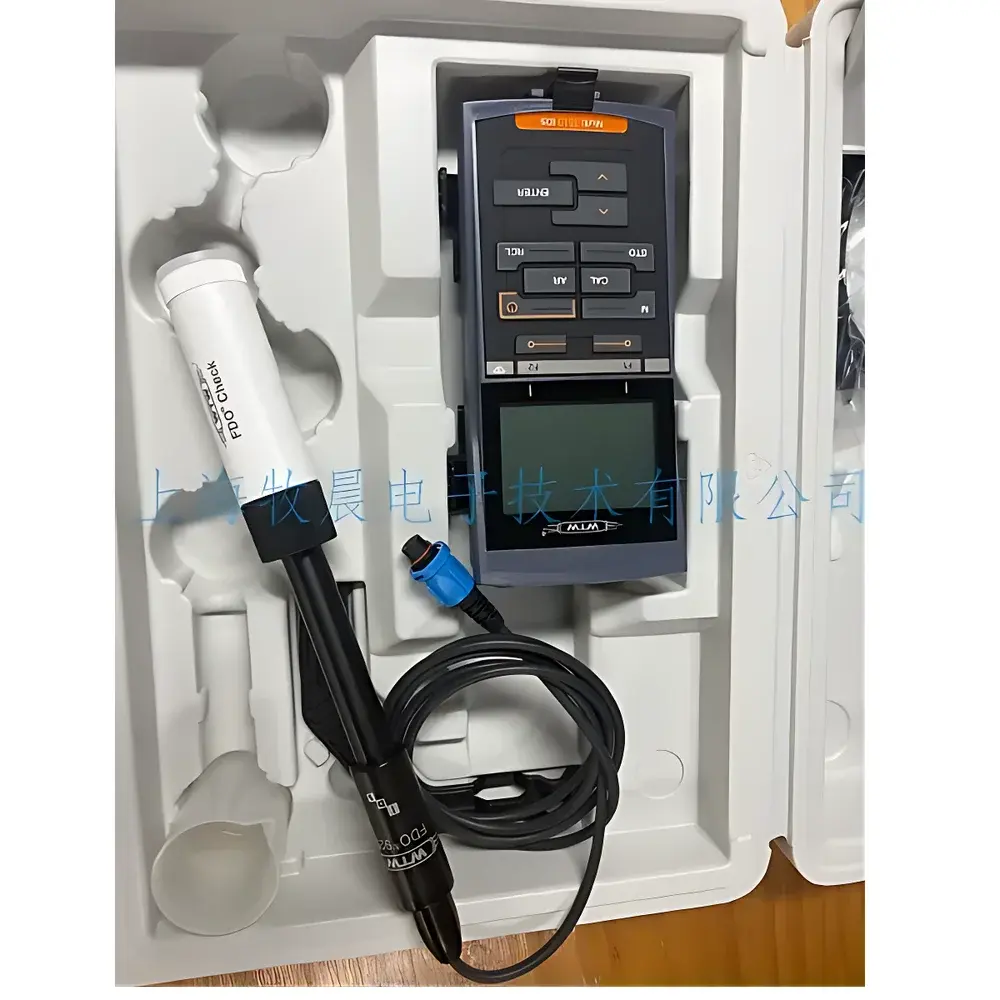
WTW Multi 3510 2FD354 Portable Multi-Parameter Water Quality Analyzer
| Brand | WTW |
|---|---|
| Origin | Germany |
| Model | Multi 3510 2FD354 |
| Instrument Type | Portable/Handheld Water Quality Analyzer |
| Detection Principle | Electrochemical Sensing |
| Measured Parameters | Dissolved Oxygen (DO), pH, ORP, Conductivity, Turbidity |
| Display | LCD Graphical Screen |
| Data Storage | Up to 10,000 datasets (manual + automatic) |
| Interface | Micro-USB-B |
| Power Supply | 4×1.5 V AA alkaline or 4×1.2 V NiMH rechargeable batteries |
| Protection Rating | IP67 |
| Probe Recognition | Automatic digital IDS probe identification |
| Electrical Isolation | Yes (prevents signal interference) |
| Compliance | CE marked |
Overview
The WTW Multi 3510 2FD354 is a high-precision, portable multi-parameter water quality analyzer engineered for field-deployable environmental monitoring in compliance with international water testing standards. Built upon WTW’s Intelligent Digital Sensor (IDS) platform, the instrument operates on electrochemical measurement principles—specifically potentiometric (pH/ORP), amperometric (dissolved oxygen), and conductometric (conductivity, TDS, salinity, resistivity) methods—combined with optical turbidimetry (90° scattered light detection per ISO 7027). Its modular architecture supports interchangeable IDS probes without manual calibration coefficient entry, enabling rapid reconfiguration for diverse sampling protocols across freshwater, wastewater, marine, and industrial effluent applications. The device meets CE requirements for electromagnetic compatibility (EMC Directive 2014/30/EU) and low-voltage safety (LVD Directive 2014/35/EU), and its robust IP67-rated housing ensures reliable operation under rain, dust, and temporary submersion conditions.
Key Features
- Automatic digital IDS probe recognition: Eliminates manual sensor configuration; stores calibration history, slope, offset, and temperature compensation parameters directly within each probe’s memory.
- Integrated electrochemical isolation: Galvanically isolated analog front-end prevents ground-loop interference and ensures stable readings in electrically noisy environments (e.g., near pumps, generators, or submerged infrastructure).
- High-capacity data logging: Stores up to 10,000 measurement records—including timestamps, GPS metadata (when paired with optional external module), and user-defined sample IDs—with flexible manual or time-triggered acquisition modes.
- Rechargeable power system: Supports both disposable AA alkaline and NiMH rechargeable batteries; USB-powered operation enables continuous use during lab-based verification or extended field deployments.
- Graphical LCD display: Provides real-time trend visualization, multi-parameter overlays, and intuitive menu navigation—even under direct sunlight—without requiring external software.
- Micro-USB-B interface: Enables secure, cable-based data export to Windows/Linux systems using WTW’s LabX® Light software or direct CSV transfer for LIMS integration.
Sample Compatibility & Compliance
The Multi 3510 2FD354 is validated for use with WTW’s full suite of IDS-certified probes—including the MPP 910 IDS (single-parameter) and MPP 930 IDS (triple-parameter deep-water sensor with integrated pressure transducer)—ensuring traceable, repeatable measurements across heterogeneous matrices. It complies with key regulatory frameworks governing environmental data integrity: ASTM D1293 (pH), ASTM D888 (dissolved oxygen), ASTM D1125 (conductivity), and ISO 7027 (turbidity). For GLP/GMP-aligned workflows, the system supports audit-trail-enabled calibration logs and user-access controls when used with LabX® Light v3.0+ (21 CFR Part 11-compliant configuration available upon request). All probes undergo factory calibration against NIST-traceable reference standards, with certificate-of-calibration included.
Software & Data Management
Data export and post-processing are facilitated via WTW’s LabX® Light desktop application—a lightweight, installer-free tool compatible with Windows 10/11 and macOS 12+. LabX® Light enables batch calibration validation, statistical summary reports (mean, SD, CV%), outlier detection, and automated report generation compliant with ISO/IEC 17025 documentation requirements. Raw datasets retain full metrological context: sensor serial numbers, calibration dates, temperature-compensation algorithms applied, and raw mV/µA/nA output values. USB transfers preserve hierarchical folder structures and timestamped filenames (e.g., “M3510_20240522_143217.csv”), facilitating seamless ingestion into enterprise LIMS or EPA-approved data management platforms such as EQuIS or Aquatic Informatics AQUARIUS.
Applications
- Routine surface water surveillance: Stream, lake, and reservoir monitoring per EPA Method 150.1 (conductivity), 365.3 (phosphate-associated turbidity), and 360.2 (pH/ORP).
- Wastewater treatment plant (WWTP) process control: Influent/effluent profiling, aeration basin DO optimization, and disinfection contact tank ORP trending.
- Marine and estuarine research: Salinity-corrected conductivity, depth-compensated DO profiles (via MPP 930 IDS), and turbidity gradients across haloclines.
- Industrial pretreatment compliance: On-site verification of discharge parameters against local limits (e.g., municipal sewer ordinances or ISO 14001 environmental management system KPIs).
- Educational field labs: Student-operated parameter mapping with built-in QA/QC prompts (e.g., automatic buffer verification alerts during pH calibration).
FAQ
Does the Multi 3510 2FD354 support GLP-compliant data handling?
Yes—when configured with LabX® Light and enabled user authentication, it generates electronic records with immutable timestamps, operator ID, calibration verification logs, and change history, satisfying core elements of 21 CFR Part 11 and ISO/IEC 17025 Clause 7.7.
Can I use non-WTW IDS probes with this analyzer?
No—the Multi 3510 2FD354 exclusively communicates with WTW-certified IDS probes via proprietary digital handshake protocol; third-party analog sensors are incompatible.
What depth range is supported when using the MPP 930 IDS probe?
The MPP 930 IDS provides depth measurement from 0.05 m to 100 m with ±0.25 m accuracy, incorporating real-time pressure-to-depth conversion and seawater density compensation per UNESCO Equation of State 1980.
Is temperature compensation applied automatically across all parameters?
Yes—each IDS probe contains an embedded Pt1000 RTD; temperature data is acquired simultaneously with primary measurements and applied using parameter-specific algorithms (e.g., DIN EN 27888 for conductivity, APHA 4500-O G for DO).
How frequently does the instrument require recalibration in routine field use?
Calibration intervals follow ISO 5725-2 guidance: typically every 24–72 hours for critical applications (e.g., regulatory reporting), or per shift for process control—though IDS probe memory retains last calibration until overwritten, enabling rapid verification without full recalibration.
Related Products







