
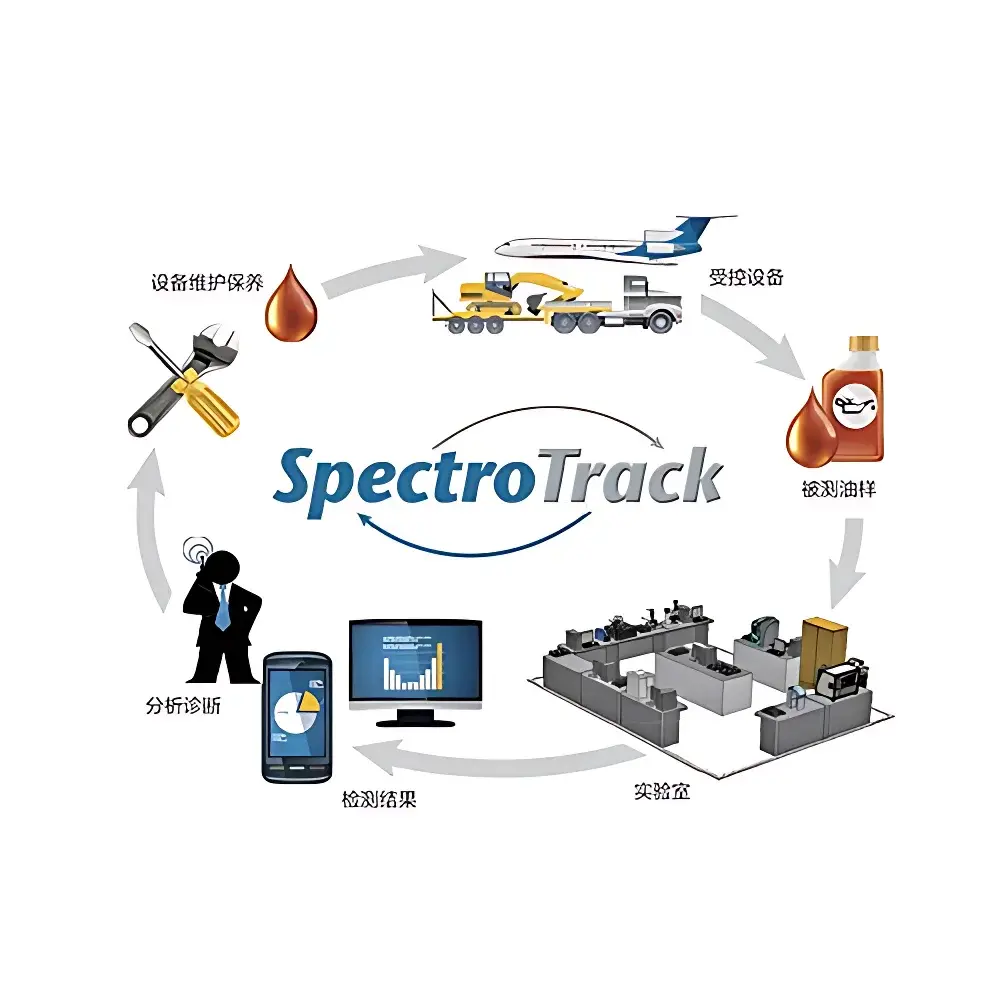
Spectro Scientific SpectroTrack Laboratory Information Management System (LIMS) for Oil Analysis
| Brand | Spectro Scientific |
|---|---|
| Origin | USA |
| Model | SpectroTrack |
| Architecture | Browser-Based (B/S) |
| Deployment | On-Premises Server |
| Compliance | Supports GLP/GMP-aligned workflows, FDA 21 CFR Part 11-ready audit trail (configurable), ISO/IEC 17025 traceability framework |
| Multi-Lab Support | Yes |
| Instrument Integration | Native drivers for Spectro oil analyzers (e.g., FluidScan, LaserNet Fines, Rotrode Filter Spectrometers), plus generic ASTM D6595/D7686-compliant CSV/API import |
| Reporting | Customizable templates, multi-language (including Chinese UI & report output), embedded graphics & spectral images |
| User Access Control | Role-based permissions, client-specific data segmentation, SSO-ready |
Overview
SpectroTrack is a purpose-built Laboratory Information Management System (LIMS) engineered exclusively for oil analysis laboratories engaged in condition-based maintenance, predictive lubrication management, and machinery health monitoring. Unlike generic LIMS platforms, SpectroTrack embeds domain-specific logic for lubricant lifecycle tracking—integrating analytical test data (elemental spectroscopy, particle counting, FTIR, viscosity, water content, etc.) with asset-level operational context: equipment history, lubrication points, maintenance logs, OEM specifications, and failure mode databases. Its architecture follows the ASTM E2500-13 and ISO/IEC 17025 principles for method validation and data integrity, enabling laboratories to meet regulatory expectations for traceability, version control, and electronic record retention. Deployed as an on-premises server application, SpectroTrack operates via standard web browsers—eliminating client-side installations while ensuring secure, role-governed access across geographically distributed sites.
Key Features
- Oil-Specific Data Model: Structured schema for lubricant types, base oils, additive packages, OEM approval codes (e.g., Caterpillar ECOSOFT, Komatsu KES), and wear metal thresholds aligned with MIL-STD-1949A and SAE J300 classifications.
- Asset-Centric Workflow Engine: Manages equipment hierarchies (fleet → machine → subsystem → lubrication point), linking oil samples directly to physical assets, maintenance work orders, and spare parts inventories.
- Automated Instrument Integration: Direct data ingestion from Spectro Scientific analyzers (FluidScan 1000/1100, LaserNet Fines 3.0, Rotrode Filter Spectrometer) and third-party instruments via ASTM E1382-compliant file parsing or OPC UA/REST API adapters.
- Trend-Driven Diagnostics: Time-series visualization of elemental concentrations, particle counts, and oxidation indices with statistically validated control charts (X-bar/R, CUSUM), auto-generated alerts based on user-defined limits per ISO 4406, NAS 1638, or custom severity matrices.
- Regulatory-Ready Audit Trail: Immutable logging of all data modifications, user logins, report generations, and configuration changes—fully compliant with FDA 21 CFR Part 11 requirements when configured with digital signatures and electronic records review protocols.
- Configurable Reporting Framework: Drag-and-drop report builder supporting bilingual output (English/Chinese), dynamic logo insertion, embedded spectra images, PDF/Excel export, and scheduled email distribution with encrypted attachments.
Sample Compatibility & Compliance
SpectroTrack accepts sample metadata and analytical results from all standard oil analysis test methods, including ASTM D5185 (ICP spectroscopy), ASTM D6595 (rotary piston pump particle counting), ASTM D7686 (microscopic particle analysis), ASTM D7622 (FTIR oxidation/nitration), and ISO 4406:2017 (contamination code assignment). The system enforces method-specific data validation rules—e.g., rejecting ICP iron values exceeding 10,000 ppm without technician justification—and cross-references results against OEM lubricant specifications (e.g., Shell Omala S4 GX vs. Mobil SHC 626). It supports GLP documentation standards through mandatory field entry for analyst ID, calibration certificate numbers, instrument serial IDs, and environmental conditions (temperature/humidity logs). All database transactions are ACID-compliant and backed by daily encrypted backups with offsite replication options.
Software & Data Management
Built on a Microsoft SQL Server or PostgreSQL backend, SpectroTrack employs a three-tier architecture: presentation layer (HTML5/CSS3/JavaScript), business logic layer (.NET Core or Java Spring Boot), and data access layer with parameterized queries to prevent SQL injection. Data encryption at rest (AES-256) and in transit (TLS 1.2+) are enforced by default. The system includes a dedicated “Data Governance Dashboard” showing real-time metrics on data completeness (% fields populated), turnaround time adherence, instrument uptime, and report issuance latency. Historical data archiving follows ISO 15489-1:2016 guidelines, allowing granular retention policies per client, equipment class, or test type. Integration with enterprise systems (CMMS like IBM Maximo or SAP PM, ERP like Oracle E-Business Suite) is achieved via certified middleware connectors supporting HL7, EDIFACT, or custom JSON payloads.
Applications
- Power generation facilities managing turbine oils, transformer fluids, and hydraulic fluids across multiple generating units.
- Mining and heavy equipment OEMs performing fleet-wide oil health surveillance for haul trucks, excavators, and drilling rigs.
- Aerospace MRO centers tracking lubricant performance in jet engines, APUs, and landing gear systems per FAA AC 120-95B requirements.
- Marine classification societies validating lube oil condition against IMO MARPOL Annex VI and ClassNK Technical Bulletin No. 2021-012.
- Third-party oil analysis labs serving industrial clients under ISO/IEC 17025 accreditation—leveraging SpectroTrack’s built-in method validation templates and uncertainty calculation modules.
FAQ
Does SpectroTrack support multi-site laboratory operations?
Yes—centralized server deployment enables synchronized data sharing across distributed laboratories while enforcing client-specific data isolation and regional compliance rules (e.g., GDPR for EU sites, CCPA for California-based users).
Can historical data from legacy LIMS be migrated into SpectroTrack?
Yes—Spectro Scientific provides certified data migration services using validated ETL scripts that preserve audit trail integrity, unit conversions, and relational dependencies between samples, instruments, and assets.
Is Chinese language support limited to the UI, or does it extend to reports and notifications?
Full bilingual capability: Chinese localization covers all interface elements, automated email alerts, PDF reports (with font-embedded GB18030 compliance), and printed labels—including client-specific logos and regulatory disclaimers.
How does SpectroTrack handle instrument calibration and maintenance tracking?
It maintains a dedicated Instrument Lifecycle Module recording calibration due dates, certificate uploads (PDF/ISO 17025-compliant), preventive maintenance logs, and out-of-tolerance event escalations—with automatic task assignment to lab supervisors.
What level of IT infrastructure is required for on-premises deployment?
Minimum: Windows Server 2019 or RHEL 8.x, 16 GB RAM, 500 GB SSD storage, and SQL Server Standard Edition 2019 or later; recommended for >50 concurrent users: clustered SQL Server AlwaysOn availability group with load-balanced web front-ends.





