
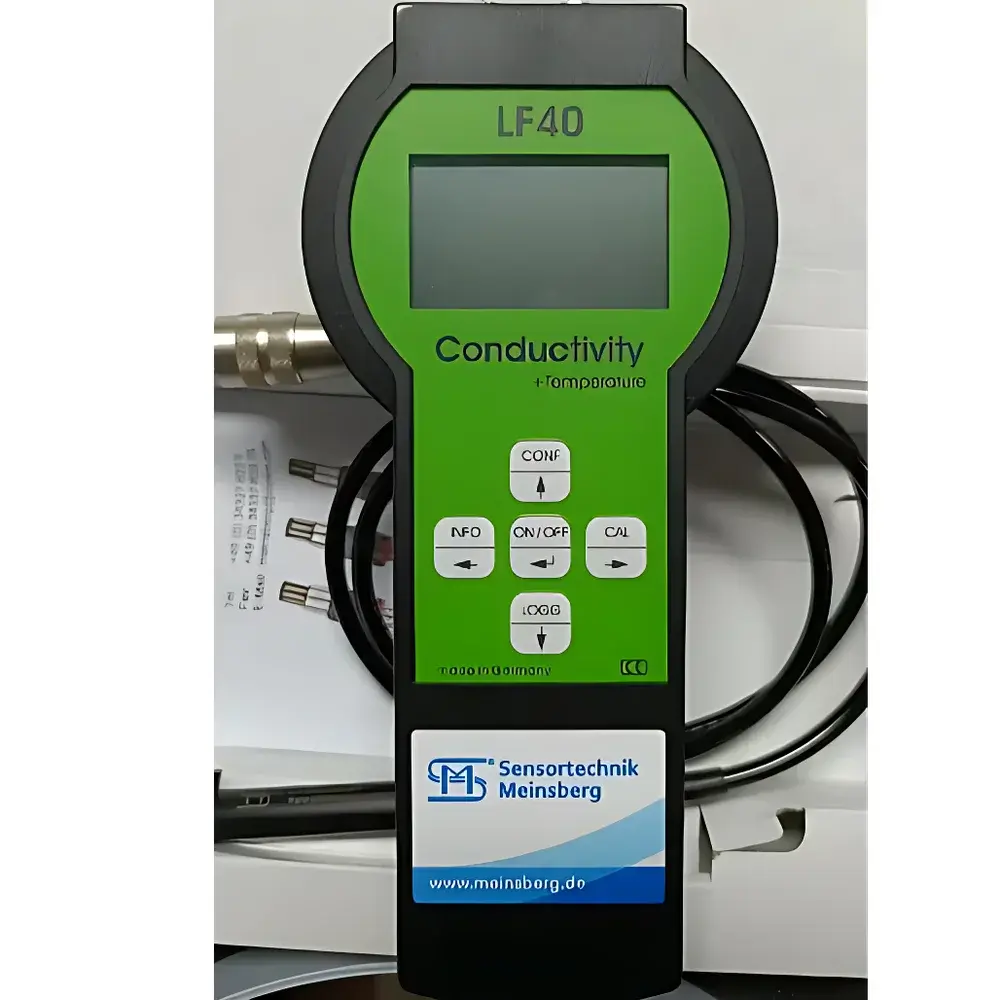
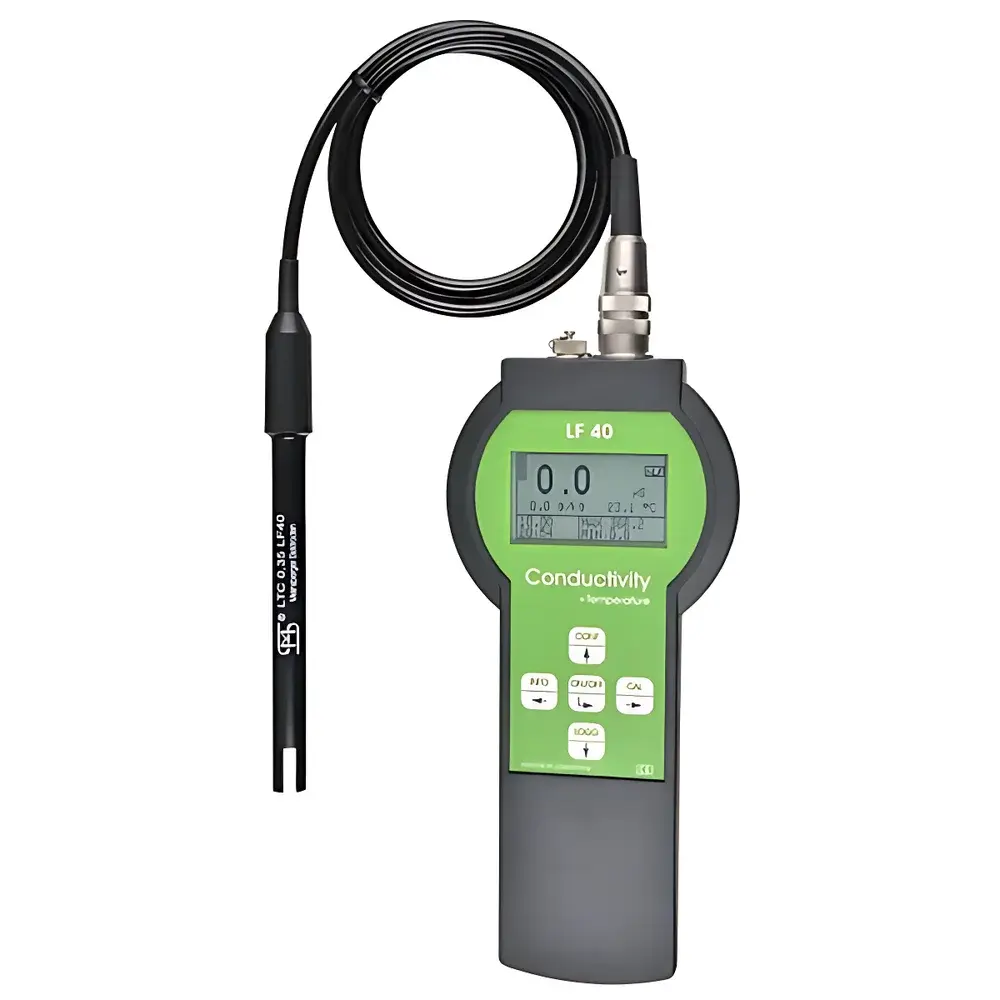
SM LF40 Portable Conductivity Meter
| Brand | SM |
|---|---|
| Origin | Germany |
| Model | LF40 |
| Portability | Portable |
| Application Environment | Laboratory & Field |
| Conductivity Range | 0–200 mS/cm (auto-ranging across 0–200 μS/cm, 0–2000 μS/cm, 0–20 mS/cm, 0–500 mS/cm) |
| TDS Ranges | 0–200 mg/L, 0–2000 mg/L, 0–20 g/L, 0–500 g/L |
| Salinity Range | 0–70 g/kg |
| Temperature Range | −10 to +100 °C |
| Resolution | 0.1 μS/cm (low range), 0.01 mS/cm / 0.1 mS/cm (mid/high ranges), 0.1 °C |
| Temperature Compensation | Pt1000 sensor (automatic or fixed) |
| Display | 128 × 64 pixel backlit LCD |
| Data Storage | 4000 measurement records |
| Connectivity | Isolated USB interface |
| Enclosure Rating | IP65 |
| Dimensions | 200 × 95 × 40 mm (W × H × D) |
| Weight | 290 g (with 3 × AA batteries) |
| EMC Compliance | EN 61326 Class B |
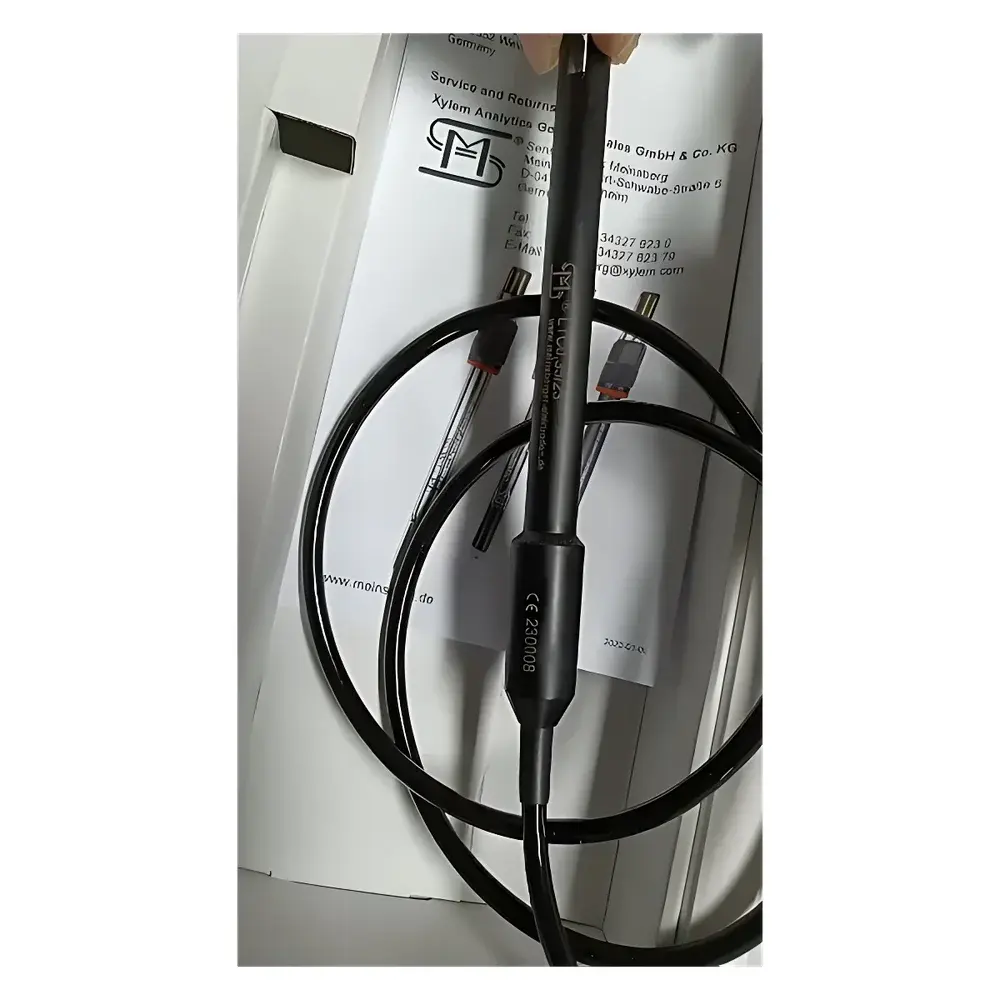
| Standard Electrode | LTC 0.35/LF 40 (4-pole, cell constant 0.33 cm⁻¹, integrated Pt1000 temperature sensor, 1 m cable with BK 6-pin connector) |
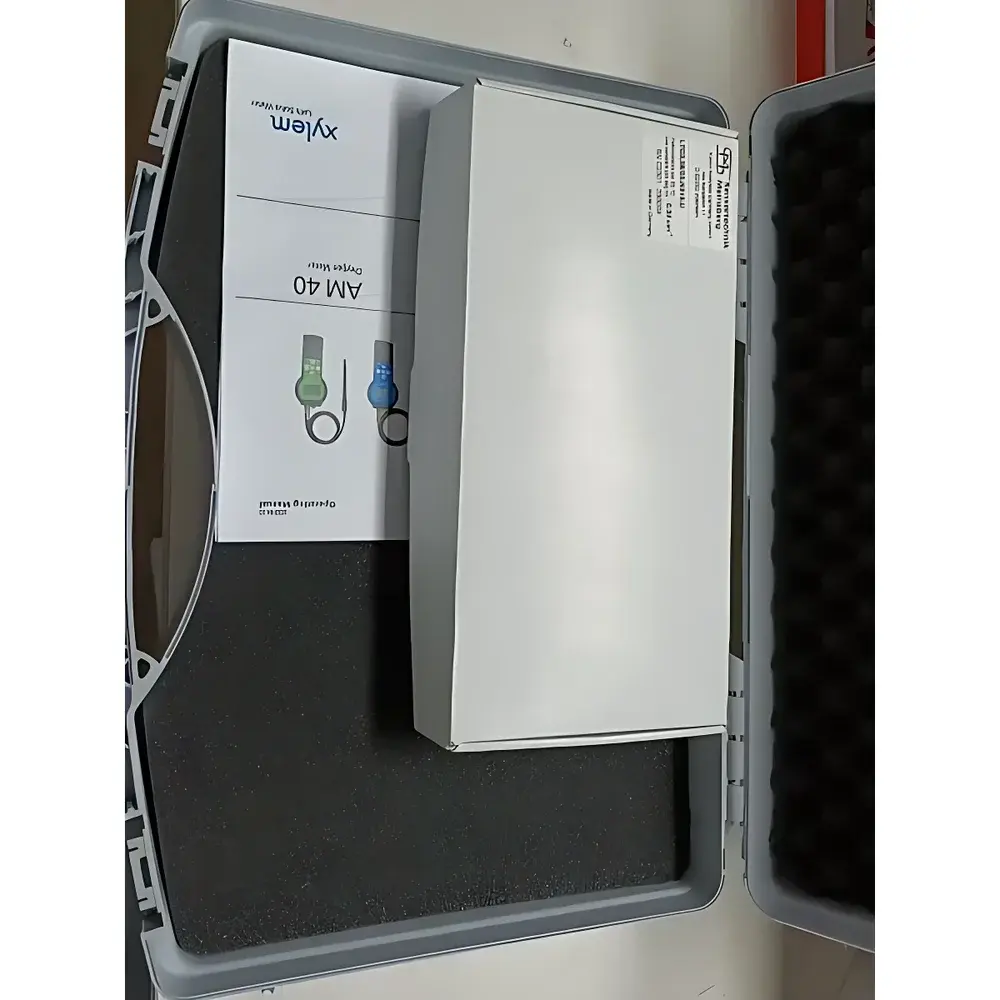
| Included Accessories | Carrying case, LF40 main unit, 3 × AA batteries, LTC 0.35/LF 40 electrode, 50 mL KCl 1413 μS/cm calibration solution |
Overview
The SM LF40 Portable Conductivity Meter is a precision-engineered electrochemical instrument designed for reliable, field-deployable measurement of electrical conductivity, total dissolved solids (TDS), salinity, and temperature in aqueous samples. Based on four-electrode (tetrapolar) AC conductivity measurement principles, the LF40 eliminates polarization errors and contact resistance artifacts commonly encountered with two-electrode systems—making it especially suitable for high-conductivity or fouling-prone matrices such as wastewater, brines, and industrial process streams. Its auto-ranging architecture dynamically selects optimal measurement ranges across five decades (0.01 μS/cm to 500 mS/cm), ensuring high resolution and linearity without manual range switching. The integrated Pt1000 temperature sensor enables accurate, real-time temperature compensation per ASTM D1125 and ISO 7888 standards, supporting both automatic and user-defined compensation modes.
Key Features
- Four-pole conductivity measurement technology for enhanced accuracy in high-ionic-strength and variable-viscosity samples
- Simultaneous real-time display of conductivity, TDS (calculated using selectable conversion factors: 0.4–1.0), salinity (g/kg), and temperature (°C)
- GLP-compliant data management: time-stamped storage of up to 4000 measurement records with min/max tracking and automatic date/time stamping
- Backlit monochrome LCD (128 × 64 pixels) optimized for low-light and outdoor use; readable under direct sunlight
- Rugged ABS housing rated IP65 for dust-tight and water-jet resistant operation—validated for use in humid laboratories, wastewater treatment plants, and riverbank sampling sites
- Isolated USB 2.0 interface compliant with IEC 61000-4-5 surge immunity requirements; enables secure data export and firmware updates without ground-loop interference
- Integrated temperature compensation using built-in Pt1000 sensor (±0.2 °C accuracy from 0–50 °C); supports fixed-temperature mode for comparative measurements
Sample Compatibility & Compliance
The LF40 is validated for routine analysis of natural waters (surface water, groundwater), municipal and industrial effluents, cooling tower fluids, aquaculture systems, and desalination pre-/post-treatment streams. Its tetrapolar electrode (LTC 0.35/LF 40, cell constant 0.33 cm⁻¹) minimizes coating-related drift during extended immersion in suspended-solids-rich media. The instrument meets essential regulatory and quality system requirements: design and electromagnetic compatibility conform to EN 61326-1 (Class B) for laboratory and light-industrial environments; data integrity features—including immutable timestamps, operator ID fields (via optional software configuration), and audit-trail-ready export logs—support alignment with GLP, ISO/IEC 17025, and FDA 21 CFR Part 11 documentation expectations when used with validated software workflows.
Software & Data Management
Data acquisition and reporting are supported via proprietary SM Connect software (Windows-compatible), which facilitates encrypted USB transfer, customizable report generation (PDF/CSV), and batch calibration verification logs. All stored measurements include metadata: date/time, conductivity value, TDS/salinity output, temperature, electrode status flag, and calibration timestamp. The software enforces structured data review workflows—e.g., automatic flagging of out-of-spec readings relative to user-defined limits—and generates traceable calibration certificates compliant with ISO 17025 clause 6.4.2. No cloud synchronization or remote telemetry is implemented, preserving data sovereignty and eliminating cybersecurity exposure vectors common in IoT-enabled meters.
Applications
- Environmental monitoring: compliance testing of discharge permits (e.g., EPA NPDES), seasonal salinity profiling in estuaries, and rapid assessment of aquifer contamination
- Water treatment: feedwater conductivity verification, RO membrane performance trending, and regeneration endpoint detection in ion exchange systems
- Food & beverage QA: rinse water validation, brine concentration control in pickling operations, and CIP solution conductivity monitoring
- Academic research: kinetic studies of dissolution processes, electrolyte diffusion modeling, and soil leachate characterization
- Pharmaceutical water systems: non-sterile utility water (PW) spot-checking per USP guidelines, where conductivity limits are defined at specified temperatures
FAQ
What electrode is required for optimal performance with the LF40?
The LF40 is calibrated and validated exclusively with the supplied LTC 0.35/LF 40 four-pole electrode (cell constant 0.33 cm⁻¹, integrated Pt1000). Substitution with non-SM electrodes invalidates factory calibration and compromises measurement traceability.
Does the LF40 support automatic calibration?
Yes—it performs one-point or two-point automatic calibration using standard KCl solutions (e.g., 1413 μS/cm or 12.88 mS/cm); calibration coefficients are stored per electrode ID to prevent cross-contamination of calibration history.
Can the device operate continuously on battery power?
With three AA alkaline cells, the LF40 delivers ≥200 hours of continuous operation under typical sampling conditions (backlight off, 1 reading/min); low-battery warning activates at ≤1.1 V per cell.
Is temperature compensation mandatory?
No—users may select fixed-temperature compensation (e.g., 25 °C reference) for comparative measurements across heterogeneous sample sets, though automatic Pt1000-based compensation is recommended for regulatory reporting.
How is data security ensured during USB transfer?
The isolated USB interface prevents ground-loop currents; all exported files are digitally signed and include embedded checksums to detect tampering or transmission corruption.




