
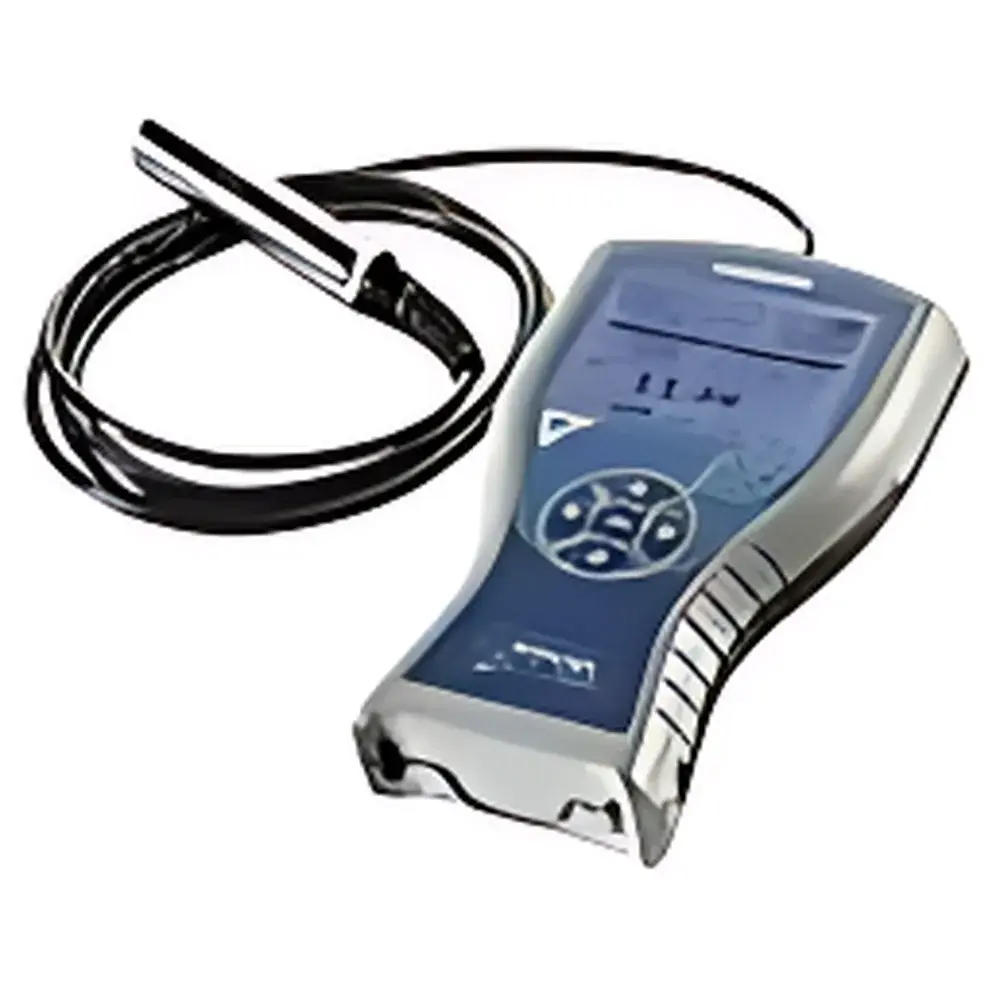
PONSEL Multy 8320 Portable Multiparameter Water Quality Analyzer
| Brand | PONSEL (France) |
|---|---|
| Origin | France |
| Model | Multy 8320 |
| Instrument Type | Portable / Handheld Water Quality Analyzer |
| Detection Principle | Electrochemical Sensing (pH, ORP, Conductivity), Fluorescence-based Optical Dissolved Oxygen (OPTOD®), Infrared Turbidity (ISO 7027) |
| Measured Parameters | pH, ORP, Dissolved Oxygen (mg/L & % saturation), Conductivity (μS/cm, mS/cm), Salinity, Temperature, Turbidity (NTU & mg/L) |
| Display | 4-inch TFT LCD |
| Data Storage | Up to 100,000 measurement sets |
| Protection Rating | IP67 |
| Compliance | GLP, ASTM D888–05, ISO 7027 |
| Communication Interface | Modbus RS-485 |
| Operating Temperature | –10 °C to +50 °C |
| Power | 4 × AA batteries (included) or optional 12 V external supply |
Overview
The PONSEL Multy 8320 is a dual-channel, field-deployable multiparameter water quality analyzer engineered for high-reliability environmental monitoring in diverse aquatic matrices—including drinking water distribution systems, wastewater treatment effluents, surface waters (rivers, lakes), estuarine and marine environments, and industrial process streams. Built upon PONSEL’s proprietary digital sensor architecture, the Multy 8320 integrates four core electrochemical and optical sensing modalities: potentiometric pH/ORP measurement using PLASTOGEL® gel-electrolyte technology; fluorescence-based dissolved oxygen detection via OPTOD® sensors compliant with ASTM D888–05; four-electrode conductivity measurement with automatic temperature, salinity, and pressure compensation; and infrared turbidity quantification per ISO 7027. Its dual-channel capability enables simultaneous real-time acquisition of two independent parameter sets—e.g., pH + DO, or conductivity + turbidity—without cross-interference or manual channel switching. The instrument operates independently of lab infrastructure, delivering laboratory-grade reproducibility (±0.1 pH, ±0.1 mg/L DO, ±1% full-scale conductivity) under variable ambient conditions.
Key Features
- Dual-channel digital interface supporting concurrent operation of up to two smart sensors—enabling synchronized, time-stamped data capture across parameter pairs.
- 4-inch high-contrast TFT display with intuitive icon-driven UI; shows live readings, electrode status, battery level, atmospheric pressure, and calibration history.
- Onboard data logger storing up to 100,000 timestamped records with metadata (date/time, sensor ID, temperature, pressure, operator tag).
- Automated diagnostics including electrode impedance check, membrane integrity verification (for legacy sensors), and self-calibration validation—fully traceable per GLP requirements.
- Automatic temperature compensation (ATC) across all parameters using integrated CTN thermistors; optional barometric and salinity compensation for DO and conductivity.
- IP67-rated rugged housing constructed from UV-stabilized PVC and stainless steel (Inox 316L for DO probe), certified for immersion up to 1 m for 30 minutes.
- Modbus RS-485 communication port enabling integration into SCADA systems, telemetry networks, or centralized data acquisition platforms.
Sample Compatibility & Compliance
The Multy 8320 is validated for use across a broad spectrum of aqueous media: potable water (per WHO and EU Directive 98/83/EC), secondary and tertiary wastewater effluents (aligned with EPA Method 1600 series), brackish and seawater (salinity up to 45 g/kg), and natural freshwater bodies. Sensor designs adhere to internationally recognized metrological standards: OPTOD® DO probes conform to ASTM D888–05 for low-oxygen accuracy and zero oxygen consumption; turbidity sensors comply with ISO 7027 for 90° scattered light detection; and conductivity cells implement four-electrode geometry to eliminate polarization errors in high-conductivity or fouling-prone samples. All firmware and data handling routines support audit trails, electronic signatures, and user-access controls required under FDA 21 CFR Part 11 and EU Annex 11 for regulated environmental testing.
Software & Data Management
Data export and configuration are managed through Wintek Viewer PC software—a secure, installer-free application compatible with Windows 10/11. Wintek Viewer supports batch download, CSV/Excel export with embedded metadata, trend visualization, statistical summaries (min/max/mean/stdev), and GLP-compliant report generation with digital signature fields. Raw data files include encrypted headers containing sensor serial numbers, calibration dates, environmental context (pressure, temperature), and operator credentials. Optional ODEON firmware upgrades (Classic → Open or X-type configurations) extend compatibility with third-party photometric modules (e.g., PHOTOPOD) for colorimetric analysis of COD, ammonia, phosphate, nitrate, chlorine, and heavy metals—without hardware modification.
Applications
- Regulatory compliance monitoring at water intake and discharge points per national environmental agency protocols (e.g., US EPA, UK EA, German LAWA).
- Process control in municipal wastewater plants—tracking nitrification/denitrification efficiency via DO/pH correlation and conductivity-guided sludge dewatering.
- Ecological field surveys assessing eutrophication indicators (turbidity, DO saturation, conductivity-derived total dissolved solids).
- Drinking water safety verification during emergency response—rapid screening for pH shifts, ORP anomalies, or sudden turbidity spikes indicating contamination events.
- Marine aquaculture site management—continuous DO and salinity profiling to optimize aeration and feeding cycles.
- Educational and research deployments requiring portable, GLP-aligned instrumentation with full traceability for peer-reviewed publications.
FAQ
Does the Multy 8320 require routine membrane replacement or electrolyte refilling for dissolved oxygen measurement?
No. The OPTOD® sensor uses solid-state fluorescent chemistry and requires no membranes, electrolytes, or polarization time—eliminating maintenance intervals and drift associated with Clark-type electrodes.
Can the instrument store calibration coefficients for multiple electrodes simultaneously?
Yes. Each digital sensor retains its own calibration profile and temperature compensation curve in non-volatile memory; the Multy 8320 auto-recalls these upon connection.
Is the turbidity sensor suitable for highly colored or suspended organic samples?
Yes. The ISO 7027-compliant 90° infrared optical design minimizes interference from sample coloration and provides stable readings across 0–4000 NTU, including wastewater and algal bloom conditions.
What battery life can be expected during continuous field use?
With alkaline AA batteries, typical operation exceeds 100 hours in logging mode (1-min interval); lithium AA batteries extend this to >200 hours under equivalent conditions.
How is data integrity ensured during wireless or cable-based transfer to central servers?
All Modbus RTU transmissions include CRC-16 error checking; Wintek Viewer enforces SHA-256 hash validation on imported datasets to prevent corruption or unauthorized modification.
Related Products







