
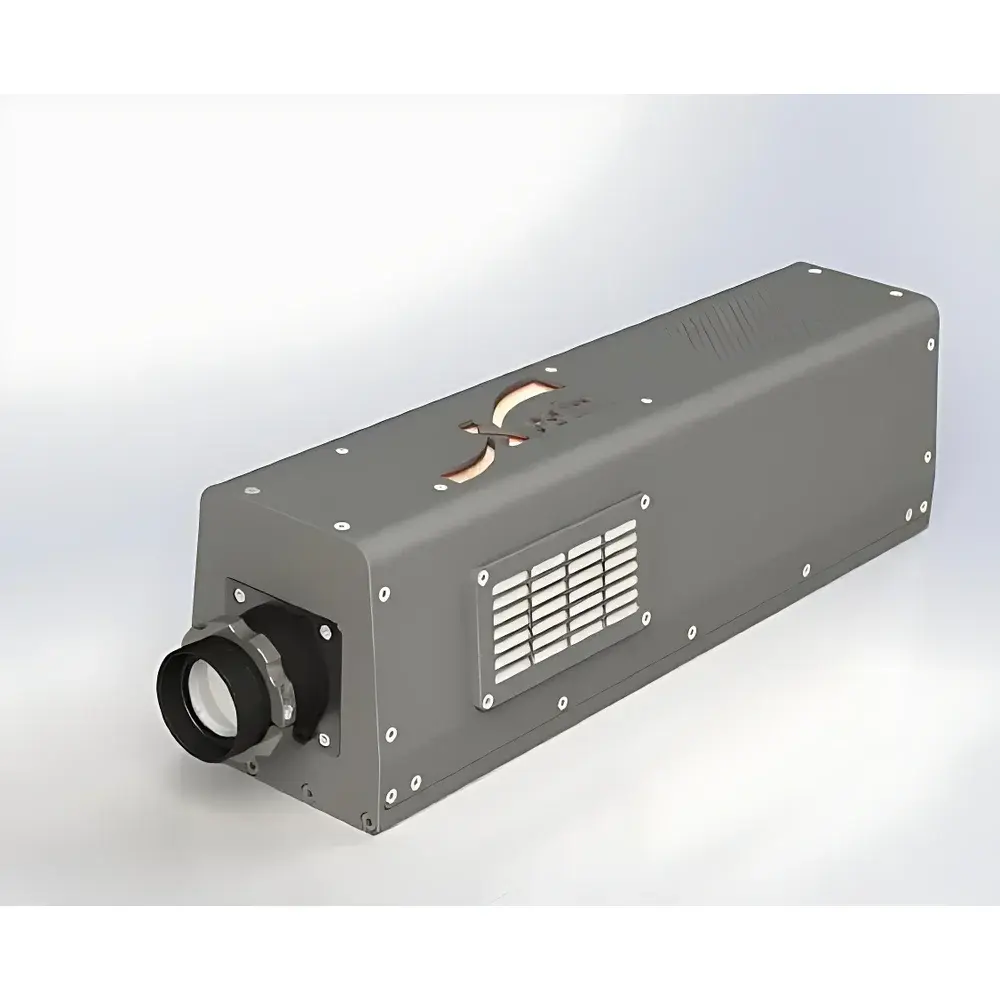
Specim sCMOS VNIR Hyperspectral Imaging System
| Brand | Specim |
|---|---|
| Origin | Finland |
| Model | sCMOS VNIR |
| Spectral Range | 400–1000 nm |
| Spectral Resolution (FWHM) | 2.9 nm (30 µm slit) |
| Spectral Sampling | 0.63–5.07 nm (adjustable via binning) |
| Spatial Resolution | 2184 pixels |
| Spectral Bands | 946 |
| Frame Rate | 100 fps (full frame), higher with binning |
| Pixel Size | 6.5 µm |
| Peak SNR | 170:1 (no binning) to 680:1 (8×2 binning) |
| Output | 16-bit CameraLink |
| Detector | Thermally Stabilized sCMOS |
| F-number | f/2.4 |
| Slit Width Options | 18, 30, 50, 80, or 150 µm |
| Effective Slit Length | 14.2 mm |
| Operating Temperature | +5 to +40 °C (non-condensing) |
| Storage Temperature | −20 to +50 °C |
| Dimensions | 400 × 110 × 120 mm |
| Weight | 2.0 kg |
| Power Supply | 110/230 V AC, 50/60 Hz or 24 V DC |
| Power Consumption | 60 W |
| Interface | CameraLink with BitFlow Carbon frame grabber |
| Exposure Time Range | 8.1–100 ms |
| Mechanical Shutter | Electromechanical |
| Mounting | Standard C-mount |
Overview
The Specim sCMOS VNIR Hyperspectral Imaging System is a high-performance, line-scan push-broom imaging spectrometer engineered for quantitative spectral analysis across the visible and near-infrared (VNIR) range (400–1000 nm). It integrates the Specim ImSpector V10E spectrograph with a thermally stabilized scientific CMOS (sCMOS) area-scan sensor to deliver continuous, pixel-registered spectral data cubes. Based on transmissive diffraction grating optics and precision lens design, the system achieves low optical distortion, high spatial fidelity, and consistent spectral calibration—critical for trace-level material identification and spatially resolved chemometric modeling. Its core architecture adheres to metrological principles of hyperspectral imaging: each spatial line captured yields a full, contiguous spectrum per pixel, enabling rigorous radiometric and spectral reproducibility under laboratory, industrial, or field-deployable conditions.
Key Features
- Thermally regulated sCMOS detector ensuring stable dark current and minimal thermal drift over extended acquisition periods
- 2184-pixel spatial resolution with RMS spot size <9 µm at f/2.4, supporting high-fidelity spatial mapping of heterogeneous samples
- 946 spectral bands with nominal FWHM of 2.9 nm (using 30 µm slit), scalable via software-selectable spatial and spectral binning
- Real-time acquisition at 100 fps (full-frame); binning modes enable >300 fps for dynamic process monitoring
- Peak signal-to-noise ratio up to 680:1 (8×2 binning), facilitating low-light applications including fluorescence and reflectance-based assays
- Modular optical interface: standard C-mount accommodates interchangeable lenses (18 mm, 23 mm, 140 mm) optimized across the VNIR band
- Electromechanical shutter synchronized to exposure timing, eliminating motion blur in stop-motion or conveyor-based scanning
- Robust mechanical housing (aluminum alloy) rated for continuous operation in controlled lab environments (IEC 60529 IP20 equivalent)
Sample Compatibility & Compliance
The system supports non-contact, non-destructive analysis of solid, semi-solid, and particulate samples—including geological specimens, agricultural produce, pharmaceutical tablets, and biological tissues—without sample preparation beyond standard illumination geometry. Its optical design conforms to ISO 13694 (spectral irradiance measurement) and ASTM E1777 (standard practice for hyperspectral imaging data acquisition). When integrated into validated workflows, the platform supports GLP-compliant documentation through audit-trail-enabled LUMO software (see Software section). While not inherently FDA 21 CFR Part 11 certified, the system’s deterministic data capture chain—hardware timestamping, raw 16-bit CameraLink output, and unprocessed data cube export—enables traceability required for GMP-aligned quality control protocols in food safety and pharma applications.
Software & Data Management
Data acquisition and real-time visualization are managed via Specim’s LUMO software suite, which provides parameter configuration (exposure, binning, ROI selection), live spectral preview, and on-the-fly data cube generation in ENVI-compatible BIL format (.hdr/.bin). All metadata—including slit width, grating position, detector temperature, and exposure time—is embedded in the header. For post-processing, native support includes MATLAB, Python (via spectral-python and scikit-image), and commercial platforms such as ENVI, ERDAS IMAGINE, and Thermo OMNIC. A comprehensive SDK (C/C++, Python, MATLAB APIs) enables integration into custom automation pipelines—e.g., coupling with motorized stages, lighting controllers, or PLC-triggered acquisition sequences. Raw data persistence follows FAIR principles: files are immutable, checksummed, and retain full bit-depth fidelity without compression artifacts.
Applications
- Mineralogical Mapping: Combined with SWIR/LWIR systems, enables multi-range spectral unmixing to distinguish alteration minerals (e.g., kaolinite, smectite) from primary lithologies; spatially resolved spectral libraries support automated domain classification and semi-quantitative abundance estimation.
- Food Safety Screening: Demonstrated detection of formaldehyde contamination in fruits (apple, tomato) using reflectance spectral signatures between 520–780 nm; classification accuracy ≥90% achieved via k-NN and SVM models trained on calibrated spectral response curves.
- Pharmaceutical Quality Assurance: Tablet coating uniformity assessment via spectral slope analysis in the 650–950 nm region; detects micro-scale delamination and API distribution heterogeneity at ≤50 µm spatial scale.
- Plant Phenotyping: Chlorophyll-a/b ratio estimation, water stress index derivation (NDWI), and anthocyanin quantification using narrowband indices derived from contiguous VNIR sampling.
- Forensic Trace Analysis: Discrimination of ink formulations, paper substrates, and counterfeit document features based on subtle absorption edge shifts undetectable by RGB or multispectral methods.
FAQ
What spectral calibration standards are supported?
The system ships with NIST-traceable tungsten-halogen and mercury-argon lamp calibration data. Users may perform in-situ wavelength and radiometric calibration using optional reference panels (e.g., Spectralon® 99% reflectance) and calibration kits.
Can the system operate in outdoor environments?
It is designed for indoor or sheltered environments only. Ambient temperature must remain within +5 to +40 °C with no condensation; direct solar exposure or vibration-prone locations require external environmental enclosures.
Is real-time processing possible on-board?
No on-board FPGA or GPU acceleration is included. Real-time spectral analysis requires host-side computation; however, CameraLink throughput (up to 2.4 Gbps) ensures low-latency streaming to compatible frame grabbers.
How is geometric correction handled?
LUMO applies factory-measured keystone and smile corrections during acquisition. Residual distortions can be refined using user-provided checkerboard or dot-grid targets via OpenCV-based geometric calibration modules.
What maintenance is required for long-term stability?
Annual verification of spectral calibration and detector dark current profile is recommended. No consumables or optical alignments are user-serviceable; all optical components are sealed and pre-aligned at the factory.





