
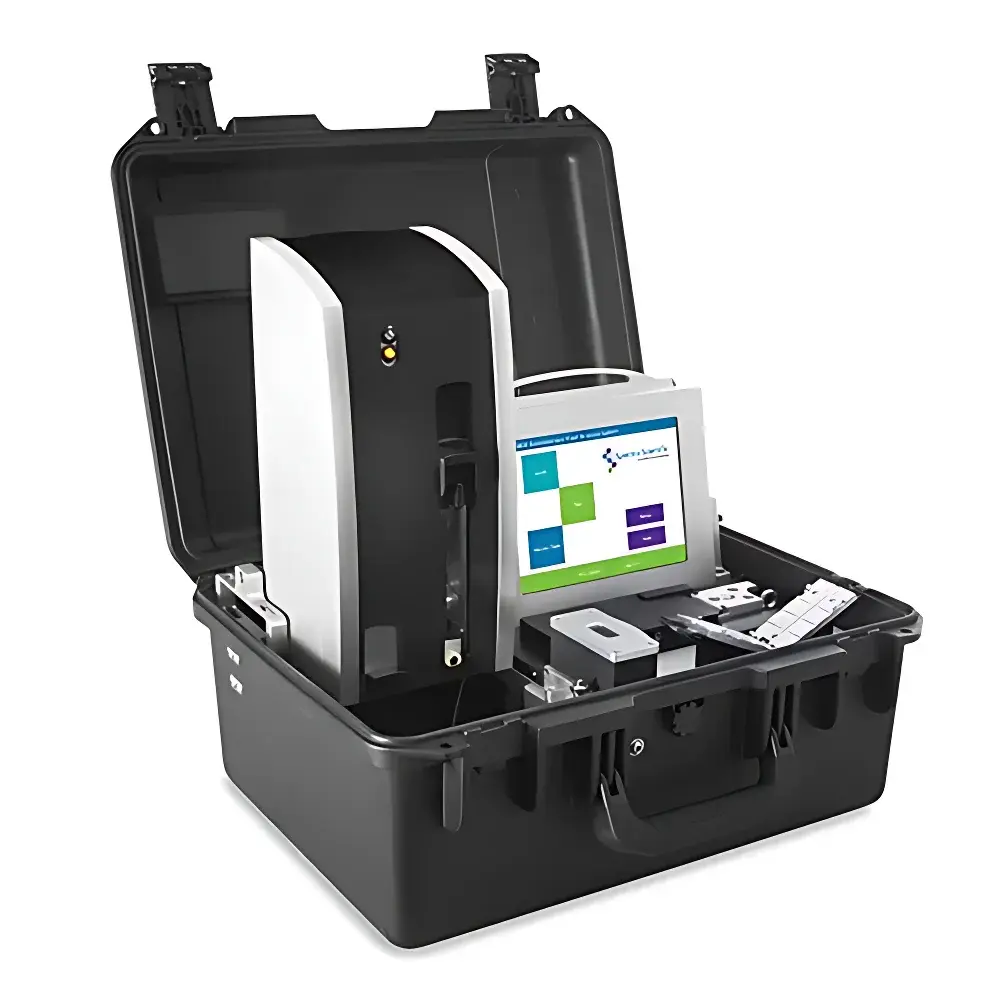
Spectro Scientific FieldLab 58 Portable Oil Condition Monitoring Laboratory
| Brand | Spectro Scientific |
|---|---|
| Origin | USA |
| Model | FieldLab 58 |
| Power Supply | Rechargeable Lithium-ion Battery |
| Dimensions | 32 × 24 × 18 cm (L×W×H) |
| Weight | 6.8 kg |
| Analytical Methods | XRF Elemental Analysis, Differential Pressure Particle Counting (FPQ), Gravity Capillary Viscometry at 40 °C, FTIR Spectroscopy |
| Sample Volume | 3–5 mL per test |
| Test Time | <10 minutes per full suite |
| Connectivity | Wi-Fi 802.11 b/g/n, Bluetooth 5.0 |
| Compliance | ASTM D6595 (XRF), ISO 4406 / ISO 11500 (particle counting), ASTM D445 (viscosity), ASTM E2412 / D7414 (FTIR oil analysis), GLP-compliant audit trail |
Overview
The Spectro Scientific FieldLab 58 is a fully integrated, field-deployable oil condition monitoring laboratory engineered for precision, ruggedness, and operational autonomy in remote or mobile environments. Unlike conventional benchtop analyzers requiring centralized lab infrastructure, the FieldLab 58 implements four orthogonal analytical modalities—X-ray fluorescence (XRF) spectroscopy, differential pressure particle counting (FPQ), gravity-driven capillary viscometry, and Fourier-transform infrared (FTIR) spectroscopy—within a single, self-contained platform. This architecture enables simultaneous assessment of three critical oil health domains: mechanical wear (via elemental quantification of Fe, Cu, Al, Cr, Pb, Sn, Si, Na, Ca, Mg, and others), particulate contamination (per ISO 4406 code generation), lubricant degradation (TAN, TBN, oxidation, nitration, sulfation, soot, water, and glycol), and rheological integrity (kinematic viscosity at 40 °C). Designed for use in mission-critical rotating and hydraulic equipment—including gas turbines, marine propulsion systems, mining haul trucks, and armored vehicle powertrains—the FieldLab 58 delivers laboratory-grade data without reliance on offsite laboratories or courier logistics.
Key Features
- Multi-modal analytical engine combining XRF, FPQ particle counting, 40 °C kinematic viscosity measurement, and FTIR spectroscopy in one compact unit
- XRF module calibrated per ASTM D6595 with detection limits ≤1 ppm for transition metals; no sample digestion or solvent required
- FPQ particle counter compliant with ISO 11500 and ISO 4406, providing real-time particle size distribution (4–100 µm) and ISO cleanliness codes
- Gravity-fed capillary viscometer meeting ASTM D445 specifications; no temperature baths or external calibration fluids needed
- FTIR spectrometer with flip-top sample cell enabling rapid, solvent-free analysis of TAN, TBN, oxidation, nitration, soot, water (detection limit <50 ppm), and fuel dilution
- Embedded touchscreen interface with guided workflow software—no operator training in spectroscopy or fluid dynamics required
- Onboard rechargeable lithium-ion battery supporting ≥8 consecutive full-test cycles (3–5 mL/sample) per charge
- Wireless data transmission via encrypted Wi-Fi and Bluetooth to Spectro’s OilView™ cloud platform or local LIMS
- Ruggedized magnesium alloy chassis rated IP54 for dust and splash resistance; tested per MIL-STD-810G for shock, vibration, and thermal cycling
Sample Compatibility & Compliance
The FieldLab 58 accepts undiluted mineral, synthetic, and semi-synthetic lubricants—including engine oils, hydraulic fluids, turbine oils, gear oils, and compressor oils—without pre-treatment. It accommodates viscosity ranges from 2 to 500 cSt at 40 °C and handles samples with up to 5% water content or 15% soot loading without signal saturation. All analytical modules are traceable to NIST standards and validated against reference materials certified by ISO/IEC 17025-accredited laboratories. The system supports GLP and GMP workflows through time-stamped, user-authenticated audit trails, electronic signatures, and FDA 21 CFR Part 11–compliant data integrity controls when integrated with OilView™ Enterprise Edition. Method compliance includes ASTM D6595 (XRF), ASTM D445 (viscosity), ISO 4406:2017 (particle counts), and ASTM E2412 (FTIR oil analysis).
Software & Data Management
FieldLab 58 operates on Spectro’s proprietary FieldOS™ embedded operating system, featuring intuitive icon-driven navigation and context-sensitive help. Test protocols are preloaded and configurable per OEM recommendations (e.g., Caterpillar S•O•S, Komatsu KOMTRAX, GE Power Services). Raw spectra, particle histograms, viscosity curves, and elemental concentration tables are stored locally with SHA-256 hashing for tamper-evident integrity. Data export supports CSV, XML, and PDF formats compatible with SAP PM, IBM Maximo, and Honeywell PHD. Cloud synchronization with OilView™ provides automated trend analytics, alarm thresholds based on ISO 4378-2 wear severity bands, and cross-fleet benchmarking across geographically distributed assets. Firmware updates and method revisions are delivered over-the-air with cryptographic verification.
Applications
The FieldLab 58 is deployed across sectors where downtime carries strategic or financial risk and laboratory turnaround is impractical: offshore drilling rigs performing daily gearbox and thruster oil checks; military forward operating bases conducting preventive maintenance on tactical vehicles and generators; pipeline compressor stations monitoring lubricant life under variable load cycles; and open-pit mining operations assessing hydraulic fluid integrity in excavators operating 24/7 in abrasive environments. Its ability to generate actionable insights—such as distinguishing adhesive wear (Fe/Cr ratio >10) from cutting wear (Si/Al ratio >3), identifying coolant ingress via glycol peaks at 1050 cm⁻¹, or detecting varnish precursors through micro-oxidation indices—enables predictive maintenance decisions grounded in physical chemistry rather than statistical extrapolation.
FAQ
Does the FieldLab 58 require consumables or calibration standards for routine operation?
No. The XRF module uses factory-calibrated targets; the FPQ sensor is self-zeroing; the viscometer relies on geometric constants; and the FTIR employs internal reference interferograms. Only periodic verification using Spectro-certified reference oils (recommended annually) is required.
Can test results be directly imported into enterprise CMMS platforms?
Yes. Through OilView™ API integration or manual CSV upload, all quantitative outputs—including elemental concentrations (ppm), ISO 4406 codes, kinematic viscosity (cSt), TAN/TBN (mg KOH/g), and water content (ppm)—map to standard CMMS asset and parameter fields.
Is the instrument suitable for use in explosive atmospheres?
The base FieldLab 58 is not ATEX or IECEx certified. For Zone 1/2 applications, Spectro offers the FieldLab 58 Ex variant with intrinsically safe design and third-party certification documentation available upon request.
How is data security ensured during wireless transmission?
All Wi-Fi and Bluetooth communications use TLS 1.2 encryption; device pairing requires mutual authentication; and local storage employs AES-256 full-disk encryption compliant with NIST SP 800-111.
What training is required for field technicians?
A two-hour instructor-led session covers sample loading, test initiation, result interpretation using built-in diagnostic logic, and basic troubleshooting—no prior spectroscopy or tribology background is assumed.




