
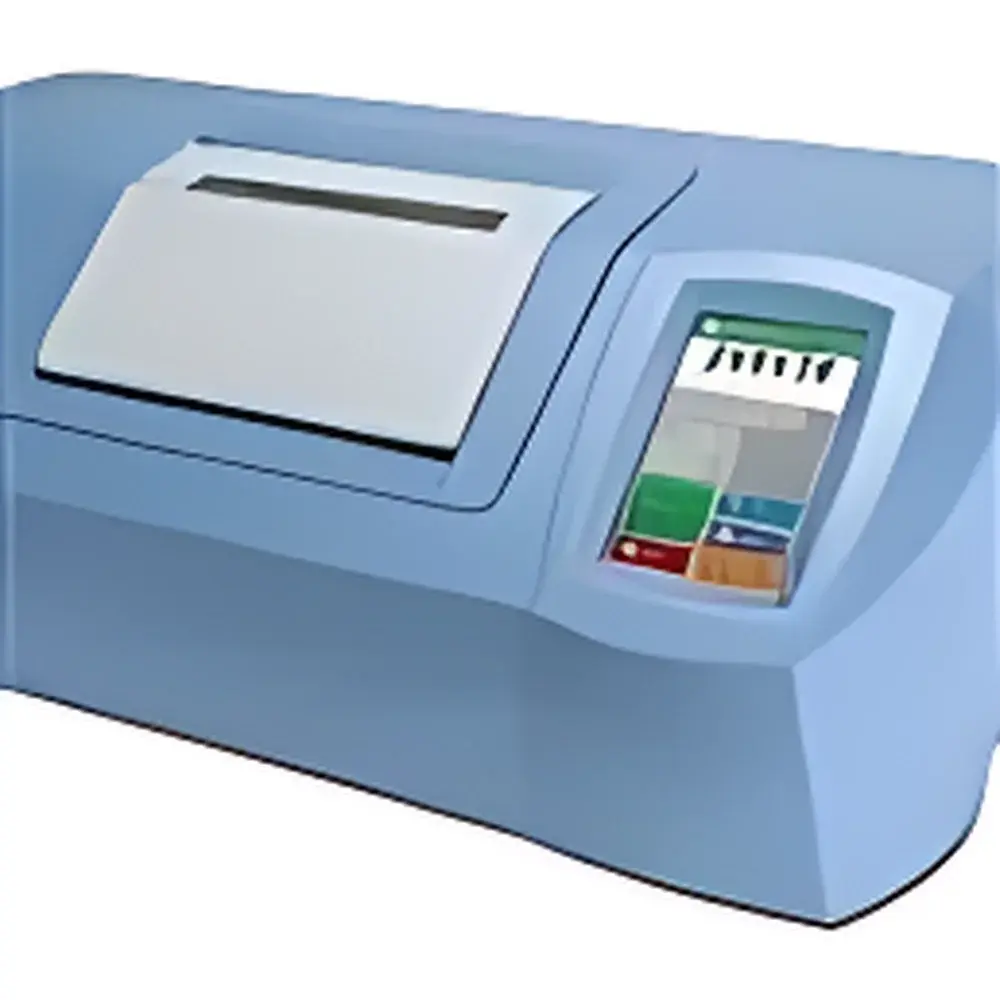
Bellingham + Stanley ADP600 Digital Polarimeter
| Brand | Bellingham + Stanley |
|---|---|
| Origin | United Kingdom |
| Model | ADP600 |
| Type | Benchtop Polarimeter |
| Temperature Control | Peltier-based |
| Display | High-resolution 7.4" color touchscreen |
| Wavelength Options | Single, dual, or up to six discrete wavelengths (325 nm, 365 nm, 405 nm, 436 nm, 546 nm, 589 nm) |
| Measurement Range | ±89°A (extendable to –355°A to +355°A via method selection) |
| Resolution | 0.0001°A |
| Accuracy | ±0.003°A (@546 nm and 589 nm) |
| Temperature Range | 15–35 °C |
| Temp. Control Precision | ±0.2 °C |
| Temperature Setpoints | 20 °C and 25 °C (user-adjustable within 20–30 °C range per method) |
| Sample Cell Length | 5–200 mm |
| Cell Diameter | 3–8 mm |
| Optical Density Range | 0.0–3.0 OD |
| Calibration Modes | Sucrose, quartz, user-defined, or no compensation |
| Measurement Modes | Specific rotation, concentration (% w/w), invert sugar %, differential (A–B) % |
| Readout Time | 15–60 s (@546/589 nm, 20/20 °C instrument/sample) |
| Light Source | UV–Vis lamp (6 V, 2 A) with narrow-band interference filters |
| Interfaces | 4 × USB, 1 × Ethernet, 1 × RS232 |
| Power Supply | 100–250 V~, 50–60 Hz, <6 A |
| Regulatory Compliance | FDA 21 CFR Part 11, USP <781>, EP 2.2.7, JP XVI |
Overview
The Bellingham + Stanley ADP600 Digital Polarimeter is a high-precision benchtop instrument engineered for accurate, traceable measurement of optical rotation in chiral substances. Operating on the fundamental principle of polarimetry—where plane-polarized light rotates upon passage through optically active media—the ADP600 delivers quantitative analysis critical for quality control, identity verification, and concentration determination in pharmaceuticals, fine chemicals, food ingredients, and academic research. Its modular wavelength architecture supports operation across ultraviolet (UV) and visible (Vis) spectral bands—from 325 nm to 589 nm—enabling method-specific validation under pharmacopoeial conditions. Unlike conventional fixed-wavelength polarimeters, the ADP600’s configurable multi-wavelength capability allows users to align measurements precisely with monochromatic reference lines specified in USP, EP, and JP monographs, ensuring regulatory alignment without hardware modification.
Key Features
- Peltier-based temperature regulation with ±0.2 °C stability across 15–35 °C operating range, supporting standardized measurements at 20 °C and 25 °C—and customizable setpoints between 20–30 °C per method.
- High-resolution 7.4-inch color touchscreen interface with intuitive navigation, real-time graphical feedback, and context-sensitive help—designed for GLP-compliant daily operation by QC analysts and researchers alike.
- Extended angular measurement range from –355°A to +355°A (with default display ±89°A), enabling robust detection of highly concentrated or strongly rotating samples without manual reorientation.
- 0.0001°A resolution and certified accuracy of ±0.003°A at sodium D-line (589 nm) and mercury e-line (546 nm), meeting stringent requirements for assay validation and stability-indicating methods.
- Integrated optical density monitoring (0.0–3.0 OD) ensures automatic signal integrity assessment—preventing erroneous readings due to excessive sample turbidity or absorption.
- Comprehensive method library supporting specific rotation (α), % w/w concentration, invert sugar quantification, and differential (A–B) calculations—with user-definable temperature compensation models (sucrose, quartz, or custom).
Sample Compatibility & Compliance
The ADP600 accommodates standard polarimetric cells ranging from 5 mm to 200 mm pathlength and 3 mm to 8 mm internal diameter—compatible with both disposable and reusable quartz cells. Its UV-capable optics (down to 325 nm) permit direct measurement of compounds with strong chromophores—such as certain antibiotics, amino acids, and synthetic intermediates—without derivatization. The instrument conforms to international pharmacopoeial standards including USP , European Pharmacopoeia 2.2.7, and Japanese Pharmacopoeia XVI. Full audit trail functionality, electronic signature support, and secure user access levels satisfy FDA 21 CFR Part 11 requirements for regulated environments. All calibration and verification procedures are documented per ISO/IEC 17025 principles, facilitating GMP and GLP audits.
Software & Data Management
The ADP600 runs embedded firmware with built-in data logging, method versioning, and export-ready reporting. Raw and processed results—including timestamp, operator ID, cell ID, wavelength, temperature, OD value, and calculation mode—are stored locally and exportable via USB or Ethernet to LIMS or ELN systems. CSV and PDF report formats include full metadata for traceability. Optional PC-based software (PolarSoft Pro) extends capabilities with statistical process control (SPC) charts, multi-batch trend analysis, and automated compliance reporting aligned with Annex 11 and ALCOA+ data integrity principles.
Applications
- Pharmaceutical QC: Identity testing and assay of chiral APIs (e.g., ibuprofen, levodopa, chloramphenicol), excipient purity verification, and stability study monitoring per ICH Q5C.
- Food & Beverage: Sucrose content in syrups and juices, invert sugar quantification in confectionery, and authenticity screening of honey and maple syrup.
- Chemical Manufacturing: Enantiomeric excess (ee) estimation in asymmetric synthesis, batch release of chiral catalysts and ligands, and raw material qualification.
- Academic Research: Kinetic studies of enzymatic hydrolysis (e.g., sucrose inversion), configurational analysis of natural products, and solvent effect investigations on optical activity.
FAQ
Does the ADP600 support 21 CFR Part 11 compliance out-of-the-box?
Yes—the instrument includes role-based user authentication, electronic signatures, immutable audit trails, and data encryption features required for Part 11 adherence.
Can I perform measurements below 350 nm without special accessories?
Yes—the integrated UV–Vis lamp and narrow-band interference filters enable direct operation at 325 nm and 365 nm without external light sources or modifications.
What temperature compensation models are available?
The ADP600 offers preloaded sucrose and quartz compensation tables, plus user-defined polynomial or tabular inputs for proprietary materials.
Is cell calibration traceable to NIST or UKAS standards?
Yes—certified quartz control plates and sucrose reference standards are supplied with UKAS-accredited calibration certificates; instrument verification follows B+S’s ISO/IEC 17025-accredited procedures.
How does the ADP600 handle highly absorbing or turbid samples?
Real-time optical density monitoring triggers warnings when transmission falls below defined thresholds, and the system automatically adjusts integration time or prompts user intervention to maintain measurement fidelity.



