
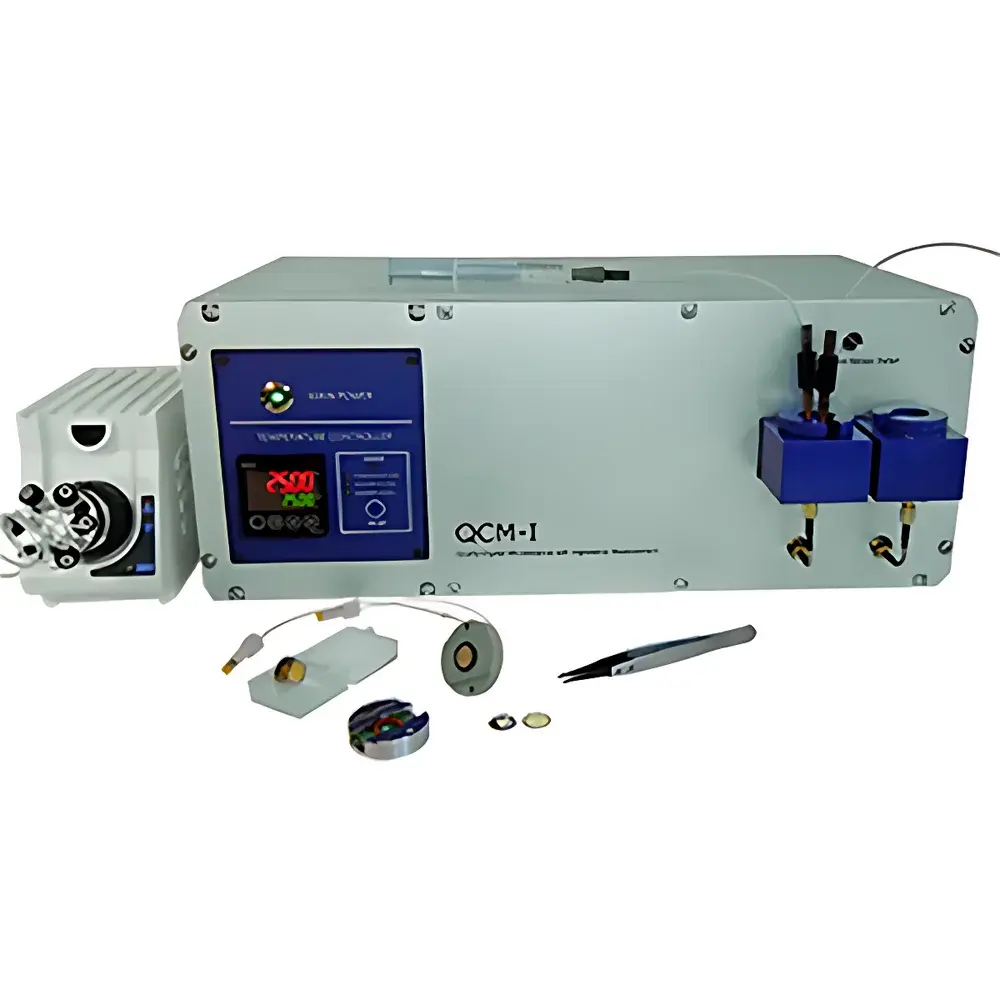
Gamry QCM-I Dissipative Quartz Crystal Microbalance
| Brand | Gamry |
|---|---|
| Origin | USA |
| Model | QCM-I |
| Temperature Control Range | 4–80 °C (±0.02 °C) |
| Harmonic Measurement Capability | up to 13th overtone on 5 MHz crystals |
| Frequency Resolution | ≤0.1 Hz |
| Dissipation Factor (D) Resolution | ≤1×10⁻⁶ |
| Interface | USB-connected to external Windows® 10 Pro PC |
| Channel Capacity | up to 4 modular sensor channels |
| Optional Modules | EC measurement module, ITO-coated QCM sensors, flow cell with semi-automated injection valve |
Overview
The Gamry QCM-I Dissipative Quartz Crystal Microbalance is an impedance-based electrochemical microgravimetric instrument engineered for real-time, label-free monitoring of interfacial mass changes and viscoelastic properties at solid–liquid interfaces. Unlike conventional frequency-only QCM systems, the QCM-I simultaneously measures both resonance frequency shift (Δf) and energy dissipation (ΔD) across multiple harmonics—enabling quantitative distinction between rigid, adsorbed monolayers and soft, hydrated, or viscoelastic films. Its operational principle relies on broadband impedance spectroscopy of AT-cut quartz resonators, where the complex admittance spectrum is fitted to extract the fundamental resonance frequency (f0) and full width at half maximum (FWHM) of the conductance peak. Since the dissipation factor D = FWHM / 2f0, the dual-parameter output provides orthogonal information: Δf correlates with coupled mass (including hydrodynamically trapped solvent), while ΔD reflects structural compliance—directly linked to film hydration, conformational flexibility, and mechanical rigidity. This dual-metric capability makes the QCM-I particularly suited for studies requiring mechanistic insight into biomolecular assembly, polymer swelling, corrosion inhibition, or nanoparticle adhesion under controlled electrochemical or thermal conditions.
Key Features
- Simultaneous high-resolution acquisition of frequency (Δf) and dissipation (ΔD) across up to 13 overtones on standard 5 MHz quartz crystals
- Precise temperature control from 4 °C to 80 °C (stability ±0.02 °C) via integrated Peltier modules, enabling thermally resolved kinetic profiling
- Modular sensor architecture supporting up to four independent measurement channels—compatible with standard gold-coated, ITO-coated, and custom electrode QCM sensors
- Optional electrochemical (EC) module for synchronized potentiostatic/galvanostatic control and QCM response during redox processes
- Flow-cell integration with semi-automated injection valve for reproducible solution exchange and multi-step binding assays
- Real-time data acquisition at user-defined intervals (down to 100 ms per spectrum), with on-the-fly calculation of f0, D, and harmonic-dependent parameters
Sample Compatibility & Compliance
The QCM-I accommodates a broad range of interfacial systems relevant to materials science, biophysics, and corrosion engineering—including protein monolayers, synthetic polyelectrolytes, lipid bilayers, conducting polymer films, colloidal nanoparticles, and inhibitor-adsorbed metal surfaces. Sensor chips are compatible with standard 14 mm diameter quartz crystals (5 MHz fundamental), with optional ITO-coated variants enabling optical transparency for correlative techniques (e.g., SPR or fluorescence microscopy). All hardware and software comply with ISO/IEC 17025 traceability requirements for measurement uncertainty reporting. Data integrity adheres to FDA 21 CFR Part 11 guidelines when configured with audit-trail-enabled software licenses and electronic signature protocols—supporting GLP/GMP-aligned laboratory workflows.
Software & Data Management
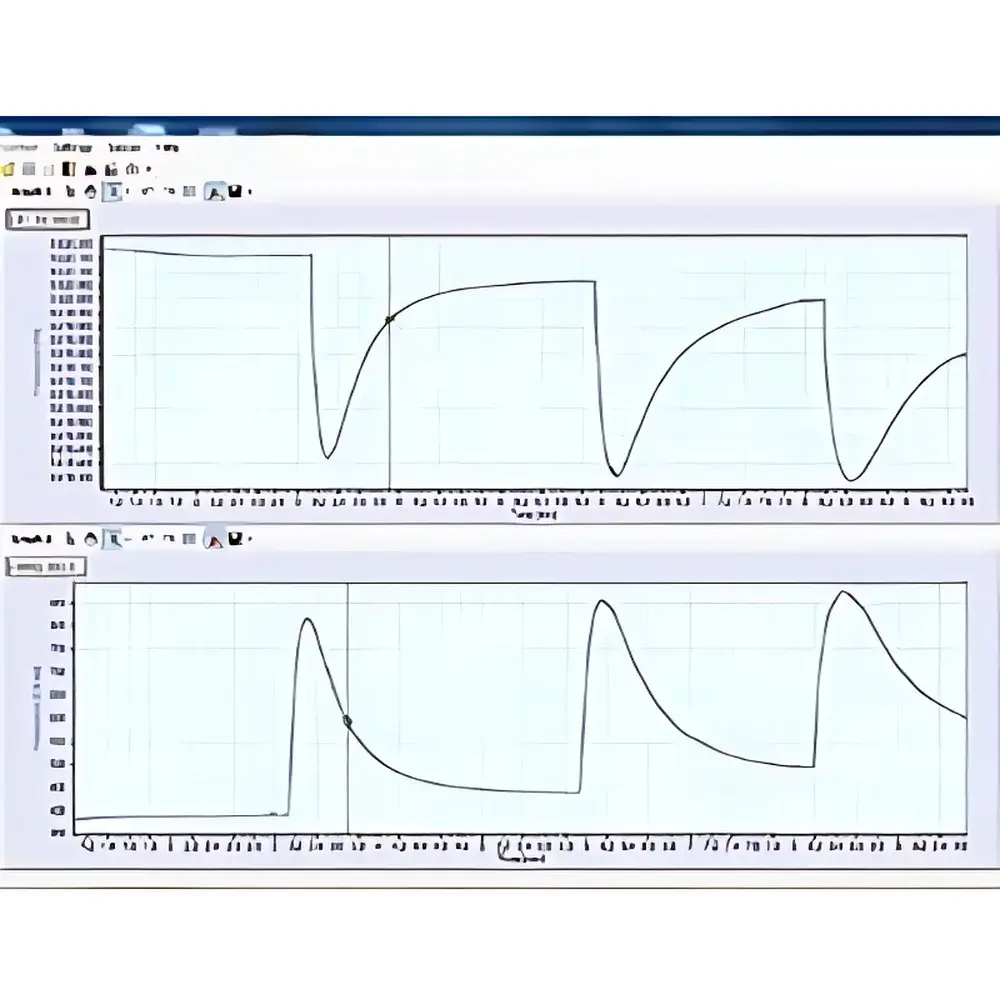
Controlled via Gamry’s BioLogic 3.xx software suite running on a dedicated Intel NUC PC with Windows® 10 Pro, the QCM-I offers two primary acquisition modes: “Resonance” mode for high-fidelity impedance sweeps (up to 70 MHz bandwidth) and “QCM-t” mode for continuous time-resolved tracking of f0 and D under dynamic conditions. The software supports model-based analysis using Sauerbrey, Voigt, or Kelvin–Voigt viscoelastic frameworks—allowing extraction of thickness, shear modulus, and hydration ratio from multi-harmonic datasets. Raw spectra, processed parameters, and metadata are stored in vendor-neutral .DTA format; export options include CSV, MATLAB (.mat), and HDF5 for third-party statistical or machine-learning pipelines. Version-controlled software updates and calibration certificate management are embedded within the platform.
Applications
- Real-time quantification of protein adsorption kinetics and conformational rearrangement on functionalized surfaces
- Electrochemically gated polymer swelling/collapse in conducting hydrogels
- In situ monitoring of inhibitor film formation and breakdown during aqueous corrosion of Cu, Fe, or Al alloys
- Characterization of vesicle fusion, supported lipid bilayer formation, and membrane protein insertion
- High-throughput screening of nanocarrier–cell membrane interactions under physiological flow conditions
- Validation of surface grafting efficiency and crosslinking density in stimuli-responsive thin films
FAQ
What distinguishes dissipative QCM (QCM-D) from traditional QCM?
Traditional QCM assumes rigid, thin-film behavior and interprets frequency shifts solely via the Sauerbrey equation. QCM-I measures dissipation alongside frequency, enabling detection of non-rigid, hydrated, or viscoelastic layers—critical for biological and polymeric systems.
Can the QCM-I operate under electrochemical control?
Yes—when equipped with the optional EC module, it enables simultaneous potentiostatic polarization and QCM monitoring, supporting studies of redox-driven adsorption/desorption or electropolymerization.
Is temperature control available for all sensor channels?
Each channel features independent Peltier-based thermal regulation, allowing differential temperature experiments or parallel screening across thermal gradients.
How is data validated for regulatory submissions?
With audit-trail configuration and electronic signatures enabled, the system meets FDA 21 CFR Part 11 and EU Annex 11 requirements for raw data archiving, user access logs, and change history tracking.
What sample volumes are required for flow-cell operation?
The integrated semi-automated injection valve supports minimal dead-volume operation (<150 µL per injection), ideal for precious biomolecular samples or limited-solvent screening campaigns.




