
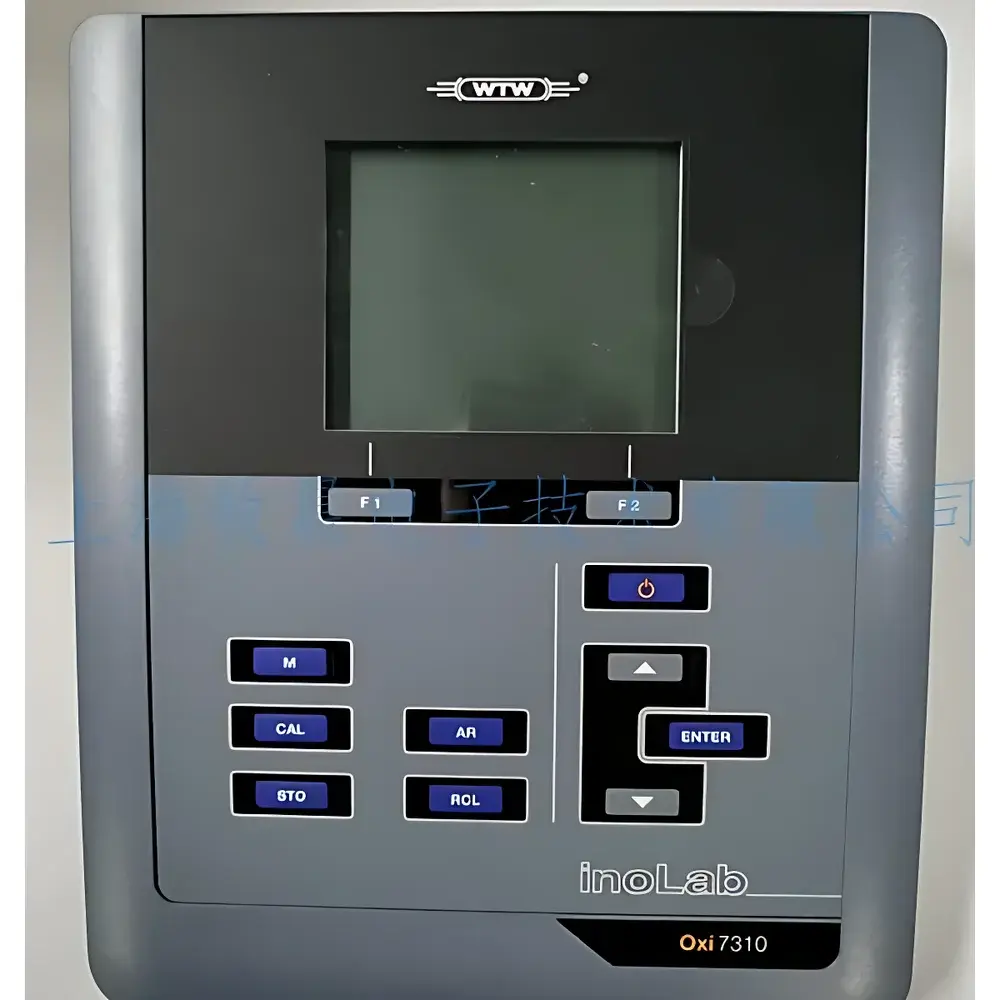
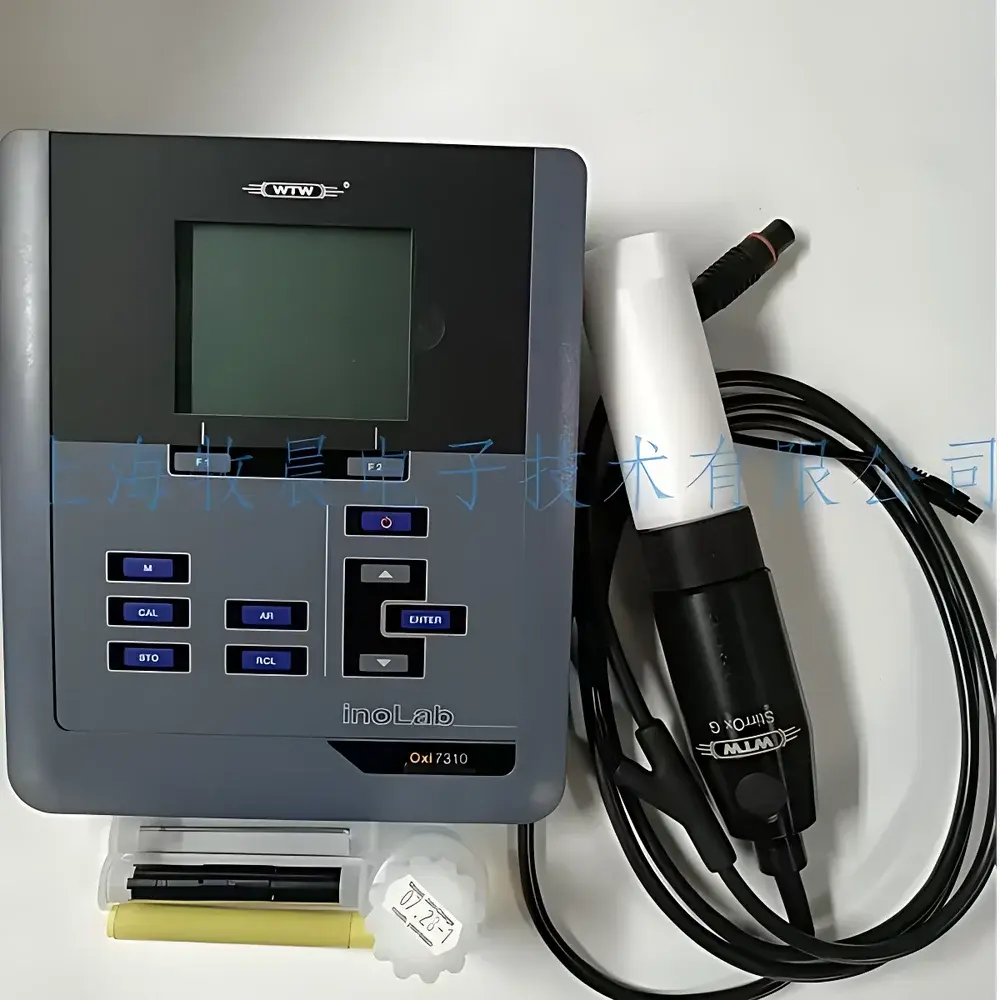
WTW inoLab Oxi 7310 Benchtop Dissolved Oxygen Meter
| Brand | WTW |
|---|---|
| Origin | Germany |
| Model | Oxi7310 |
| Instrument Type | Benchtop (not portable — corrected per technical specification) |
| Measurement Principle | Electrochemical (Clark-type polarographic sensor) |
| Dissolved Oxygen Range | 0.00–19.99 mg/L |
| Accuracy | ±0.5% of reading |
| Data Storage | 5,000 automatic / 500 manual entries |
| Pressure Compensation | Automatic (integrated barometric sensor, 500–1100 mbar) |
| Salinity Compensation | Manual (0.0–70.0 g/kg) |
| Temperature Range | 0.0–50.0 °C |
| Temperature Accuracy | ±0.1 °C |
| Interface | Mini-USB |
| Display | Backlit LCD with graphical capability |
| Power | AC adapter, 4×AA alkaline batteries, or USB bus power |
| Battery Life | Up to 800 h (backlight off), 100 h (backlight on) |
| Compliance | GLP/AQA-compliant data logging with audit trail support |
Overview
The WTW inoLab Oxi 7310 is a high-precision benchtop dissolved oxygen (DO) meter engineered for routine and regulatory-grade water quality analysis in environmental monitoring laboratories, municipal wastewater facilities, research institutions, and industrial process control environments. It operates on the Clark-type polarographic principle—utilizing a gold cathode and silver/silver chloride anode immersed in an electrolyte-filled membrane cap—to generate a diffusion-limited current proportional to the partial pressure of molecular oxygen dissolved in the sample. This electrochemical transduction ensures stable, reproducible measurements across varying temperatures, salinities, and hydrodynamic conditions. The instrument integrates automatic barometric pressure compensation via an internal sensor (500–1100 mbar range), eliminating manual correction errors, while supporting manual salinity input (0.0–70.0 g/kg) to correct for ionic strength effects on oxygen solubility. Designed for GLP (Good Laboratory Practice) and AQA (Analytical Quality Assurance) compliance, the Oxi7310 records full metadata—including date/time stamp, sensor ID, calibration history, temperature, pressure, and salinity settings—with traceable, tamper-resistant timestamps.
Key Features
- Benchtop architecture optimized for stability and long-term calibration retention—distinct from field-portable DO meters
- Integrated mini-USB interface enabling direct export of measurement data in CSV format to PCs or LIMS systems
- Optional built-in thermal printer for real-time hardcopy reporting of measurements and calibration reports
- Large-capacity memory storing up to 5,000 automatically logged readings and 500 manually triggered entries, each with full contextual metadata
- Graphical backlit LCD display supporting trend visualization, real-time DO/temperature overlays, and intuitive menu navigation
- Dual-range measurement capability: DO (0.00–20.00 mg/L at 0.01 mg/L resolution; 0–90.0 mg/L at 0.1 mg/L resolution), saturation (0–200.0 % at 0.01 % resolution; 0–600 % at 1 % resolution), and oxygen partial pressure (0–200.0 mbar at 0.01 mbar resolution; 0–1250 mbar at 1 mbar resolution)
- Temperature measurement with ±0.1 °C accuracy over 0.0–50.0 °C range, supporting automatic temperature compensation during DO calculation per ISO 5814 and ASTM D888 standards
Sample Compatibility & Compliance
The inoLab Oxi 7310 is compatible with WTW’s StirrOx-G self-stirring polarographic DO probe—a purpose-engineered sensor for BOD incubation vials and low-flow applications. The StirrOx-G incorporates an integrated magnetic stirrer motor that maintains consistent, turbulence-free flow across the membrane surface, eliminating dependence on external stirring and minimizing boundary layer artifacts. Its IP67-rated immersion housing allows safe use in submerged or splash-prone environments. With intrinsic oxygen consumption as low as 0.008 µg·h⁻¹ per mg/L, the probe minimizes analytical bias in low-oxygen or small-volume samples. The system supports full traceability per FDA 21 CFR Part 11 requirements when paired with compliant data management software, and meets ISO/IEC 17025 documentation expectations for accredited testing laboratories. Calibration verification follows ISO 5814:2012 (electrochemical determination of dissolved oxygen) and EPA Method 360.1.
Software & Data Management
Data acquisition and reporting are fully supported via WTW’s proprietary LabX® software (compatible with Windows OS), which enables remote configuration, automated calibration validation, batch report generation, and electronic signature workflows. All stored datasets include embedded calibration certificates, sensor diagnostics (e.g., membrane integrity checks, electrolyte level status), and environmental parameters used in calculation. Exported CSV files contain column headers aligned with LIMS ingestion standards (e.g., “Timestamp”, “DO_mg_L”, “Saturation_%”, “Temp_C”, “Pressure_mbar”, “Salinity_g_kg”). Audit trails record user actions—including calibration edits, data deletions, and parameter changes—with immutable timestamps and operator IDs where configured. Firmware updates preserve historical data integrity and maintain backward compatibility with prior calibration profiles.
Applications
- Regulatory wastewater effluent monitoring per NPDES permit requirements
- BOD₅ and BOD₂₀ testing using StirrOx-G probes in standard 300-mL BOD bottles under ASTM D5210 and ISO 5815-1
- Drinking water treatment plant process control (aeration basin optimization, clarifier performance assessment)
- Aquaculture and aquatic ecology studies requiring high-resolution DO profiling across temperature gradients
- Pharmaceutical water system validation (PW, WFI) per USP and EU GMP Annex 1
- Academic and governmental environmental research programs adhering to ISO 14001 or ISO/IEC 17025 frameworks
FAQ
Is the inoLab Oxi7310 classified as a portable or benchtop instrument?
It is a benchtop instrument—designed for fixed-lab deployment with AC power priority, extended battery life, and enhanced thermal stability—not a handheld or field-portable device.
Does the Oxi7310 support automatic salinity compensation?
No—it provides manual salinity input (0.0–70.0 g/kg) for compensation; automatic conductivity-based salinity detection requires integration with a separate WTW multiparameter probe (e.g., TetraCon® or SenTix® series).
Can the StirrOx-G probe be used with other WTW meters?
Yes—the StirrOx-G is compatible with all WTW inoLab and MultiLine® platforms supporting analog polarographic input and StirrOx-specific firmware protocols.
What is the recommended recalibration interval under GLP conditions?
Daily zero and span calibration is advised for critical applications; documented calibration checks must occur before each analytical batch and after any sensor maintenance or membrane replacement.
How does the Oxi7310 handle data integrity during power interruption?
All measurements and calibration events are written to non-volatile memory prior to display update, ensuring no loss of logged data during unexpected power loss or battery depletion.
Related Products







