
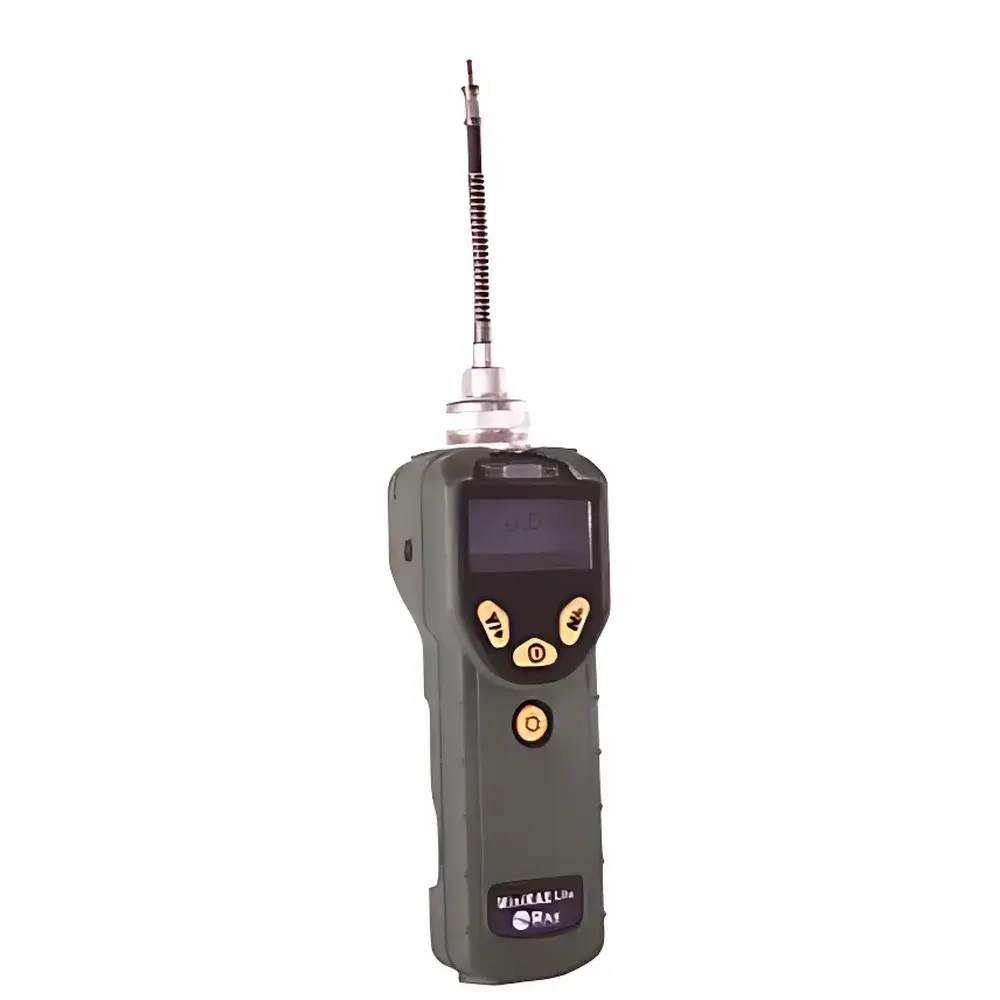
RAE Systems MiniRAE Lite PGM-7300 Portable VOC Detector with PID Sensor
| Brand | RAE Systems Inc. |
|---|---|
| Origin | USA |
| Manufacturer Type | Authorized Distributor |
| Origin Category | Imported |
| Model | PGM-7300 |
| Detection Principle | Photoionization Detection (PID) |
| Instrument Type | Portable |
| Configuration | Multi-gas VOC Detector |
| Detection Range | 0.1–5000 ppm |
| Resolution | 0.1 ppm |
| Accuracy | ±3% of reading |
| Response Time | T90 ≤ 2 s |
Overview
The RAE Systems MiniRAE Lite PGM-7300 is a compact, handheld volatile organic compounds (VOC) detector engineered for rapid, reliable, and field-deployable quantitative analysis in dynamic industrial and environmental settings. Utilizing third-generation photoionization detection (PID) technology, the instrument operates with a high-energy 10.6 eV ultraviolet lamp to ionize a broad spectrum of VOCs—including benzene, toluene, xylene, styrene, acetone, isopropanol, and many chlorinated hydrocarbons—without chemical consumption or catalytic degradation. Unlike flame ionization detectors (FIDs), which require hydrogen fuel and elevated operating temperatures, the PID-based MiniRAE Lite delivers inherently safer, lower-power, and maintenance-light operation while maintaining sub-part-per-trillion (ppt) detection capability for select compounds when calibrated appropriately. Its design prioritizes operational robustness in harsh environments: IP65-rated ingress protection, -20 °C to +50 °C operating temperature range, and shock-resistant housing meet IEC 60068-2 mechanical stress requirements.
Key Features
- Third-generation 10.6 eV UV lamp with patented self-cleaning mechanism—maintains consistent photon flux and extends lamp service life beyond 12,000 hours.
- Modular architecture enables tool-free sensor and battery replacement in under 30 seconds—critical during time-sensitive emergency response or routine calibration intervals.
- Integrated sampling pump with adjustable flow rate (300–500 mL/min) and support for extended sample draw via 30-meter conductive tubing; maintains measurement integrity across full draw length per ASTM D5402-19 guidelines for passive/active sampling validation.
- Bluetooth 4.2 LE and optional 802.11 b/g/n wireless modules enable real-time telemetry to cloud-connected dashboards or on-site mobile devices—compatible with RAE’s MultiRAE Pro software and third-party SCADA integrations.
- Internal data logger stores up to 12 months of second-by-second readings (1 million data points) with UTC timestamping, event tagging, and configurable alarm logging (TWA, STEL, peak, and excursion events).
Sample Compatibility & Compliance
The MiniRAE Lite PGM-7300 is validated for direct ambient air analysis and point-source sampling across diverse matrices including refinery headspace, wastewater treatment off-gases, indoor air quality (IAQ) surveys, and confined space entry pre-screening. It complies with OSHA 29 CFR 1910.120 (HAZWOPER), EPA Method TO-15 and TO-17 for VOC screening, and meets CE marking requirements under Directive 2014/30/EU (EMC) and 2014/34/EU (ATEX Category II 2G, Ex ib IIB T4 Gb). For regulated laboratory use, its firmware supports audit trail functionality aligned with FDA 21 CFR Part 11 Annex 11 principles—enabling electronic signature capture, user access control, and immutable data export in CSV or .raedat format.
Software & Data Management
RAE’s proprietary MultiRAE Pro desktop application provides full configuration management, calibration certificate generation (NIST-traceable), and advanced trend analytics—including temporal mapping, exposure heatmaps, and automated report generation compliant with ISO 45001 occupational health documentation standards. Raw sensor output undergoes digital signal processing using adaptive baseline correction and humidity-compensated algorithms (based on integrated RH/T sensor), reducing drift-related uncertainty in high-moisture environments. All firmware updates are cryptographically signed and delivered over secure HTTPS channels to ensure integrity and traceability.
Applications
- Petroleum refining: Leak detection and repair (LDAR) surveys per EPA 40 CFR Part 60 Subpart VV and Subpart OOOOa.
- Chemical manufacturing: Process vent monitoring, drum storage area screening, and fugitive emission quantification.
- Environmental remediation: Soil vapor intrusion assessment, landfill gas plume tracking, and brownfield site characterization.
- Occupational safety: Confined space entry verification, TWA/STEL compliance verification, and incident-driven hotspot identification.
- Indoor air quality: Post-remediation verification after mold abatement or solvent-based coating application.
FAQ
Does the MiniRAE Lite require daily bump testing?
Yes—per ISEA 101-2019 and manufacturer recommendations, a functional check with certified 100 ppm isobutylene standard gas is required before each day’s use.
Can it detect methane or carbon monoxide?
No—the 10.6 eV lamp does not efficiently ionize gases with ionization potentials >10.6 eV (e.g., CH₄ = 12.6 eV, CO = 14.0 eV); dedicated electrochemical or NDIR sensors are required for those analytes.
Is calibration traceable to NIST standards?
Yes—all factory calibrations are performed using NIST-traceable gas standards, and calibration certificates include uncertainty budgets per ISO/IEC 17025:2017 requirements.
What is the expected sensor lifetime under normal field use?
The PID lamp and electrode assembly typically sustain ≥18 months of continuous operation in typical industrial environments; replacement intervals are tracked automatically in device firmware and logged in calibration records.
Does it support intrinsically safe operation in Class I, Division 1 areas?
Yes—the PGM-7300 is certified as UL 913 Class I, Division 1, Groups A–D and ATEX II 2G Ex ib IIB T4 Gb, permitting use in flammable vapor atmospheres without explosion risk.
Related Products







