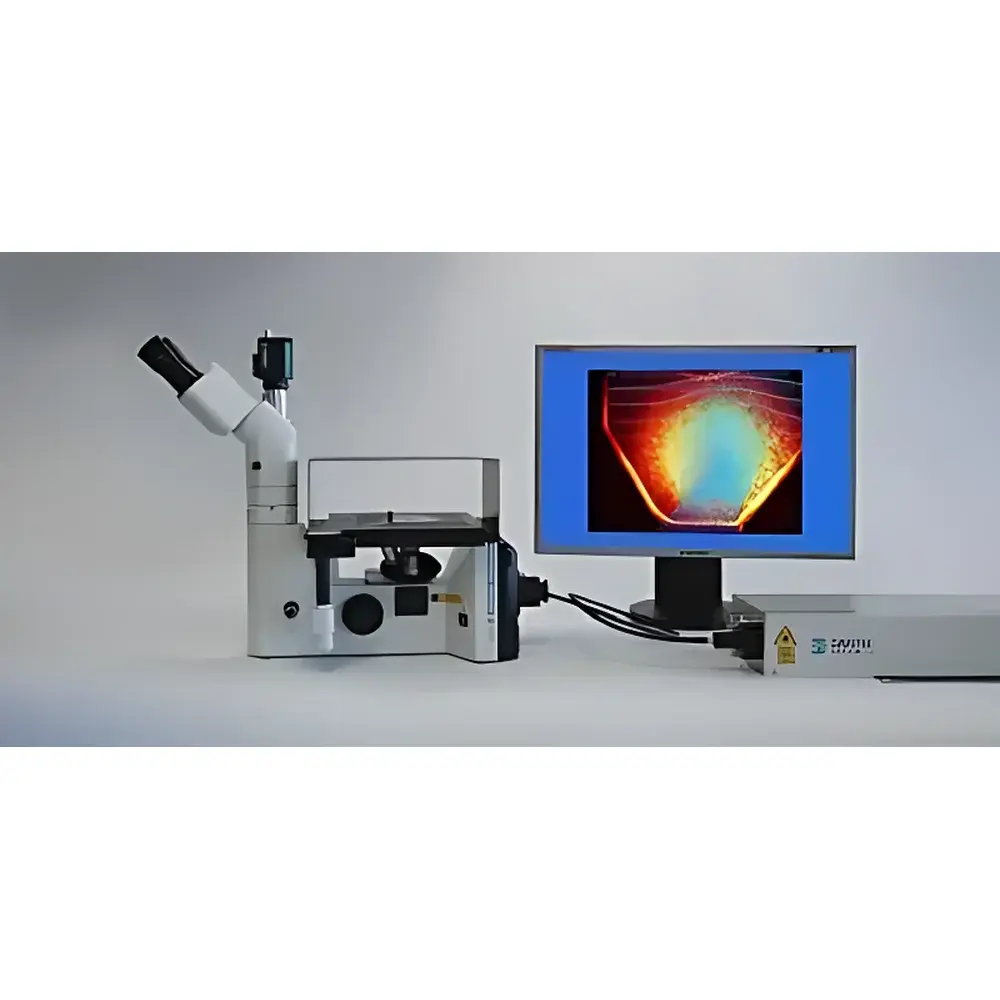
Dantec Dynamics MicroPIV System
| Brand | Dantec Dynamics |
|---|---|
| Origin | Denmark |
| Model | MicroPIV |
| Measurement Domain | 15 µm × 15 µm to 3 mm × 3 mm |
| Velocity Range | 0–2 m/s |
| Accuracy | ±1% of measured velocity |
| Spatial Resolution | Down to ~1 µm (dependent on optics & particle seeding) |
| Temporal Resolution | Low-frequency operation (typically < 100 Hz, configurable via laser pulse separation and camera frame rate) |
| Optical Configuration | Inverted fluorescence microscope optimized for PIV |
| Camera Option | HiSense MkII sCMOS sensor with peak quantum efficiency of 72% |
| Upgrade Paths | Unstructured grid PIV, MicroLIF (Micro Laser-Induced Fluorescence) |
Overview
The Dantec Dynamics MicroPIV System is a high-precision optical diagnostic platform engineered for quantitative two-dimensional (2D) and stereoscopic three-dimensional (3D) velocity field measurements in microscale fluidic environments. Based on the principle of Particle Image Velocimetry (PIV), the system captures sequential images of fluorescent or reflective tracer particles suspended in a fluid under pulsed laser illumination. By cross-correlating particle displacement between successive image pairs—acquired through a high-numerical-aperture inverted fluorescence microscope—the system computes instantaneous velocity vectors across the entire illuminated measurement plane. Unlike intrusive probes or single-point techniques, MicroPIV provides full-field, non-intrusive, time-resolved data with spatial resolution down to approximately 1 µm (subject to optical magnification, particle density, and seeding quality). Its integration with microfluidic device characterization makes it especially valuable for validating computational fluid dynamics (CFD) simulations, optimizing lab-on-a-chip designs, and investigating low-Reynolds-number flows where viscous effects dominate.
Key Features
- Inverted fluorescence microscope optimized specifically for PIV applications—featuring enhanced light transmission efficiency (up to 300% higher than standard inverted fluorescence platforms) to maximize signal-to-noise ratio in low-light microscale imaging.
- HiSense MkII sCMOS camera option with peak quantum efficiency of 72% at 560 nm, enabling high-fidelity acquisition of faint particle signals even under minimal laser fluence—critical for photolabile biological samples or low-concentration seeding.
- Modular architecture supporting seamless upgrades to advanced modalities, including unstructured-grid PIV for irregular geometries and MicroLIF (Micro Laser-Induced Fluorescence) for simultaneous concentration or temperature field mapping.
- Integrated laser synchronization unit for precise control of double-pulse separation (typically 1–100 µs), allowing adaptation to both quasi-steady and transient flow regimes within the 0–2 m/s operational range.
- Robust mechanical design compliant with ISO 14644-1 Class 5 cleanroom compatibility when configured with appropriate enclosures—suitable for use in academic cleanrooms, pharmaceutical microdevice development labs, and semiconductor R&D facilities.
Sample Compatibility & Compliance
The MicroPIV system accommodates a wide range of transparent or semi-transparent microfluidic substrates—including PDMS, glass, quartz, cyclic olefin copolymer (COC), and SU-8 photoresist devices—without requiring surface metallization or electrical contact. Tracer particle selection (e.g., 0.2–1.0 µm fluorescent polystyrene or silica beads) is guided by Stokes number constraints and refractive index matching to minimize slip velocity error. The system supports ASTM F3021-15 (Standard Guide for Microfluidic Device Characterization) and aligns with ISO/IEC 17025 requirements for measurement traceability when operated with calibrated reference standards. Data acquisition workflows are compatible with GLP/GMP documentation practices, and optional audit-trail-enabled software modules support FDA 21 CFR Part 11 compliance for regulated environments.
Software & Data Management
Dantec Dynamics’ DynamicStudio software provides end-to-end control—from hardware synchronization and real-time image preview to multi-pass interrogation, vector validation, and post-processing. The software implements adaptive window deformation algorithms and ensemble-averaging routines to improve accuracy in regions of high shear or low particle density. Export formats include HDF5, ASCII, and Tecplot-compatible PLT files for direct import into CFD post-processors (e.g., ANSYS Fluent, COMSOL Multiphysics, OpenFOAM). All raw image sequences, processing parameters, and metadata are stored in timestamped project archives with SHA-256 checksum verification—ensuring full reproducibility and version-controlled experiment tracking.
Applications
- Validation of numerical models for pressure-driven, electro-osmotic, and magnetohydrodynamic flows in microchannels.
- Quantitative analysis of mixing efficiency, vortex formation, and boundary layer development in droplet-based microreactors.
- Characterization of cell suspension rheology and particle migration under Dean flow in curved microchannels.
- Development and optimization of point-of-care diagnostic cartridges, organ-on-a-chip platforms, and micro-scale heat exchangers.
- Interfacial flow studies at liquid–liquid or liquid–gas boundaries with sub-micron spatial resolution.
FAQ
What is the minimum resolvable velocity magnitude in MicroPIV measurements?
The theoretical lower limit depends on pixel displacement detection capability and interrogation window size; under optimal conditions (high particle density, low noise, 2×2 pixel displacement threshold), velocities as low as ~10 µm/s can be resolved.
Can MicroPIV be used with opaque or highly scattering microfluidic materials?
No—optical access from at least two orthogonal directions (for stereo-PIV) or one high-NA objective path (for 2D-PIV) is required. Materials must exhibit sufficient transmission at the laser and emission wavelengths used.
Is calibration required before each experiment?
Yes—spatial calibration using a certified graticule and temporal calibration via laser pulse delay verification are recommended prior to quantitative measurements, particularly when changing magnification or fluid medium.
Does the system support real-time velocity field visualization?
DynamicStudio provides near-real-time vector field display during acquisition (with latency < 500 ms), though final validated results require post-processing with multi-pass correlation and outlier replacement.
How is data integrity ensured during long-duration experiments?
The system logs hardware timestamps, thermal drift compensation values, and sensor gain settings for every frame; combined with automatic disk-space monitoring and write-verification protocols, this ensures traceable, lossless acquisition over multi-hour sessions.