
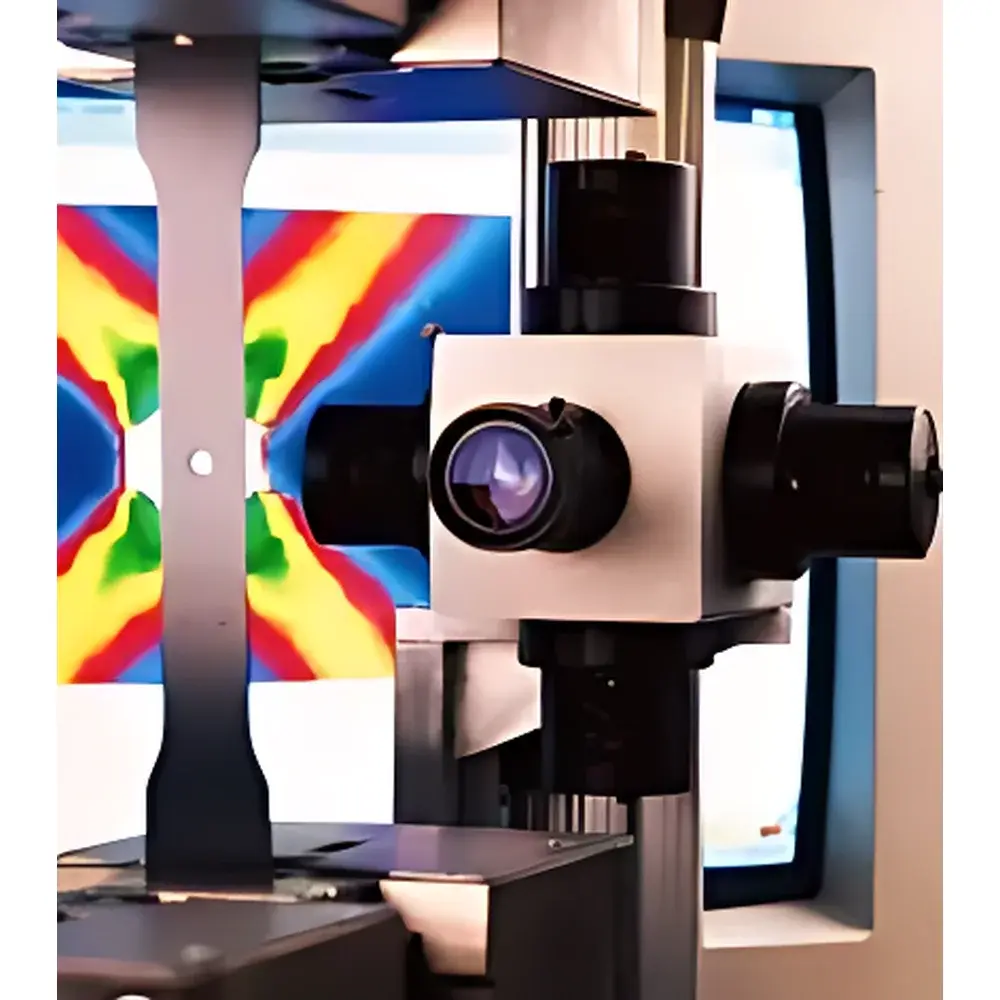
Dantec Dynamics Q-300 Electronic Speckle Pattern Interferometer (ESPI)
| Brand | Dantec Dynamics |
|---|---|
| Origin | Denmark |
| Model | Q-300 |
| Measurement Dimensions | 1D/2D/3D |
| Maximum Field of View | 200 mm × 300 mm |
| Displacement Resolution | 0.03–0.1 µm (adjustable) |
| Strain Range | 0.005%–100% |
| Contactless Operation | Yes |
| Application Domain | Full-field deformation, displacement, strain, and defect detection |
Overview
The Dantec Dynamics Q-300 Electronic Speckle Pattern Interferometer (ESPI) is a high-sensitivity, non-contact optical metrology system engineered for full-field, real-time measurement of surface deformation, displacement, and strain in solid mechanics applications. ESPI operates on the principle of coherent laser illumination and interferometric analysis of time-varying speckle patterns generated by scattering from rough surfaces. When a test object undergoes mechanical loading or thermal excitation, minute changes in surface topology induce phase shifts between two temporally separated speckle fields—captured by a high-resolution CCD or CMOS camera and processed via digital phase-shifting algorithms. The Q-300 implements dual-beam or multi-beam optical configurations to enable quantitative extraction of out-of-plane, in-plane, or fully 3D displacement components with sub-micron resolution. Its design adheres to fundamental principles of wave optics and coherent interferometry, making it suitable for laboratory-based R&D, structural integrity assessment, and validation of finite element models.
Key Features
- Full-field, non-contact measurement of displacement, strain, vibration modes, and surface defects without surface preparation or sensor attachment
- Configurable 1D, 2D, and 3D measurement capability via optical path selection and phase-unwrapping algorithms
- Adjustable displacement sensitivity ranging from 0.03 µm to 0.1 µm per fringe order, optimized for both micro-deformation and large-strain regimes
- Strain quantification across five decades—from 0.005% (50 µε) to 100%, supporting elastic, plastic, and post-yield characterization
- Real-time acquisition at frame rates up to 100 Hz (dependent on camera and processing load), enabling dynamic event capture such as impact response or thermal expansion transients
- Robust mechanical architecture with kinematic optical mounts, temperature-stabilized laser source (typically He–Ne or diode-pumped solid-state), and active vibration isolation compatibility
- Integrated environmental compensation options—including air turbulence correction and thermal drift monitoring—for improved long-duration measurement stability
Sample Compatibility & Compliance
The Q-300 accommodates a broad range of material types—including metals, composites, ceramics, polymers, and coated substrates—provided they exhibit sufficient surface roughness (Ra ≥ 0.2 µm) to generate stable speckle contrast. Specimen geometry is unconstrained within the field of view (up to 200 mm × 300 mm), and measurements are insensitive to specimen color, reflectivity (within operational laser power limits), or moderate ambient lighting. The system complies with ISO 10360-8 (geometrical product specifications – acceptance and verification tests for coordinate measuring systems – Part 8: CMMs with optical distance sensors), and its traceable calibration methodology supports adherence to ASTM E2567 (Standard Practice for Digital Image Correlation) and ISO/IEC 17025 requirements when deployed in accredited testing laboratories. All firmware and control logic are designed to support GLP/GMP audit trails where integrated with validated data management workflows.
Software & Data Management
Operation is managed through Dantec’s proprietary Istra 4D software platform, which provides synchronized hardware control, real-time fringe visualization, phase map generation, and vector field computation. The software supports batch processing, script-driven automation (via Python API), and export of displacement/strain maps in standard formats (HDF5, TIFF, CSV, VTK). Raw image sequences and processed results are stored with embedded metadata—including timestamp, laser wavelength, magnification, calibration coefficients, and user-defined experimental parameters—to ensure data provenance and reproducibility. For regulated environments, optional 21 CFR Part 11 compliance modules provide electronic signatures, role-based access control, and immutable audit logs. Data integrity is further reinforced through checksum validation and version-controlled configuration files.
Applications
- Mechanical testing: Quantitative strain mapping during tensile, compression, bending, and fatigue experiments
- Non-destructive evaluation (NDE): Detection and characterization of subsurface delaminations, disbonds, and impact damage in composite laminates
- Thermo-mechanical analysis: Real-time monitoring of thermal expansion coefficients and residual stress relaxation
- Micro-electromechanical systems (MEMS): In-situ actuation characterization and modal analysis of cantilevers and diaphragms
- Aerospace component validation: Deformation behavior of turbine blades, wing skins, and adhesive joints under simulated service loads
- Biomechanics research: Surface strain distribution in soft tissue analogs or bone specimens subjected to physiological loading
FAQ
What laser wavelength does the Q-300 use, and is it Class 1 compliant?
The system typically employs a stabilized 632.8 nm He–Ne laser or a 532 nm frequency-doubled DPSS source, configurable per application requirements. Laser safety class depends on optical configuration and enclosure integration—fully enclosed setups meet IEC 60825-1 Class 1 requirements.
Can the Q-300 measure through transparent materials such as glass or acrylic?
Yes—provided the rear surface or interface of interest produces sufficient speckle contrast. Transmission-mode ESPI configurations are available for volumetric or interface-specific displacement analysis.
Is external vibration isolation mandatory for reliable operation?
While not strictly mandatory, passive or active vibration isolation is strongly recommended for sub-100 nm displacement resolution. Performance degradation due to floor-borne noise becomes statistically significant below 0.05 µm sensitivity thresholds.
Does the system support synchronization with external loading equipment or environmental chambers?
Yes—the Q-300 features TTL-compatible trigger I/O and Ethernet-based command protocols compatible with universal test machines (UTMs), thermal chambers, and piezoelectric actuators for stimulus-synchronized acquisition.
How is calibration performed, and what traceability documentation is provided?
Calibration is conducted using NIST-traceable step-height standards and interferometric reference flats. A full calibration certificate—including uncertainty budgets per ISO/IEC 17025—is supplied with each instrument shipment and upon annual recalibration.



