
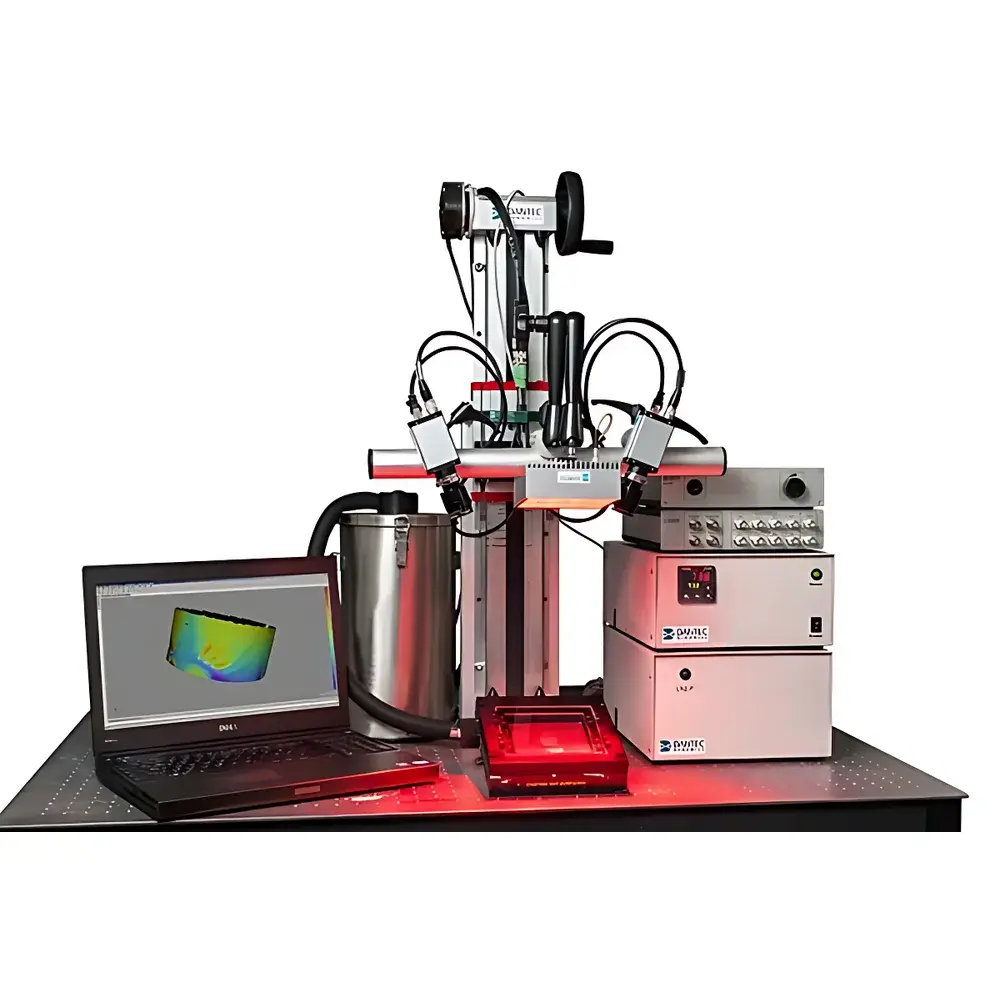
Dantec Dynamics Q-400TCT Digital Image Correlation (DIC) System for Thermal Expansion, Warpage, and Strain Mapping
| Brand | Dantec Dynamics |
|---|---|
| Origin | Germany |
| Model | Q-400TCT |
| Measurement Dimensions | 2D & 3D |
| Measurement Area | 20 mm × 20 mm to 250 mm × 250 mm |
| Displacement Resolution | 1 µm |
| Strain Range | 0.005% – 100% |
| Temperature Control Stage | −40 °C to +300 °C |
| Heating/Cooling Rate | up to 50 °C/min |
Overview
The Dantec Dynamics Q-400TCT is a high-precision, non-contact optical metrology system engineered for full-field thermal mechanical characterization of solid materials. Built upon digital image correlation (DIC) principles, the system captures sequential stereo or monocular images of a stochastic surface pattern applied to a specimen, then computes pixel-level displacement vectors by tracking intensity gradients across frames. This correlation-based algorithm enables quantitative mapping of in-plane and out-of-plane displacements, strains, and rigid-body motions—without requiring physical attachment or calibration artifacts. The Q-400TCT integrates a programmable environmental chamber with active temperature control (−40 °C to +300 °C), enabling real-time, synchronized acquisition during thermal ramping or isothermal holds. Its primary engineering purpose is the determination of coefficient of thermal expansion (CTE), warpage evolution, thermal strain distribution, and dimensional stability under controlled thermal loading—critical for qualification of PCBs, molded polymers, metal alloys, composites, and advanced packaging substrates.
Key Features
- Integrated high-stability temperature-controlled stage with ±0.5 °C uniformity over 200 mm × 200 mm active zone and programmable ramp/soak profiles
- Dual-camera stereo-DIC configuration supporting both 2D surface displacement and 3D shape+deformation reconstruction
- Modular lens and lighting options optimized for measurement scales from micro-scale (20 mm × 20 mm FOV) to macro-scale (250 mm × 250 mm FOV)
- Sub-pixel displacement resolution down to 1 µm and strain sensitivity of 0.005% (50 µε), traceable to NIST-traceable calibration standards
- Ruggedized optical bench with vibration-damped base and thermal drift compensation algorithms embedded in Istra4D software
- Real-time synchronization between thermal controller, camera trigger, and data logging via TTL and analog I/O interfaces
Sample Compatibility & Compliance
The Q-400TCT accommodates specimens ranging from thin film coupons (≥50 µm thickness) to rigid printed circuit assemblies (PCBAs) up to 300 mm diagonal. Surface preparation requires only a stochastic speckle pattern—achievable via airbrushed matte paint, laser ablation, or commercial spray—ensuring compatibility with metals, ceramics, silicon wafers, FR-4, polyimide, and epoxy-molded compounds. The system supports compliance workflows aligned with ASTM E228 (linear thermal expansion), IPC-TM-650 2.4.37 (warpage of laminates), JEDEC JESD22-A104 (temperature cycling), and ISO 11359-2 (polymer CTE). Data integrity meets GLP/GMP documentation requirements through audit-trail-enabled software and user-access controls compliant with FDA 21 CFR Part 11 when configured with optional electronic signature modules.
Software & Data Management
Istra4D v5.x serves as the native acquisition, processing, and reporting platform. It provides real-time DIC calculation at up to 15 Hz (full-resolution stereo mode), batch post-processing with spatial filtering and outlier rejection, and automated CTE derivation via linear regression of displacement vs. temperature curves. All raw images, calibrated coordinates, displacement fields, and metadata are stored in HDF5 format with embedded timestamps, environmental logs, and operator annotations. Export options include CSV, MATLAB .mat, and standardized XML schemas compatible with enterprise LIMS and PLM systems. Version-controlled script automation (Python API) enables integration into automated qualification test sequences and statistical process control (SPC) dashboards.
Applications
- CTE mismatch analysis in multi-layer packaging (e.g., die attach, underfill, substrate interfaces)
- Warpage quantification of wafer-level packages (WLP), fan-out wafer-level packages (FOWLP), and panel-level substrates during reflow simulation
- Thermo-mechanical fatigue assessment of solder joints under thermal cycling conditions
- Validation of finite element models (FEM) for thermal stress prediction in aerospace composites and power electronics modules
- Dimensional stability testing of additive-manufactured metal parts across build orientations
- Strain gradient mapping in heterogeneous materials such as metal matrix composites and ceramic–polymer hybrids
FAQ
What temperature ramp rates are achievable while maintaining measurement fidelity?
The system supports controlled ramps up to 50 °C/min; however, optimal DIC accuracy is maintained at ≤20 °C/min for high-strain-gradient samples, with adaptive frame rate adjustment enabled in Istra4D.
Can the Q-400TCT measure through transparent encapsulants or glass lids?
Yes—provided the underlying surface has adequate speckle contrast and minimal optical distortion; refractive index matching or polarization filtering may be required for thick or curved transparent media.
Is calibration required before each test series?
A single geometric calibration (camera-lens-stage alignment) suffices for all measurements within a fixed setup; thermal drift correction is performed automatically during acquisition using reference markers.
How is uncertainty quantified for CTE results?
Istra4D reports combined standard uncertainty per ASTM E2554, incorporating contributions from pixel noise, lens distortion, temperature sensor accuracy (±0.3 °C), and speckle pattern quality metrics.
Does the system support third-party thermal chambers?
Yes—the Q-400TCT optical head and software support external chamber integration via RS-232, Ethernet, or analog voltage interfaces for custom environmental control environments.



