Dantec Dynamics PIV System – Low-Frequency Particle Image Velocimetry Instrument
| Brand | Dantec Dynamics |
|---|---|
| Origin | Denmark |
| Manufacturer Status | Authorized Distributor |
| Import Category | Imported |
| Model | Low-Frequency PIV |
| Measurement Capability | Planar (2D/3D) |
| Measurement Frequency | Low-Frequency |
| Velocity Range | 0–1000 m/s |
| Accuracy | ±1% |
| Measurement Area | 200 mm × 200 mm to 1000 mm × 1000 mm |
Overview
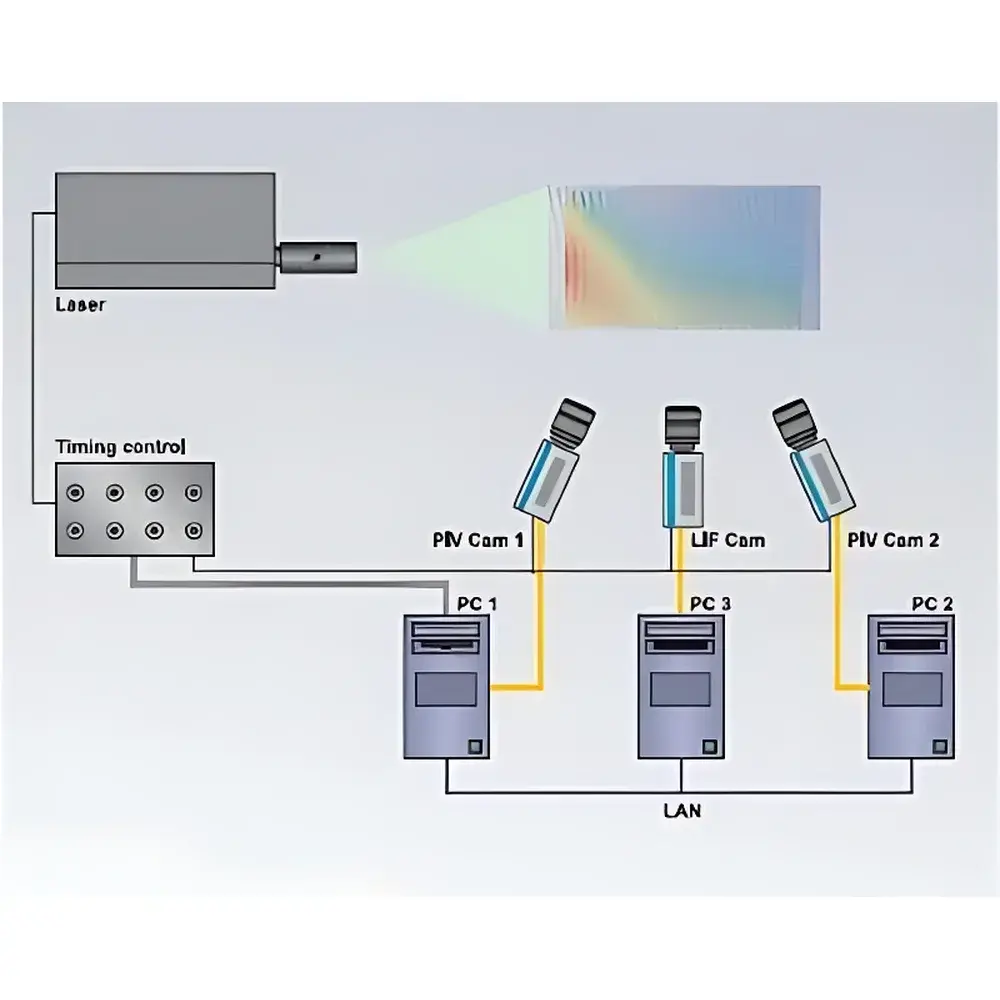
The Dantec Dynamics Low-Frequency Particle Image Velocimetry (PIV) System is an optically based, non-intrusive flow diagnostic instrument engineered for quantitative, planar velocity field measurements in transparent fluid media—including gases and liquids. Operating on the principle of double-pulse laser illumination and high-resolution digital imaging, the system captures two successive particle-seeded images within a user-defined time interval (Δt). Cross-correlation analysis of these image pairs yields instantaneous, spatially resolved velocity vectors across the entire illuminated measurement plane. Unlike point-wise techniques—such as hot-wire anemometry, Pitot tubes, or Laser Doppler Velocimetry (LDV)—which inherently suffer from temporal asynchrony when reconstructing planar fields, PIV acquires all velocity data simultaneously, preserving phase coherence and enabling true snapshot characterization of unsteady, turbulent, or transient flows. This capability is essential for validating computational fluid dynamics (CFD) simulations, investigating vortex dynamics, quantifying mixing efficiency, and characterizing boundary layer development under realistic operating conditions.
Key Features
- Optical, non-intrusive measurement architecture—eliminates probe-induced flow disturbance and sensor calibration drift.
- Support for multiple vector field configurations: 2D2C (two-dimensional, two-component), 2D3C (stereo-PIV), and 3D3C (tomographic PIV) with appropriate optical setup and camera synchronization.
- Proprietary unstructured mesh PIV algorithm—enables robust interrogation in regions of strong shear, discontinuity, or complex geometry where conventional regular-grid correlation fails.
- Multi-pass, adaptive interrogation window deformation—enhances resolution near boundaries and in low-signal regions while maintaining global convergence.
- Integrated Particle Tracking Velocimetry (PTV) module with feature-tracking capability—supports Lagrangian trajectory reconstruction and statistical ensemble averaging over thousands of seeding particles.
- Modal decomposition suite including Proper Orthogonal Decomposition (POD) and Oscillation Pattern Decomposition (OPD)—facilitates spatiotemporal stability analysis, coherent structure identification, and reduced-order modeling of turbulent flows.
- Hardware-synchronized triggering interface—allows precise alignment of PIV acquisition with external stimuli such as pressure transducers, acoustic exciters, or CFD solver time steps.
Sample Compatibility & Compliance
The system is compatible with standard neutrally buoyant tracer particles (e.g., polystyrene latex, hollow glass spheres, or oil droplets) sized between 0.5 µm and 10 µm, selected based on fluid kinematic viscosity and Stokes number requirements. Illumination is achieved via frequency-doubled Nd:YAG lasers (typically 532 nm) with pulse energies scalable from 10 mJ to >200 mJ per pulse. All optical components comply with IEC 60825-1:2014 Class 4 laser safety standards. The instrument architecture supports audit-trail-enabled operation in GLP- and GMP-regulated environments; software modules are configurable to meet FDA 21 CFR Part 11 requirements for electronic records and signatures when deployed in pharmaceutical or biomedical fluid research applications. Calibration traceability follows ISO/IEC 17025 guidelines through NIST-traceable reference plates and certified flow rigs.
Software & Data Management
The system operates under Dantec Dynamics’ DynamicStudio™ platform—a modular, scriptable environment built on Qt and Python APIs. Core processing includes real-time correlation, vector validation (peak ratio, universal outlier detection), sub-pixel interpolation, and multi-frame ensemble averaging. Export formats include HDF5, ASCII, Tecplot PLT, and VTK for direct ingestion into post-processing tools such as MATLAB, ParaView, or ANSYS Fluent. Time-resolved datasets support automated batch processing via XML-based workflow definitions. All processing parameters, hardware settings, and metadata are embedded in output files, ensuring full experimental reproducibility. Audit logs record operator actions, parameter changes, and file modifications—critical for regulatory submissions and inter-laboratory comparison studies.
Applications
- Aerodynamic development of automotive and aerospace components—surface flow visualization, separation bubble detection, wake characterization.
- Combustion chamber diagnostics—flame-front propagation velocity, turbulent flame speed estimation, fuel-air mixing assessment.
- Biomedical fluid mechanics—blood flow in stented arteries, inhalation dynamics in upper airways, microfluidic device validation.
- Environmental hydraulics—sediment transport in open channels, wave–structure interaction, pollutant dispersion modeling.
- Industrial process optimization—mixing tank homogeneity evaluation, nozzle jet development, HVAC airflow uniformity mapping.
FAQ
What does “low-frequency PIV” mean in practice?
Low-frequency PIV refers to systems optimized for time-resolved measurements at repetition rates typically below 15 Hz—suited for quasi-steady or slowly evolving flows such as natural convection, large-scale vortex shedding, or steady-state wind tunnel testing. It prioritizes high dynamic range, signal-to-noise ratio, and spatial resolution over ultra-high frame rates.
Can this system perform true 3D3C measurements?
Yes—when configured with four synchronized high-speed cameras and tomographic reconstruction optics, the platform supports volumetric 3D3C velocity field reconstruction. This requires additional calibration procedures and increased computational resources.
Is third-party software integration supported?
DynamicStudio provides native Python bindings and RESTful API access for custom automation, machine learning pipeline integration, and real-time feedback control loops.
How is measurement accuracy validated?
Accuracy is verified using calibrated rotating disk targets, precision translation stages, and synthetic image generation tools that embed known displacement fields with controlled noise profiles—per ASTM F3082-14 standards for PIV uncertainty quantification.
Does the system support long-term unattended operation?
With proper thermal management, stable laser power supply, and automated focus/motion compensation, the system supports continuous acquisition over multi-hour campaigns—common in environmental or industrial monitoring applications.