
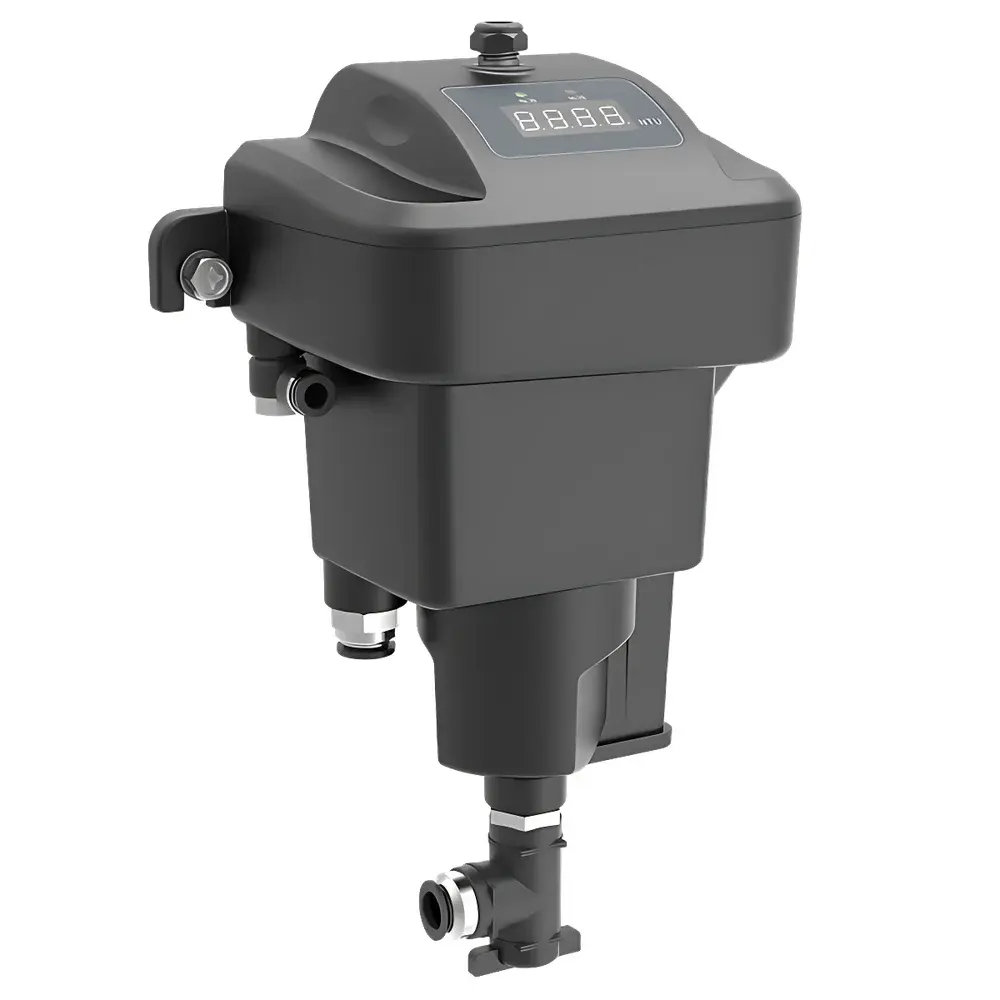
Zming Environmental HQ10-LT Online Low-Range Turbidimeter
| Brand | Zming Environmental Technology Co., Ltd. |
|---|---|
| Origin | Jiangsu, China |
| Manufacturer Type | Authorized Distributor |
| Country of Origin | China |
| Model | HQ10-LT |
| Price | Upon Request |
| Measurement Range | 0–20 NTU (customizable ranges available) |
| Resolution | 0.001 NTU |
| Accuracy | ±2% or ±0.02 NTU (whichever is greater) |
| Zero Drift | ≤0.015 NTU |
| Operating Temperature | 0–50 °C (non-freezing) |
| Storage Temperature | −10–60 °C |
| Power Supply | 12 V DC / 0.03 A |
| Light Source | Long-life laser diode |
| Output Interface | RS485 Modbus RTU |
| Display | Integrated LCD screen |
| Anti-condensation Design | Yes |
| Flow Stabilization & De-aeration System | Built-in |
Overview
The Zming Environmental HQ10-LT Online Low-Range Turbidimeter is an industrial-grade, continuous-monitoring instrument engineered for precise turbidity measurement in ultra-low-turbidity water matrices. It operates on the principle of 90° scattered light detection using a stable, temperature-compensated laser diode source—complying with ISO 7027-1:2016 and EPA Method 180.1 for nephelometric turbidity measurement. Designed specifically for applications where turbidity values frequently fall below 0.5 NTU—including finished drinking water, membrane filtrate, point-of-use systems, and distribution network endpoints—the HQ10-LT delivers metrological reliability under dynamic hydraulic conditions. Its optical architecture minimizes sensitivity to flow-induced turbulence and microbubble interference through integrated laminar flow conditioning and passive de-aeration, enabling stable long-term operation without recalibration or consumable replacement.
Key Features
- Laser-based 90° nephelometric detection with <0.015 NTU detection limit—validated per ISO/IEC 17025-accredited calibration protocols
- Built-in flow stabilization chamber and microbubble suppression system to ensure measurement repeatability across variable inlet pressures (0.1–6 bar)
- Condensation-resistant optical path design with heated sensor window and thermal gradient management—enabling reliable deployment in high-humidity environments (e.g., pump stations, underground vaults)
- Self-contained 12 V DC power architecture optimized for low-power SCADA integration; typical current draw: 36 mW at steady state
- Integrated monochrome LCD display with real-time NTU readout, status indicators (flow OK, signal strength, calibration alert), and local menu navigation
- RS485 serial interface compliant with Modbus RTU protocol (slave ID configurable, baud rate 9600–115200 bps) for seamless integration into PLC-based monitoring networks
Sample Compatibility & Compliance
The HQ10-LT is validated for continuous online measurement in clarified potable water, reverse osmosis permeate, nanofiltration effluent, and disinfected distribution system water. It meets the performance criteria specified in ISO 7027-1:2016 for instrument linearity, zero stability, and scatter response uniformity. For regulatory reporting, its measurement traceability aligns with national metrology standards maintained by CNAS-accredited laboratories in China (CNAS L7231). While not certified for FDA 21 CFR Part 11 compliance out-of-the-box, audit-ready data logging—when paired with compatible SCADA historian software—supports GLP/GMP-aligned operational qualification (OQ) documentation for municipal and industrial QA/QC workflows.
Software & Data Management
The HQ10-LT outputs raw and processed turbidity values via Modbus register mapping (holding registers 40001–40010), including real-time NTU, temperature-compensated signal voltage, flow status flag, and internal diagnostics. When interfaced with Zming’s optional cloud gateway (ZMGW-200), data are transmitted via TLS 1.2-encrypted MQTT to a secure SaaS dashboard supporting time-series visualization, threshold-based SMS/email alerts, and exportable CSV reports. All remote access adheres to IEC 62443-3-3 Level 1 cybersecurity principles. Local data retention is not performed on-device; persistent storage requires external historian or SCADA system configuration.
Applications
- Drinking water treatment: Final effluent monitoring at clearwell outlets and chlorine contact basins
- Distribution system integrity verification: Real-time detection of particulate release from pipe corrosion or biofilm sloughing at critical nodes (e.g., dead ends, valve chambers)
- Secondary water supply systems: Continuous verification of booster station filtration performance and tank sediment resuspension events
- Membrane process control: Feed-forward feedback for backwash scheduling in UF/MF plants based on permeate turbidity excursions
- Recreational water safety: Compliance monitoring for swimming pool and spa circulation loops per WHO Guidelines for Safe Recreational Water Environments
- Environmental surveillance: Low-turbidity baseline tracking in protected surface water intakes and spring sources
FAQ
What is the minimum detectable turbidity level, and how is it verified?
The instrument achieves a practical detection limit of 0.015 NTU, determined under controlled laboratory conditions using formazin primary standards traceable to NIST SRM 2134. This value reflects 3σ noise floor over 60-second averaging and is documented in the factory calibration certificate.
Does the HQ10-LT require periodic lamp replacement or optical cleaning?
No. The laser diode has a rated lifetime exceeding 100,000 hours (>11 years continuous operation), and the optical path is sealed and purge-protected. No user-serviceable light source or lens cleaning is required during normal service life.
Can the device operate reliably in outdoor enclosures exposed to condensation?
Yes. The sensor head incorporates dual-stage anti-condensation engineering: a thermally isolated optical chamber and resistive window heating (activated automatically below 12 °C ambient), preventing dew formation that could otherwise scatter incident light.
Is analog output (e.g., 4–20 mA) available as an alternative to Modbus?
Not natively. The HQ10-LT provides digital-only communication via RS485 Modbus RTU. Analog conversion requires an external protocol converter (e.g., MOXA EDS-405A with Modbus-to-4–20 mA firmware).
How often must the instrument be calibrated in field use?
Factory calibration remains valid for 12 months under typical municipal water conditions. Field verification using 0.02 NTU and 1.0 NTU formazin standards is recommended quarterly; full recalibration is advised only if verification error exceeds ±0.03 NTU or after mechanical shock or extended dry-run exposure.
Related Products







