
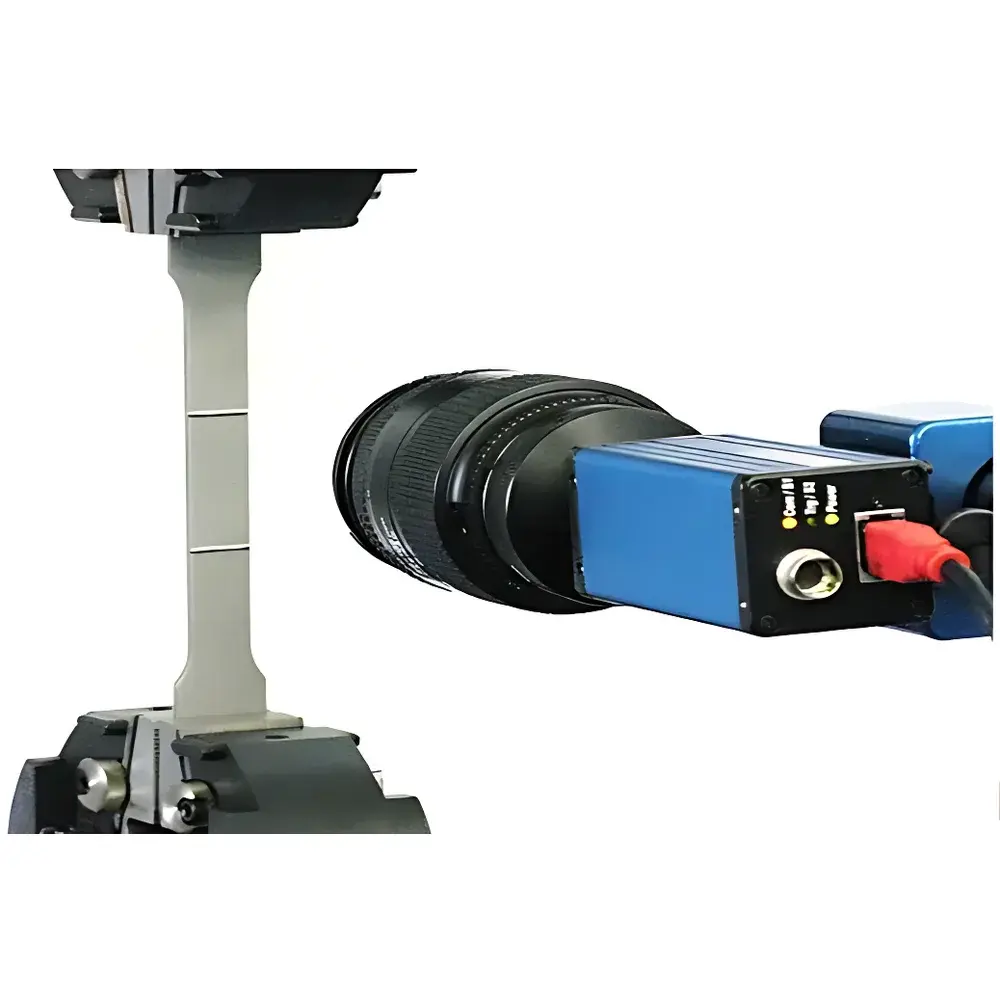
Dantec Dynamics RTSS Q-410 Real-Time Optical Strain Sensor
| Brand | Dantec Dynamics |
|---|---|
| Origin | Germany |
| Model | RTSS Q-410 |
| Measurement Principle | Digital Image Correlation (DIC)-based Real-Time Strain Sensing |
| Sampling Rate | Up to 4,000 Hz |
| Output Interface | Analog (±10 V) and Digital (Ethernet, TTL Sync) |
| Compliance | CE, RoHS |
| Supplier Status | Authorized Distributor |
| Origin Category | Imported Instrument |
Overview
The Dantec Dynamics RTSS Q-410 Real-Time Optical Strain Sensor is a high-speed, non-contact strain measurement system engineered for integration into mechanical testing environments—particularly uniaxial tensile, compression, and cyclic fatigue test setups. Unlike traditional contact-based extensometers, the RTSS Q-410 employs a calibrated monochrome CMOS camera coupled with real-time digital image correlation (DIC) algorithms to compute longitudinal and transverse strain directly from surface texture patterns on the specimen. The system operates by tracking two user-defined virtual gauge lines—oriented parallel and perpendicular to the loading axis—and continuously calculating engineering strain (εxx, εyy) at up to 4,000 full-field updates per second. This enables precise, drift-free strain acquisition without mechanical interference, thermal influence, or slippage artifacts common in clip-on or laser interferometric solutions. Its deterministic latency (<100 µs end-to-end) and hardware-synchronized trigger architecture ensure temporal alignment with load-cell and displacement signals—critical for closed-loop control and high-fidelity stress–strain curve reconstruction.
Key Features
- Real-time strain computation at up to 4,000 Hz with sub-pixel displacement resolution (≤0.01 pixel RMS noise)
- Dual-output interface: analog voltage outputs (±10 V, 16-bit DAC) for direct integration with servo-hydraulic controllers, plus Ethernet-based digital streaming (TCP/IP) for synchronized data logging
- Hardware-triggered acquisition with TTL-compatible sync input/output for phase-locked operation with universal testing machines (UTMs)
- Configurable virtual gauge length (0.5–100 mm) and orientation via intuitive PC-based setup software
- Ruggedized industrial housing (IP54-rated) with passive thermal management, suitable for laboratory and production-floor deployment
- No calibration drift: optical geometry remains invariant between measurements; only initial camera calibration required per setup
Sample Compatibility & Compliance
The RTSS Q-410 accommodates specimens across a broad range of materials—including metals, polymers, composites, elastomers, and thin films—as long as surface texture provides sufficient contrast for reliable DIC tracking. Specimen preparation may involve stochastic speckle patterning (e.g., airbrushed matte white/black paint), though naturally textured surfaces (e.g., rolled steel, extruded profiles) often require no treatment. The system complies with European CE marking requirements and adheres to RoHS 2011/65/EU directives for hazardous substance restriction. While not a certified metrology instrument per ISO/IEC 17025, its traceable performance aligns with ASTM E8/E8M (tension testing of metallic materials) and ISO 527-1 (plastics tensile testing) best practices for non-contact strain measurement validation. All firmware and configuration files support audit-ready versioning, facilitating GLP/GMP-aligned documentation workflows.
Software & Data Management
Configuration, calibration, and real-time monitoring are managed through Dantec’s proprietary RTSS Control Center—a Windows-based application supporting both local operation and remote supervision via network connection. The software provides live overlay of gauge lines, strain trend plots, and configurable alarm thresholds (e.g., yield onset detection). Raw strain time-series data are exported in ASCII (.csv) and HDF5 formats, preserving metadata such as timestamp (PTPv2-synchronized), camera exposure settings, and synchronization pulse logs. For regulated environments, optional FDA 21 CFR Part 11 compliance packages include electronic signatures, role-based access control, and immutable audit trails for all parameter changes and calibration events. Integration with third-party platforms (LabVIEW, MATLAB, Python via TCP socket API) is supported without proprietary runtime dependencies.
Applications
- High-strain-rate tensile testing of advanced high-strength steels and aluminum alloys under dynamic loading conditions
- In-situ strain mapping during thermomechanical cycling of shape-memory alloys and Ni-based superalloys
- Validation of finite element models using full-field strain data at critical deformation stages (necking, yielding, fracture initiation)
- Quality assurance in automotive component testing where contact extensometers risk altering local stress states
- Research-grade characterization of soft biomaterials (hydrogels, tissues) where minimal boundary perturbation is mandatory
- Feedback signal generation for adaptive load control in closed-loop fatigue testers operating above 100 Hz
FAQ
What is the minimum required surface pattern contrast for reliable tracking?
A minimum grayscale standard deviation of ≥35 DN (8-bit) across the gauge region is recommended. Speckle size should be 2–5 pixels in diameter for optimal sub-pixel accuracy.
Can the RTSS Q-410 measure Poisson’s ratio in real time?
Yes—simultaneous acquisition of εxx and εyy enables continuous calculation of instantaneous Poisson’s ratio (ν = −εyy/εxx) with user-defined smoothing windows.
Is camera recalibration needed after every test?
No—once geometric calibration (focal length, lens distortion, sensor tilt) is performed for a fixed optical setup, it remains valid unless mechanical repositioning occurs.
Does the system support multi-camera stereo configurations?
The RTSS Q-410 is a single-camera solution; stereo-DIC functionality requires the separate Dantec Dynamics Q-Series Stereo system.
How is synchronization achieved with third-party test controllers?
Via hardware TTL trigger signals (start/stop/frame-sync) and/or IEEE 1588 Precision Time Protocol (PTP) over Ethernet for sub-millisecond temporal alignment.



