
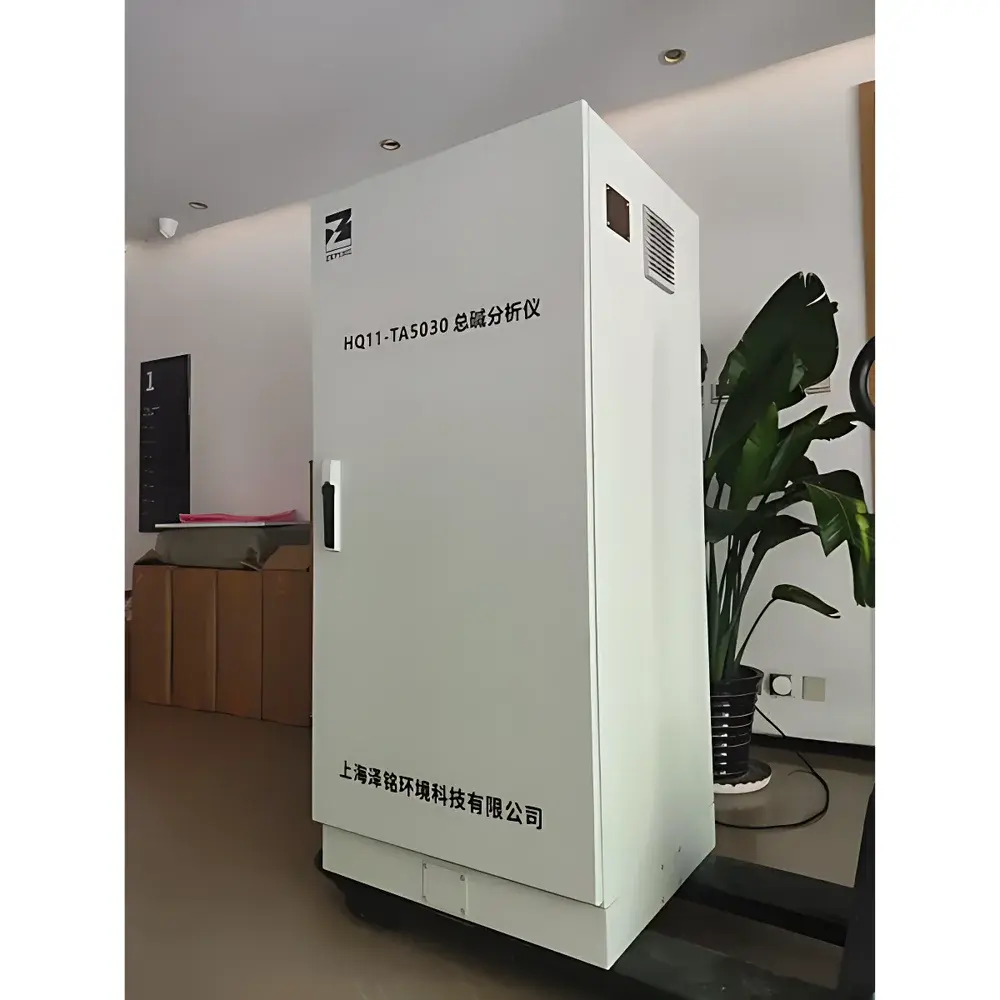
Zming HQ11-TA5030 Total Alkalinity Analyzer
| Brand | Zming Environmental Technology Co., Ltd. |
|---|---|
| Origin | Shanghai, China |
| Manufacturer Type | Authorized Distributor |
| Product Origin | Domestic (China) |
| Model | HQ11-TA5030 |
| Pricing | Upon Request |
Overview
The Zming HQ11-TA5030 Total Alkalinity Analyzer is a dedicated benchtop analytical instrument engineered for precise, automated determination of total alkalinity in aqueous samples—primarily targeting municipal and industrial wastewater, drinking water, boiler feedwater, cooling tower systems, and environmental monitoring applications. It operates on a hybrid analytical principle combining potentiometric titration with spectrophotometric endpoint detection, enabling high reproducibility across variable sample matrices. The system implements acid–base titration using standardized sulfuric or hydrochloric acid titrant against carbonate/bicarbonate/hydroxide species, with pH-sensitive electrode feedback and optional colorimetric confirmation to minimize interference from turbidity, suspended solids, or weak acid buffers. Its modular fluidic architecture isolates reagent pathways from peristaltic pump tubing, significantly extending consumable service life and reducing maintenance frequency.
Key Features
- Multi-method validation support: Simultaneous operation of potentiometric titration and spectrophotometric (colorimetric) endpoint detection ensures robust result verification under diverse water quality conditions.
- High-precision fluid handling: Peristaltic pumping system delivers titrant volumes with ±20 µL accuracy per drop, calibrated against NIST-traceable standards and verified via gravimetric dispensing protocols.
- Isolated fluid path design: Tubing-free contact between pump rollers and liquid stream eliminates cross-contamination risk and extends pump tube lifetime beyond 10,000 cycles under standard operating conditions.
- Integrated temperature compensation: Built-in Pt100 sensor enables real-time correction of titration curves according to sample temperature (range: 5–40 °C), aligning results with ASTM D1067 and ISO 9963-1 reporting conventions.
- Modular reagent management: Dual-reagent cartridge interface supports pre-filled, barcode-scanned acid and indicator solutions—reducing manual preparation errors and supporting GLP-compliant audit trails.
- Self-diagnostic firmware: Automated calibration verification, electrode impedance monitoring, and flow-path pressure sensing provide proactive fault alerts prior to measurement deviation.
Sample Compatibility & Compliance
The HQ11-TA5030 accepts liquid samples with TSS ≤ 100 mg/L and chloride concentration < 5,000 mg/L without pretreatment. It accommodates sample volumes from 25 mL to 100 mL and tolerates pH ranges from 4.0 to 11.5. Method performance complies with EPA Method 310.1 (Alkalinity, Titrimetric), ASTM D1067–22, and ISO 9963-1:2021. Instrument firmware supports 21 CFR Part 11–compliant user authentication, electronic signatures, and immutable audit logs when operated in networked laboratory environments. All calibration and QC data are timestamped, operator-identified, and exportable in CSV or PDF formats for regulatory submission.
Software & Data Management
The embedded Zming Analytical Suite v3.2 provides intuitive touchscreen navigation, method library management, and customizable report templates aligned with ISO/IEC 17025 documentation requirements. Data integrity safeguards include role-based access control (admin/operator/technician profiles), automatic backup to internal SSD and optional cloud sync (via TLS 1.3 encrypted HTTPS), and configurable retention policies. Raw titration curves, derivative plots, and endpoint interpolation tables are stored alongside metadata (sample ID, analyst, ambient temperature, barometric pressure). Export options include LIMS-compatible XML, Excel-ready .xlsx, and print-ready PDF with digital signature fields.
Applications
- Wastewater treatment plant process control: Real-time alkalinity monitoring for biological nutrient removal (BNR) optimization and lime dosing calibration.
- Drinking water quality assurance: Verification of corrosion control stability and compliance with WHO Guidelines for Drinking-water Quality (Section 12.3.2).
- Power generation facilities: Feedwater and condensate alkalinity profiling to prevent copper alloy corrosion in steam cycles.
- Environmental field labs: Rapid assessment of carbonate buffering capacity in surface water bodies impacted by acid mine drainage or agricultural runoff.
- Academic research: Teaching laboratories utilize the dual-endpoint functionality to demonstrate titration theory, buffer equilibria, and carbonate system speciation modeling.
FAQ
What titration methods does the HQ11-TA5030 support?
It supports both potentiometric titration (using a combination pH electrode) and spectrophotometric titration (with bromocresol green–methyl red indicator), allowing method cross-validation per ISO 9963-1 Annex B.
Can the instrument be integrated into an existing LIMS?
Yes—it provides HL7 and ASTM E1384-compliant data export, plus optional OPC UA server module for real-time integration with enterprise laboratory informatics platforms.
Is routine electrode calibration required before each analysis?
No; the system performs automatic electrode diagnostics and slope verification at startup and between samples. Full 2-point calibration is recommended every 8 hours of continuous use or after reagent cartridge replacement.
Does the analyzer meet GLP or GMP requirements?
When configured with audit trail logging, electronic signatures, and user access controls enabled, it satisfies core GLP principles per OECD Series on Principles of Good Laboratory Practice and supports GMP-aligned water system qualification per USP and EP 2.2.38.
What maintenance intervals are specified for pump tubing and electrodes?
Peristaltic tubing requires replacement every 6 months under typical usage (≤20 analyses/day); pH electrodes are rated for ≥12 months of continuous immersion in buffered aqueous media with weekly cleaning and storage in 3 M KCl solution.
Related Products







