
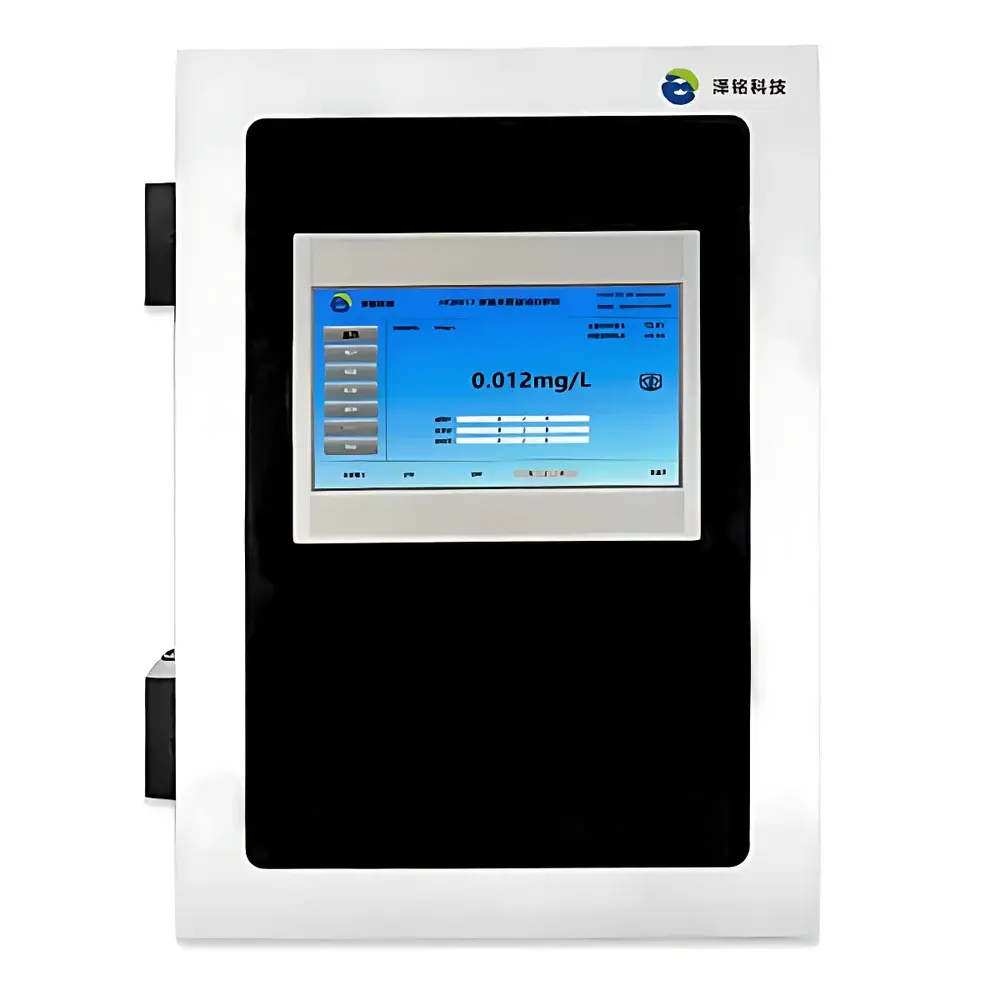
Zming Environmental HQ6000 Series Microfluidic Ammonia Nitrogen / Free & Total Chlorine / Residual Ozone Analyzer
| Brand | Zming Environmental Technology Co., Ltd. |
|---|---|
| Origin | Jiangsu, China |
| Manufacturer Type | Authorized Distributor |
| Product Origin | Domestic (China) |
| Models | HQ6017, HQ6018, HQ6019 |
| Instrument Type | Online Analyzer |
| Measurement Principle | Colorimetric Method (DPD-based) |
| Optical Path Length Options | 2, 5, 10, 20, 30, 40 mm |
| Sample Reaction Volume | ≤ 0.4 mL per assay |
| Reagent Dispense Precision | 0.03 mL |
| Repeatability | ±0.1% RSD |
| Communication Interface | RS-485 |
| Analog Output | 4–20 mA |
| Power Consumption | Low |
| Footprint | 0.3 m² (Standard Cabinet-Sized Enclosure) |
Overview
The Zming Environmental HQ6000 Series is an online microfluidic analyzer engineered for continuous, high-precision measurement of key disinfection and nutrient parameters in water distribution systems, treatment plants, and industrial process streams. Built upon continuous flow analysis (CFA) architecture, the platform leverages miniaturized fluidic pathways to achieve sub-milliliter reaction volumes (≤0.4 mL), significantly reducing reagent consumption, waste generation, and sample demand while maintaining analytical rigor. Its core measurement principle is standardized colorimetry—specifically the N,N-diethyl-p-phenylenediamine (DPD) method for free chlorine, total chlorine, chlorine dioxide, and ozone; and the salicylate or phenol-hypochlorite method for ammonia nitrogen—ensuring compatibility with ISO 7393-2, ASTM D1253, APHA 4500-Cl G, and USP . The system supports variable optical path lengths (2–40 mm) to optimize sensitivity and dynamic range across diverse concentration levels—from trace residual disinfectants (10 mg/L NH₃-N)—without hardware modification.
Key Features
- Microfluidic reaction manifold enabling ≤0.4 mL per analysis cycle and precise 0.03 mL reagent metering—reducing annual reagent usage by >70% versus conventional segmented flow analyzers.
- Multi-parameter capability: simultaneous or sequential monitoring of free/total chlorine, residual ozone, chlorine dioxide, ammonia nitrogen, nitrite nitrogen, phosphate, silicate, and fluoride—all within a single cabinet-integrated platform.
- No external pressure relief required: integrated active sampling pump eliminates need for auxiliary pressure regulation or backpressure control, simplifying installation at tap points, distribution nodes, or effluent lines.
- Four programmable operational modes: single-shot, continuous real-time, time-scheduled (e.g., every 15/30/60 min), and event-triggered (e.g., post-backwash or pump start) acquisition—supporting adaptive monitoring strategies.
- Self-diagnostic firmware with real-time reagent level tracking, flow path integrity verification, photometric baseline validation, and fault-specific alarm codes (e.g., “Low Flow”, “Photodiode Drift”, “Reagent Exhaust”)
- Modular mechanical design: optically isolated detector module, independently serviceable peristaltic pump head, and swappable cuvette holders—enabling field maintenance without full system shutdown.
- Industrial-grade I/O: dual RS-485 Modbus RTU ports for SCADA integration and isolated 4–20 mA analog outputs compliant with IEC 61000-6-2 EMC standards.
Sample Compatibility & Compliance
The HQ6000 series accommodates raw, filtered, or clarified aqueous samples with turbidity ≤10 NTU and suspended solids <5 mg/L. It meets performance criteria specified in ISO 15839 (water quality analyzers), EN 14181 (QAL2/QAL3 validation for online instruments), and supports GLP/GMP data integrity requirements via optional audit-trail-enabled firmware (21 CFR Part 11-ready configuration available). All DPD-based assays comply with EPA Method 334.0 and APHA Standard Methods 4500-Cl G for chlorine species, while ammonia nitrogen modules align with ISO 7150-1 and ASTM D1426. Calibration verification is supported through automated standard addition and multi-point bracketing routines.
Software & Data Management
The embedded Linux-based controller provides local web interface (HTTPS) for configuration, calibration, and diagnostics. Remote access enables secure firmware updates, method parameter revision, and historical trend review (≥30 days onboard storage). Data export formats include CSV and Modbus TCP packets compatible with PI System, Ignition SCADA, and LabVantage LIMS. Optional cloud gateway (MQTT over TLS) allows encrypted transmission to AWS IoT Core or Azure IoT Hub with configurable retention policies and role-based user permissions.
Applications
- Municipal drinking water: real-time residual disinfectant profiling at treatment plant outfalls, booster stations, and critical network junctions.
- Secondary distribution systems: monitoring chlorine decay kinetics and breakpoint chlorination stability in aging infrastructure.
- Recreational water: automated pool/spa dosing control based on dynamic free chlorine and cyanuric acid-corrected residual targets.
- Healthcare facilities: continuous surveillance of chlorine demand in hospital wastewater pre-treatment units per CDC Guideline 2022.
- Pharmaceutical manufacturing: TOC-informed disinfectant residual mapping in purified water (PW) and water-for-injection (WFI) loops.
- Industrial cooling towers: synergistic monitoring of biocide efficacy (chlorine/ozone) and corrosion indicators (phosphate, nitrite).
FAQ
What sample pretreatment is required prior to analysis?
Minimal pretreatment is needed: samples must be filtered to ≤5 µm (inline 5-µm cartridge filter recommended) and maintained at 5–35 °C. No dechlorination or pH adjustment is necessary for DPD-based assays.
Can the same instrument measure both chlorine and ammonia nitrogen simultaneously?
Yes—the HQ6000 uses time-multiplexed fluidic routing and wavelength-switching photometry (LED sources at 515 nm, 550 nm, and 660 nm) to perform orthogonal assays without cross-interference.
Is method validation documentation provided for regulatory submissions?
Zming supplies IQ/OQ protocols, factory calibration certificates traceable to NIST SRMs, and a comprehensive Performance Verification Report per ISO/IEC 17025 guidelines.
How often does the system require maintenance?
Peristaltic tubing replacement every 3–6 months (dependent on duty cycle); optical window cleaning every 2 weeks in high-turbidity environments; full QAL2 verification annually per EN 14181.
Does the platform support remote calibration and zero/span adjustments?
Yes—via secure web interface or Modbus command set; all adjustments are logged with timestamp, operator ID, and pre/post calibration verification data.







