
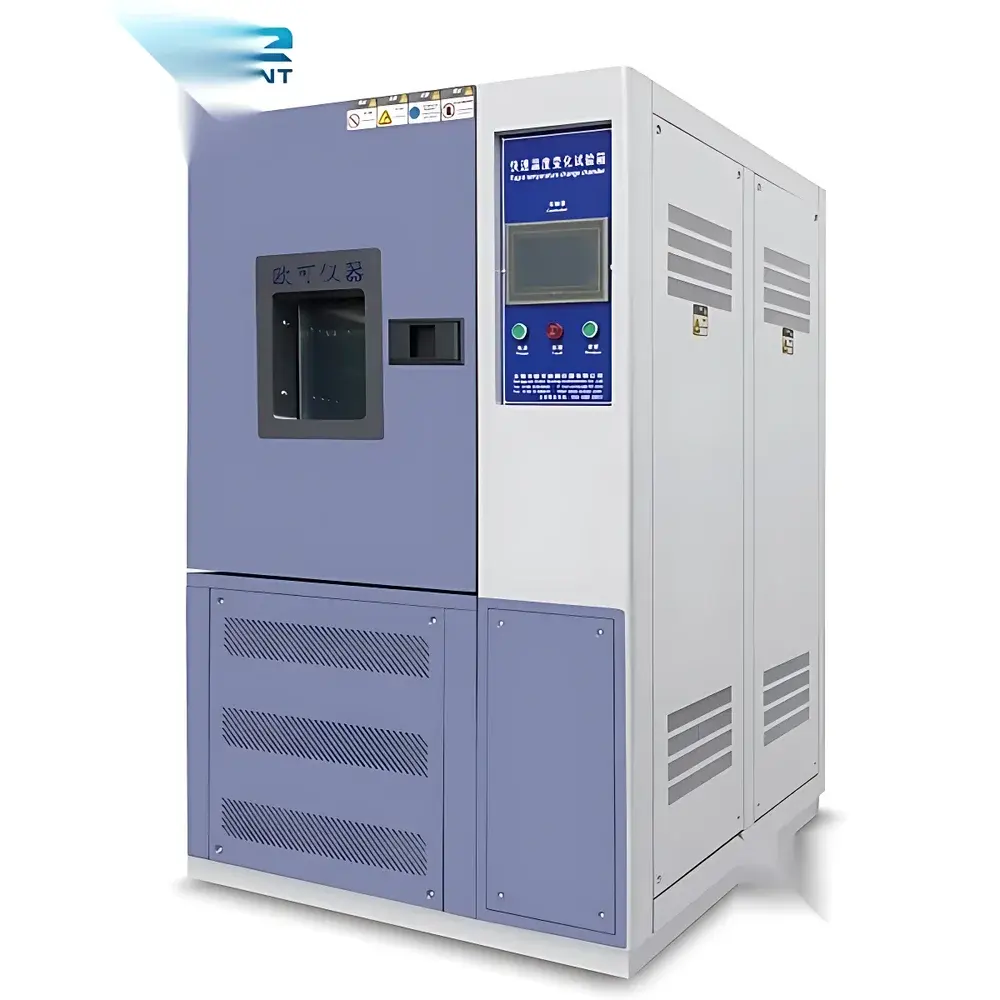
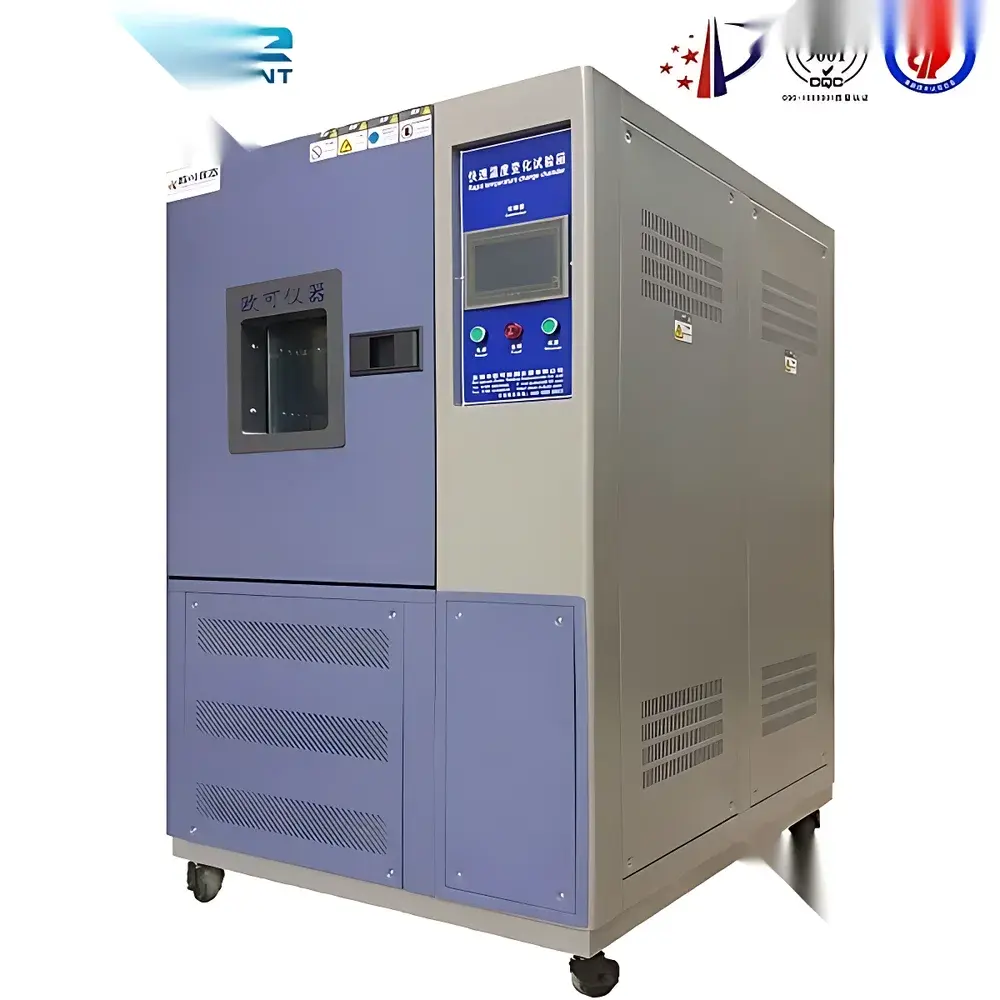
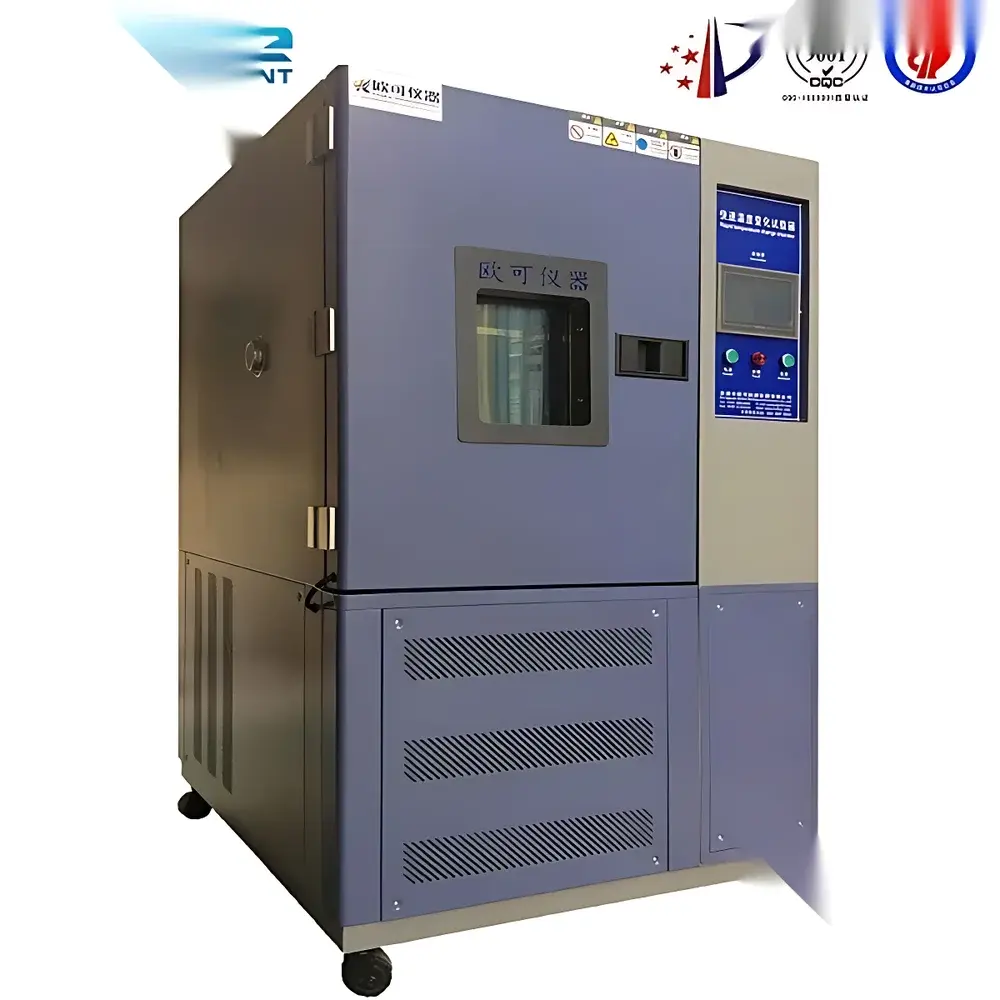
Ouke Rapid Temperature & Humidity Cycling Chamber
| Brand | Ouke |
|---|---|
| Model Series | KS-TH-100 / KS-TH-225 / KS-TH-500 / KS-TH-800 / KS-TH-010 |
| Internal Dimensions (D×W×H, mm) | 450×450×500 |
| External Dimensions (D×W×H, mm) | 1100×750×1000 |
| Construction | Exterior – Cold-rolled carbon steel with phosphating + electrostatic powder coating OR SUS304 stainless steel brushed finish |
| Temperature Range | +10°C to +150°C |
| Humidity Range | 85–98% RH |
| Temp. Uniformity/Fluctuation | ±2°C / ±0.5°C |
| Humidity Deviation | +2 / −3% RH |
| Heating Rate | 1–3°C/min |
| Controller | Microprocessor-based integrated temperature & humidity controller |
| Set/Display Resolution | 0.1°C / 1% RH |
| Sensor | PT100 platinum resistance thermometer & capacitive RH sensor |
| Heating System | Independent nickel-chromium alloy heater |
| Humidification | External isolated stainless steel shallow-surface evaporative humidifier |
| Dehumidification | Evaporator coil dew-point contact method |
| Water Supply | Auto-controlled with condensate recovery |
| Air Circulation | High-efficiency low-noise AC motor + multi-blade centrifugal impeller |
| Safety Protections | Over-temperature, over-current, leakage, short-circuit, dry-run, motor overheat, water shortage |
| Power Supply | AC 380V ±10%, 50 ±0.5 Hz, 3-phase 5-wire |
| Ambient Operating Conditions | 5–30°C, ≤85% RH |
| Energy-Saving Technology | PWM-controlled refrigerant flow regulation (cold/hot bypass + main circuit) enabling compressor-only low-temp stabilization — ~40% energy reduction vs. conventional PID-heating compensation methods |
| Compliance Context | Designed for test execution per IEC 60068-2-1 (Cold), IEC 60068-2-2 (Dry Heat), IEC 60068-2-30 (Damp Heat, Cycling), MIL-STD-810H Method 502.6 & 507.6, and supports GLP/GMP-aligned validation protocols including IQ/OQ documentation traceability |
Overview
The Ouke Rapid Temperature & Humidity Cycling Chamber (KS-TH series) is an environmental stress screening (ESS) system engineered for accelerated reliability assessment of electronic components, automotive modules, aerospace subsystems, polymer materials, and metallic assemblies under dynamically varying thermal and hygrothermal conditions. Unlike static chamber designs, this platform implements a dual-axis controlled environment—simultaneously modulating temperature (+10°C to +150°C) and relative humidity (85–98% RH) within a single test volume—enabling simulation of real-world operational extremes such as tropical storage, cold-start condensation, or rapid diurnal cycling. Its core thermodynamic architecture integrates a three-way PWM-regulated refrigeration loop, eliminating energy-wasteful heater-compressor antagonism typical in legacy PID-based systems. This enables stable low-temperature operation without auxiliary heating, reducing power consumption by approximately 40% during sustained sub-ambient profiles—a critical advantage for laboratories conducting long-duration qualification tests compliant with JEDEC JESD22-A104 or IPC-9701.
Key Features
- PWM-driven refrigerant flow control across main, hot-bypass, and cold-bypass circuits—enabling precise, energy-efficient temperature stabilization without resistive heating compensation
- Dual-layer high-temperature silicone door gasket and SUS304 mirror-finish interior chamber minimizing moisture retention and facilitating ISO 17025-compliant cleaning validation
- Microprocessor-based controller with 0.1°C/1% RH setpoint resolution, real-time trend logging, and programmable ramp-soak profiles up to 99 segments
- External isolated stainless steel evaporative humidifier with automatic water level monitoring and condensate recovery circuitry—reducing consumable usage and operator intervention
- Robust mechanical construction: choice of phosphated carbon steel or optional SUS304 exterior cladding; rigid polyurethane + glass fiber composite insulation achieving <0.8 W/m²·K thermal transmittance
- Integrated safety suite including independent over-temperature cutoff, phase-loss detection, motor thermal protection, and dry-run prevention for humidifier and circulation system
Sample Compatibility & Compliance
The KS-TH series accommodates test specimens ranging from PCB assemblies and battery packs to structural composites and sealed enclosures—supported by standardized 25 mm, 50 mm, and 100 mm cable/port access openings and two adjustable stainless steel sample racks. All models meet the mechanical and environmental requirements for test execution per IEC 60068-2-30 (cyclic damp heat), IEC 60068-2-14 (change of temperature), and MIL-STD-810H Methods 502.6 (low temperature) and 507.6 (humidity). The controller firmware supports audit-ready data integrity features—including user-level access control, electronic signature capability, and tamper-evident event logs—aligning with FDA 21 CFR Part 11 and EU Annex 11 expectations for regulated testing environments. Calibration traceability follows ISO/IEC 17025 principles using NIST-traceable reference standards.
Software & Data Management
Ouke’s proprietary chamber management software (v3.2+) provides local and remote supervision via Ethernet or RS485 interface. It supports automated report generation in PDF/CSV format, including chamber status, deviation alarms, and pass/fail evaluation against user-defined acceptance criteria. Historical datasets are stored with time-stamped metadata (operator ID, test ID, environmental parameters), enabling full reconstruction of test conditions for internal audits or regulatory submissions. Optional integration with LIMS platforms is available through OPC UA or Modbus TCP protocols. All firmware updates undergo version-controlled release validation and include rollback capability to ensure continuity in GxP-aligned validation states.
Applications
- Qualification testing of automotive ECUs under ISO 16750-4 (climate load cycles)
- Moisture sensitivity level (MSL) preconditioning per JEDEC J-STD-020 prior to reflow soldering
- Accelerated aging of elastomeric seals and adhesives under combined thermal-hygric stress
- Stability assessment of lithium-ion battery cells during calendar life simulation at elevated RH
- Validation of hermetic packaging integrity for MEMS sensors and medical electronics
- Material compatibility screening of conformal coatings and potting compounds under cyclic condensation
FAQ
What is the maximum allowable test load volume relative to chamber capacity?
For validated uniformity performance, total occupied volume should not exceed 30% of internal chamber volume. Load configuration must permit unobstructed airflow around all specimens.
Can the chamber operate continuously at 98% RH above 85°C?
Yes—provided ambient supply air dew point remains below −10°C and chamber door is not opened during operation. Continuous high-RH/high-T operation requires periodic desiccant maintenance on the humidifier feed system.
Is third-party calibration certification included with delivery?
Factory calibration with NIST-traceable certificates for temperature and humidity sensors is standard. On-site IQ/OQ protocol execution and 21 CFR Part 11-compliant validation support are available as optional services.
Does the system support custom profile programming for non-standard test sequences?
Yes—the controller accepts user-defined multi-segment profiles with independent ramp rates, dwell times, and humidity setpoints. Profile import/export is supported via USB or network transfer.
What maintenance intervals are recommended for optimal long-term stability?
Compressor oil analysis every 2,000 operating hours; humidifier tank cleaning weekly; evaporator coil inspection quarterly; full sensor recalibration annually or after any impact event or firmware update.
Related Products



