
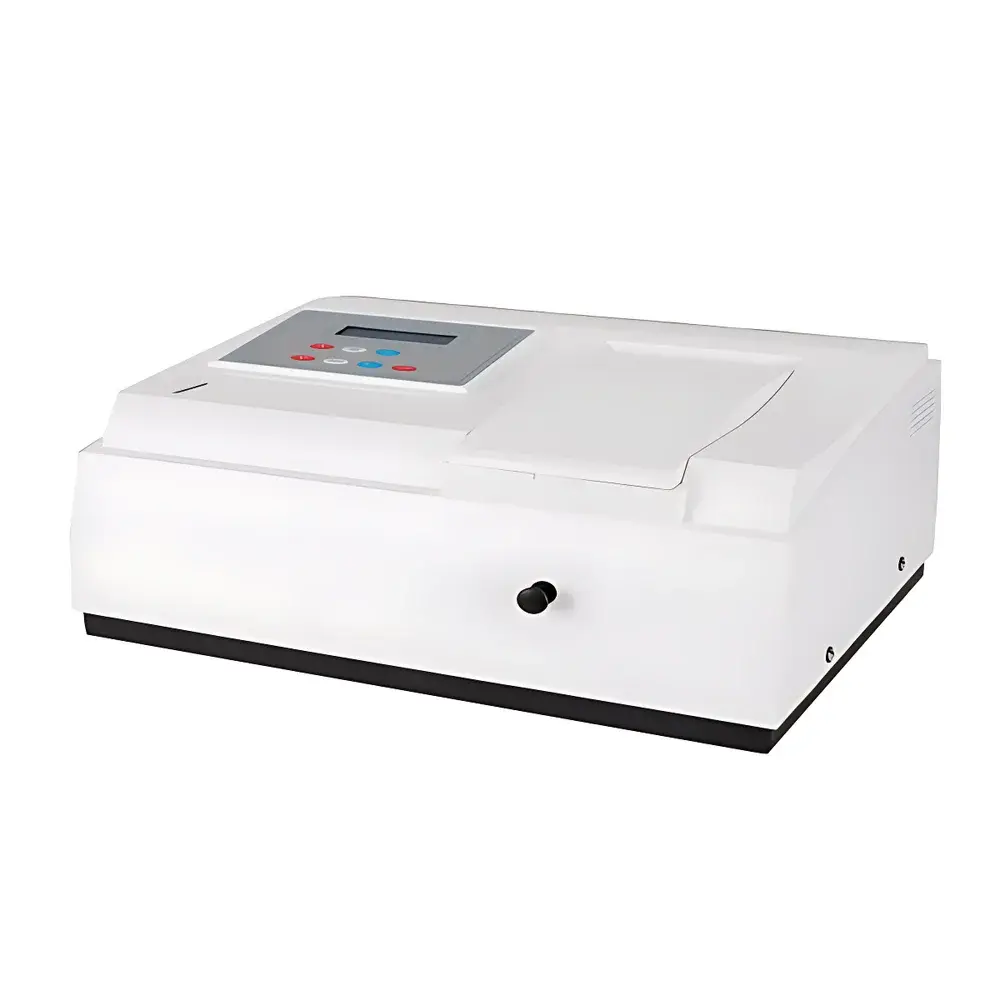
Hailong UV-Vis Spectrophotometer Series 723 / 723N / 7230G / X3
| Brand | Hailong |
|---|---|
| Origin | Shanghai, China |
| Model | 723 / 723N / 7230G / X3 |
| Wavelength Range | 325–1000 nm |
| Spectral Bandwidth | 2–4 nm |
| Wavelength Accuracy | ±1–±2 nm |
| Stray Light | ≤0.2%T @ 360 nm |
| Photometric Accuracy | ±0.3–±0.5%T |
| Photometric Repeatability | ≤0.2%T |
| Baseline Stability | ±0.002 A/h @ 500 nm |
| Wavelength Resolution | 0.1 nm |
| Detector Type | Photomultiplier Tube (PMT) |
| Optical Design | Czerny-Turner Monochromator |
| Light Source | Imported Tungsten-Halogen Lamp |
| Display | LCD with 0.1 nm wavelength resolution |
| Sample Compartment | Accepts 5–100 mm cuvettes |
| Measurement Modes | Transmittance (T), Absorbance (A), Concentration (C), Factor (F) |
| Auto-zero & Auto-100%T Calibration | Yes |
| Interface | USB (for optional XP-based analysis software) |
| Power Supply | AC 90–240 V, 50 Hz |
| Dimensions | 470 × 370 × 200 mm |
| Weight | 12 kg |
Overview
The Hailong UV-Vis Spectrophotometer Series 723 / 723N / 7230G / X3 is a benchtop double-beam (dual-wavelength) absorption spectrophotometer engineered for routine quantitative and qualitative analysis in academic teaching labs, quality control environments, and industrial R&D settings. Operating on the principle of Beer-Lambert law-based absorbance measurement, the instrument employs a Czerny-Turner monochromator architecture with a high-efficiency 1200 lines/mm diffraction grating and an imported tungsten-halogen lamp to deliver stable, reproducible spectral output across the visible and near-UV range (325–1000 nm). Its dual-wavelength capability enables simultaneous monitoring at two user-defined wavelengths—critical for kinetic assays, differential analysis, and background correction in complex matrices. Designed for robustness and ease of integration, the series supports standardized photometric workflows without requiring external calibration references for zero or 100% transmittance adjustments.
Key Features
- Optimized optical path with high-stability tungsten-halogen source and photomultiplier tube (PMT) detector for enhanced signal-to-noise ratio and low-level absorbance detection.
- Automatic wavelength scanning and real-time calibration: one-touch auto-zero and auto-100%T functions eliminate manual black-body insertion and reduce operator-induced variability.
- High-resolution LCD display with 0.1 nm wavelength readout precision ensures traceable wavelength positioning and repeatable method execution.
- Universal sample compartment accommodating standard cuvettes from 5 mm to 100 mm pathlength—compatible with quartz, glass, and plastic cells per ISO 3664 and ASTM E275 guidelines.
- Dual-wavelength operation mode facilitates ratiometric measurements, isosbestic point verification, and multi-component quantification without sequential scans.
- USB interface enables direct communication with Windows-based analytical software (optional XP-compatible suite), supporting data export, method storage, and report generation compliant with GLP documentation requirements.
- Microprocessor-controlled firmware delivers consistent baseline stability (±0.002 A/h @ 500 nm) and minimizes thermal drift during extended acquisition periods.
Sample Compatibility & Compliance
The instrument accommodates standard rectangular cuvettes (10 mm, 20 mm, 50 mm, and 100 mm pathlengths) made from optical-grade fused silica, borosilicate glass, or UV-transparent polymers. All models meet essential performance criteria outlined in ISO 6223 (spectrophotometer performance testing) and are suitable for applications governed by USP , EP 2.2.25, and ASTM E380 for photometric accuracy validation. Stray light performance (≤0.2%T @ 360 nm) satisfies minimum requirements for reliable low-transmittance measurements in turbid or highly absorbing samples. The system’s photometric repeatability (≤0.2%T) and wavelength accuracy (±1–±2 nm) align with routine QC specifications for pharmaceutical excipient testing, water quality analysis (e.g., COD, nitrate), and dye concentration monitoring.
Software & Data Management
When paired with the optional XP-compatible analytical software, the spectrophotometer supports full method development—including time-scan kinetics, multi-point calibration curves (C = kA + b), and fixed-wavelength monitoring. Data files are exported in CSV or TXT format for downstream statistical analysis in Excel or validated LIMS platforms. Audit trail functionality (via timestamped log files) supports basic 21 CFR Part 11 readiness when deployed in regulated environments. Software-generated reports include instrument ID, date/time stamp, operator ID (manual entry), measurement parameters, and raw absorbance/transmittance values—enabling traceability per ISO/IEC 17025 clause 7.8.2.
Applications
- Quantitative determination of analytes in pharmaceutical formulations (e.g., paracetamol, caffeine) using single- or dual-wavelength calibration.
- Enzyme kinetics studies (e.g., NADH oxidation at 340 nm) with time-scan capability enabled via software interface.
- Water and wastewater analysis: measurement of phosphate, nitrate, and heavy metal complexes (e.g., Fe-phenanthroline) per APHA Standard Methods.
- Educational laboratory instruction: demonstration of Beer’s law, spectral scanning, and interference correction techniques.
- Industrial QC of dyes, pigments, and food colorants where batch-to-batch consistency is assessed against reference spectra.
FAQ
What wavelength accuracy can be expected across the 723 series models?
The X3 and 723N models guarantee ±1 nm wavelength accuracy; the 7230G and base 723 models specify ±2 nm—consistent with ICH Q2(R2) guidance for identification tests in non-GMP settings.
Is this instrument suitable for GLP-compliant laboratories?
Yes, when used with the optional software and documented calibration procedures (including annual verification against NIST-traceable filters), it meets core GLP data integrity requirements for instrument qualification and record retention.
Can the PMT detector be replaced or serviced in-field?
The photomultiplier tube is factory-aligned and sealed within the optical housing; replacement requires authorized service technician intervention and post-replacement wavelength/photometric recalibration.
Does the instrument support compliance with FDA 21 CFR Part 11?
While the hardware itself does not include electronic signatures or role-based access control, the optional software package provides audit trail logging and exportable metadata—serving as foundational elements for Part 11 implementation when integrated into a validated IT infrastructure.
What is the maximum allowable cuvette height for the sample compartment?
The chamber accommodates cuvettes up to 45 mm in total height (including cap or stopper), with a standard vertical clearance of 40 mm between the beam path and upper compartment lid.
Related Products



