
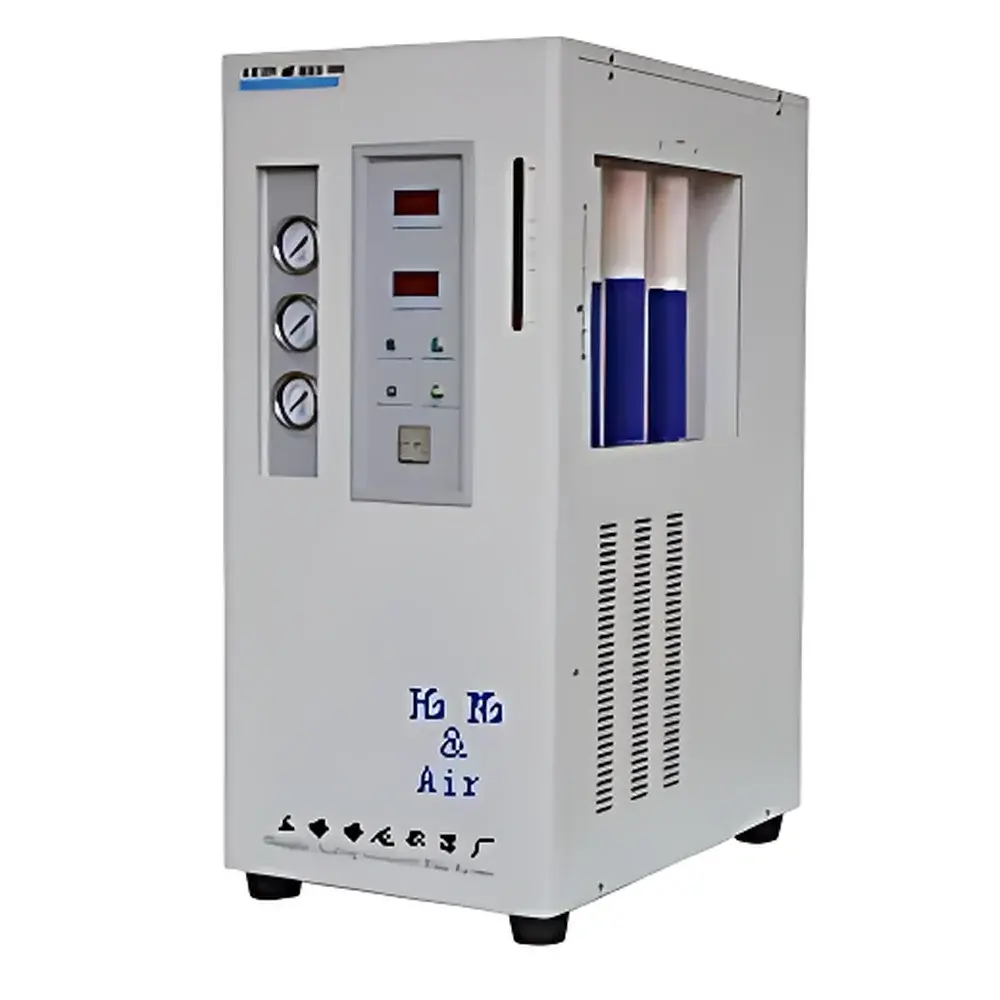
Hailong HLT-300II Integrated Nitrogen-Hydrogen-Air Gas Generator
| Brand | Hailong |
|---|---|
| Origin | Shanghai, China |
| Model | HLT-300II |
| Nitrogen Purity | >99.999% |
| Hydrogen Purity | >99.999% |
| Air Quality | Oil-free, desiccated, triple-purified |
| N₂/H₂ Flow Range | 0–300 mL/min |
| Air Flow Range | 0–2000 mL/min |
| H₂ Output Pressure | 0–0.4 MPa (factory-set at 0.3 MPa) |
| N₂ Output Pressure | 0–0.5 MPa (factory-set at 0.4 MPa) |
| Air Output Pressure | 0–0.4 MPa |
| Power Supply | 220 V ±10%, 50 Hz ±5% |
| Max. Power Consumption | 400 W |
| Operating Environment | 10–40 °C, RH ≤85%, non-corrosive, low-dust |
| Dimensions (W×D×H) | 460 × 440 × 370 mm |
| Weight | 40 kg |
| Warranty | 1-year full unit, 3-year electrolytic cell |
Overview
The Hailong HLT-300II Integrated Nitrogen-Hydrogen-Air Gas Generator is an engineered solution for laboratories requiring simultaneous, on-demand supply of high-purity nitrogen, hydrogen, and instrument-grade air—without reliance on high-pressure cylinders. Designed around membrane separation (for nitrogen), PEM electrolysis (for hydrogen), and multi-stage compression/filtration (for air), the system delivers stable, continuous gas streams with trace-level impurity control. Its compact footprint and modular internal architecture enable seamless integration into GC, GC-MS, FID, TCD, and other analytical platforms where consistent gas quality directly impacts baseline stability, retention time reproducibility, and detector sensitivity. The generator operates under closed-loop pressure regulation and real-time flow feedback, ensuring compliance with method requirements across ISO/IEC 17025-accredited environments.
Key Features
- Triple-gas output from a single chassis: independently regulated nitrogen, hydrogen, and air—each with dedicated purification pathways and pressure stabilization.
- PEM-based hydrogen generation with automatic anti-alkaline backflow protection and dynamic flow tracking to match instrument demand without manual adjustment.
- Membrane-based nitrogen generation utilizing selective permeation through hollow-fiber modules, achieving >99.999% purity with oxygen and moisture removal via integrated desiccant and catalytic scrubbers.
- Instrument air subsystem featuring oil-free scroll compressor, refrigerated dryer, coalescing filters, and activated carbon polishing—delivering Class 1 compressed air per ISO 8573-1:2010 (solid particles ≤0.1 µm, dew point ≤−40 °C, oil content <0.01 mg/m³).
- Stainless steel gas storage tanks for nitrogen and hydrogen—rated to 1.0 MPa working pressure, ASME BPVC Section VIII compliant, with integrated pressure relief valves and leak-tested manifolds.
- Intelligent control panel with LED status indicators, digital pressure/flow readouts, and fault logging; supports remote monitoring via optional RS-485 interface for integration into lab-wide asset management systems.
Sample Compatibility & Compliance
The HLT-300II is compatible with all major gas-chromatographic detectors requiring carrier, fuel, or make-up gases—including flame ionization (FID), thermal conductivity (TCD), electron capture (ECD), and nitrogen-phosphorus (NPD) detectors. Its output specifications meet or exceed the gas quality thresholds defined in ASTM D6299 (precision and bias in GC analysis), USP (chromatography), and ICH Q2(R2) (analytical procedure validation). All internal wetted materials are 316L stainless steel or EPDM-certified elastomers. The system includes built-in safety interlocks (over-pressure shutdown, temperature cutoff, electrolyte level monitoring) and conforms to CE machinery directive 2006/42/EC and electromagnetic compatibility standard EN 61326-1.
Software & Data Management
While the HLT-300II operates as a standalone hardware platform, its embedded firmware supports audit-ready event logging—including runtime hours, pressure excursions, filter saturation alerts, and maintenance timestamps. Optional firmware upgrade enables data export via USB or serial connection for integration into LIMS or electronic lab notebooks (ELN). All operational parameters are stored with timestamped metadata, satisfying FDA 21 CFR Part 11 requirements for electronic records when paired with validated user access controls and change management protocols. Calibration history and service entries can be exported in CSV format for GLP/GMP documentation workflows.
Applications
- Gas chromatography: nitrogen as carrier gas for capillary columns; hydrogen as fuel gas for FID; zero air as oxidant for FID and as makeup gas for ECD/NPD.
- Residual solvent analysis in pharmaceuticals per ICH Q3C guidelines, where ultra-high-purity nitrogen prevents oxidation artifacts during headspace sampling.
- Environmental testing labs performing EPA Method 8260/8270, where consistent hydrogen flow and purity are critical for quantitative accuracy in volatile organic compound (VOC) profiling.
- Quality control labs in polymer and petrochemical industries relying on TCD detection with high-stability nitrogen carrier gas to minimize baseline drift over extended runs.
- Research facilities conducting hyphenated techniques (e.g., GC-FTIR, GC-MS/MS) where cross-contamination between gas lines must be eliminated via physically isolated, dedicated supply paths.
FAQ
What is the expected lifetime of the PEM electrolyzer stack?
Under normal operating conditions (≤8 h/day, ambient humidity <70% RH), the PEM stack is rated for ≥5,000 operating hours; the 3-year electrolyzer warranty reflects typical degradation kinetics observed in controlled laboratory environments.
Can the generator be installed in an enclosed cabinet?
No—adequate ventilation is required: minimum 200 cm² free-air intake and exhaust area, with ambient airflow ≥0.5 m/s to dissipate heat generated by the compressor and power supply.
Is third-party calibration available for flow and pressure sensors?
Yes—certified calibration services are offered annually per ISO/IEC 17025:2017, including traceable NIST-certified flow meters and deadweight pressure standards.
How often must the air dryer desiccant be replaced?
Under typical lab use (2000 mL/min air, 8 h/day), replacement is recommended every 12 months—or sooner if dew point monitoring indicates >−30 °C saturation.
Does the system support remote start/stop via external TTL signal?
Yes—terminal block inputs accept 5–24 V DC dry-contact signals for automated activation synchronized with GC oven ramp sequences or autosampler triggers.



