
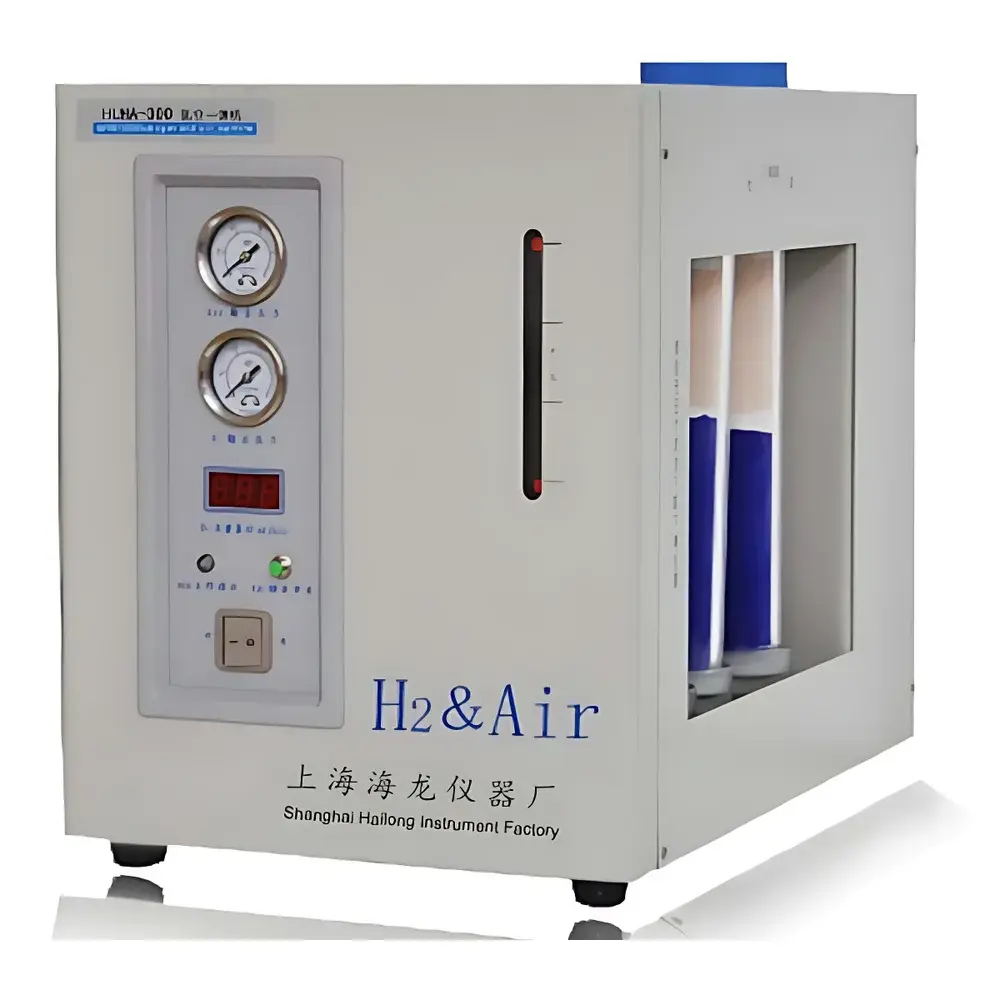
HLHA-300II / HLHA-500II Hydrogen & Air Integrated Gas Generator (Domestic Compressor Version)
| Brand | Hailong |
|---|---|
| Origin | Shanghai, China |
| Model | HLHA-300II, HLHA-500II |
| Hydrogen Purity | >99.999% |
| H₂ Flow Range | 0–300 mL/min (300II) / 0–500 mL/min (500II) |
| H₂ Pressure Range | 0–0.5 MPa (factory-set at 0.4 MPa) |
| Air Flow Range | 0–2000 mL/min (300II) / 0–5000 mL/min (500II) |
| Air Pressure Range | 0–0.5 MPa (factory-set at 0.4 MPa) |
| Hydrocarbon Concentration in Air Output | <0.1 ppm |
| Max Input Hydrocarbon in Ambient Air | <100 ppm |
| Pressure Stability Accuracy | <0.001 MPa |
| Max Power Consumption | 350 W (300II) / 450 W (500II) |
| Operating Temperature | 0–40 °C |
| Operating Humidity | ≤85% RH |
| Dimensions (W×D×H) | 300×480×380 mm |
| Weight | 29 kg |
Overview
The HLHA-300II and HLHA-500II Hydrogen & Air Integrated Gas Generators are engineered for laboratories requiring continuous, on-demand supply of high-purity hydrogen and instrument-grade compressed air—primarily for gas chromatography (GC) detectors including FID, TCD, and NPD. Unlike traditional cylinder-based systems, these units integrate a PEM-type alkaline electrolysis cell for hydrogen generation and a brushless oil-free diaphragm compressor with multi-stage filtration for air production—all within a single compact chassis. The core architecture leverages electrochemical water splitting (2H₂O → 2H₂ + O₂) under controlled current density, coupled with pressure-regulated gas delivery and real-time overpressure cutoff. This eliminates the logistical burden and safety risks associated with high-pressure gas cylinders while maintaining compliance with GC carrier and fuel gas specifications per ASTM D6299 and ISO 8573-1 Class 1 for particulate and hydrocarbon content.
Key Features
- Integrated dual-gas architecture: Simultaneous, independent regulation of hydrogen and air output pressures and flow rates via precision solenoid valves and digital PID controllers.
- Stainless steel moisture-separating storage tanks with auto-drain functionality to prevent condensate accumulation and ensure long-term system integrity.
- Three-stage hydrogen purification train: Palladium-doped membrane diffusion followed by desiccant and particulate filters, achieving >99.999% purity (residual O₂ < 1 ppm, H₂O < 1 ppm).
- Two-stage air pressure stabilization and three-stage filtration: Coalescing pre-filter, activated carbon adsorption bed (hydrocarbon removal to <0.1 ppm), and sub-micron final filter (0.01 µm absolute).
- Fail-safe engineering: Electrolyte level monitoring, automatic alkali reflux prevention, thermal cut-off at 85 °C, and mechanical pressure relief valves (set at 0.6 MPa) compliant with PED 2014/68/EU.
- Compact footprint (300 × 480 × 380 mm) optimized for benchtop deployment in regulated environments where space and auditability are critical.
Sample Compatibility & Compliance
Designed for direct integration into analytical workflows requiring ultra-low hydrocarbon air (e.g., GC-FID flame stability) and ultra-high-purity hydrogen (e.g., GC carrier or detector fuel), the HLHA series meets baseline requirements for ISO/IEC 17025-accredited laboratories. Its air output satisfies ISO 8573-1:2010 Class 1.2.1 (solid particles ≤0.1 µm, dew point −40 °C, hydrocarbons <0.1 ppm), while hydrogen output conforms to ASTM D7217–19 Grade 5 specifications. All electrical components comply with IEC 61010-1:2012 for laboratory equipment safety. The unit supports GLP/GMP traceability through non-volatile event logging (power cycles, pressure excursions, maintenance alerts) and is compatible with third-party environmental monitoring systems via RS232/USB interface.
Software & Data Management
Equipped with embedded firmware supporting local parameter configuration via OLED menu navigation (no PC required), the HLHA generators log operational data—including cumulative runtime, electrolyzer voltage history, pressure deviation events, and filter service intervals—in internal flash memory (16 MB). Optional USB-C connectivity enables export of CSV-formatted logs for audit review or preventive maintenance scheduling. While not FDA 21 CFR Part 11–certified out-of-the-box, the firmware architecture supports electronic signature-ready extensions when deployed with validated LIMS or ELN platforms. Firmware updates are delivered via signed binary packages verified using SHA-256 checksums.
Applications
- Gas chromatography: Primary hydrogen source for FID, HID, and as carrier gas in capillary GC (with appropriate pressure/flow tuning).
- Trace-level volatile organic compound (VOC) analysis: Ultra-low-hydrocarbon air supply ensures baseline stability and minimizes ghost peaks in environmental and pharmaceutical testing.
- Hydrogenation reaction support: On-demand, low-flow hydrogen for small-scale catalytic screening in synthetic chemistry labs.
- Calibration gas blending systems: Stable, metered H₂ and air streams serve as base gases for dynamic dilution calibrators (e.g., permeation tubes, mass flow mixers).
- Education and method development labs: Reliable, quiet, and maintenance-transparent gas supply for teaching GC fundamentals and validating new analytical protocols.
FAQ
What is the expected service life of the electrolysis cell under standard operating conditions?
With daily operation at ≤80% of rated flow and ambient humidity ≤60% RH, the alkaline electrolyzer demonstrates ≥5,000 hours of stable performance before scheduled replacement—equivalent to ~24 months of continuous 8-hour/day use.
Can the unit be operated in an unventilated enclosure?
No. Although equipped with O₂ venting and thermal management, the generator must be installed in a well-ventilated area meeting local codes for hydrogen-emitting equipment (NFPA 50A, IEC 60079-10-1). A minimum clearance of 15 cm on all sides is required for heat dissipation.
Is deionized water the only acceptable feedstock?
Yes. Feed water conductivity must remain ≤1 µS/cm (per ASTM D1193 Type I). Tap water, distilled water, or bottled drinking water will cause rapid electrode fouling and void the warranty.
How often do the air and hydrogen filters require replacement?
Under typical lab conditions (20–25 °C, ≤50% RH), the air carbon filter and hydrogen desiccant cartridge should be replaced every 6,000 operating hours or annually—whichever occurs first. Filter status is indicated via front-panel LED and logged in system diagnostics.
Does the generator support remote monitoring via Ethernet or Modbus?
Not natively. RS232 and USB are the only supported digital interfaces. Integration with building management systems (BMS) or SCADA requires external protocol converters configured for ASCII command/response framing.
Related Products



