
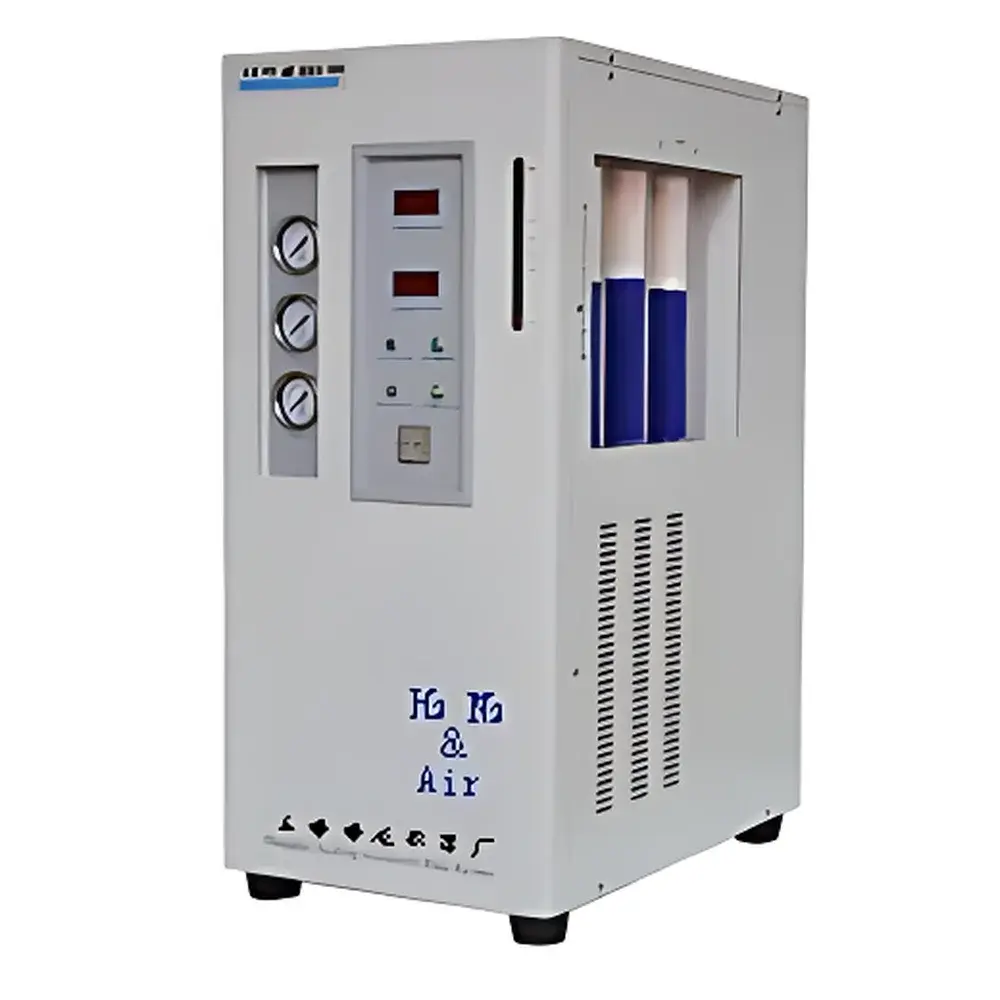
Hailong HLT-300G Nitrogen-Hydrogen-Air Integrated Gas Generator
| Brand | Hailong |
|---|---|
| Origin | Shanghai, China |
| Model | HLT-300G |
| Nitrogen Purity | >99.999% |
| Hydrogen Purity | >99.999% |
| Air Quality | Oil-free, Dry, Triple-Purified |
| N₂/H₂ Flow Range | 0–300 mL/min |
| Air Flow Range | 0–2000 mL/min |
| H₂ Output Pressure | 0–0.4 MPa (factory-set at 0.3 MPa) |
| N₂ Output Pressure | 0–0.5 MPa (factory-set at 0.4 MPa) |
| Air Output Pressure | 0–0.4 MPa |
| Power Supply | 220 V ±10%, 50 Hz ±5% |
| Max. Power Consumption | 400 W |
| Operating Environment | 10–40 °C, RH ≤85%, non-corrosive, low-dust |
| Dimensions (W×D×H) | 460 × 440 × 370 mm |
| Weight | 40 kg |
| Warranty | 1-year system warranty, 3-year electrolyzer warranty |
Overview
The Hailong HLT-300G Nitrogen-Hydrogen-Air Integrated Gas Generator is an engineered solution for laboratories requiring simultaneous, on-demand delivery of high-purity nitrogen, hydrogen, and instrument-grade air—without reliance on high-pressure gas cylinders. Designed specifically for analytical instrumentation such as gas chromatographs (GC), GC-MS systems, and flame-based detectors (e.g., FID, TCD, NPD), the unit employs membrane-based separation for nitrogen generation, PEM (Proton Exchange Membrane) electrolysis for hydrogen production, and a multi-stage compression/filtration system for oil-free, desiccated air. Its fully integrated architecture eliminates cross-contamination risks between gas streams and ensures independent pressure and flow regulation per output channel—critical for detector stability and method reproducibility. The stainless-steel internal storage reservoirs provide buffer capacity while maintaining safety compliance equivalent to ISO 8573-1 Class 1 compressed air and ASTM D6352-compliant hydrogen purity.
Key Features
- Triple-gas independence: Separate, isolated generation pathways for N₂, H₂, and air—no shared components or pressure coupling.
- PEM electrolysis cell with automatic anti-alkali-backflow protection and real-time flow tracking to match downstream demand without manual adjustment.
- Membrane nitrogen generator with integrated catalytic oxygen scavenging, delivering >99.999% N₂ purity at up to 300 mL/min (verified by online paramagnetic O₂ sensor).
- Oil-free scroll air compressor with integrated refrigerant dryer, coalescing filter, and automatic condensate drain—ensuring consistent dew point ≤−40 °C and particulate removal down to 0.01 µm.
- Microprocessor-controlled pressure regulation with digital setpoint memory; factory presets include 0.3 MPa for H₂, 0.4 MPa for N₂, and 0.4 MPa for air—adjustable within operational limits.
- Comprehensive safety architecture: Over-temperature shutdown, electrolyte level monitoring, pressure relief valves on all three outputs, and audible/visual fault alerts with event logging.
Sample Compatibility & Compliance
The HLT-300G is validated for continuous operation with gas chromatography systems from Agilent, Thermo Fisher, Shimadzu, and PerkinElmer, including compatibility with capillary columns, packed columns, and auxiliary detectors requiring stable, low-particulate carrier and fuel gases. All gas outputs meet or exceed the purity and cleanliness specifications defined in ASTM D6352 (hydrogen for GC), ISO 8573-1:2010 Class 1.2.1 (compressed air), and USP requirements for pharmaceutical analysis. The unit’s electrical design conforms to IEC 61010-1 for laboratory equipment safety, and its firmware supports audit-ready event logs required under GLP and GMP environments. No external venting or exhaust ducting is required—suitable for installation inside standard laboratory fume hoods or instrument rooms.
Software & Data Management
While the HLT-300G operates as a stand-alone hardware platform, its embedded controller maintains timestamped records of operational parameters—including runtime hours, pressure deviations, temperature excursions, and alarm events—for up to 12 months. These logs are exportable via USB interface in CSV format for integration into LIMS or quality documentation workflows. Optional RS-232 or Ethernet connectivity (available upon request) enables remote status monitoring and basic control via SCADA-compatible protocols. All firmware updates are performed offline using signed binary packages to ensure data integrity and regulatory traceability—fully aligned with FDA 21 CFR Part 11 requirements for electronic records and signatures when deployed in regulated QC/QA labs.
Applications
- Carrier gas supply for GC and GC-MS analyses requiring ultra-high-purity nitrogen (e.g., residual solvent testing, environmental VOC profiling, polymer additive screening).
- Fuel gas source for flame ionization detectors (FID) and flame photometric detectors (FPD), where consistent H₂ flow and purity directly impact baseline noise and linear dynamic range.
- Make-up and combustion air for ECD, TCD, and NPD detectors—eliminating hydrocarbon contamination risks associated with oil-lubricated compressors.
- Gas supply for nitrogen purging in sample preparation workstations, glove boxes, and inert-atmosphere reactors.
- Backup or primary gas source in centralized lab gas networks where redundancy and localized control are prioritized over bulk cylinder logistics.
FAQ
Can the HLT-300G replace high-pressure gas cylinders in regulated environments?
Yes—the unit meets ISO/IEC 17025 traceability requirements when paired with periodic third-party verification of output purity and pressure stability. Certificate of Conformance and factory calibration reports are provided with each shipment.
What maintenance intervals are recommended for long-term reliability?
Annual replacement of air intake filters and desiccant cartridges is advised; the PEM electrolyzer and nitrogen membranes require no scheduled replacement under normal operating conditions and are covered by a 3-year limited warranty.
Is remote monitoring supported out-of-the-box?
Standard configuration includes local LCD interface and USB data export. RS-232 or Ethernet modules are optional add-ons for integration into facility-wide monitoring systems.
Does the unit require external cooling or ventilation?
No—its thermal management system is self-contained and rated for continuous operation in ambient temperatures up to 40 °C without forced airflow or dedicated HVAC support.
How is gas purity verified during operation?
Real-time purity assurance is achieved through integrated electrochemical O₂ sensors (for N₂ stream), thermal conductivity detection (for H₂), and dew point sensors (for air)—all continuously logged and accessible via the front-panel menu.



