
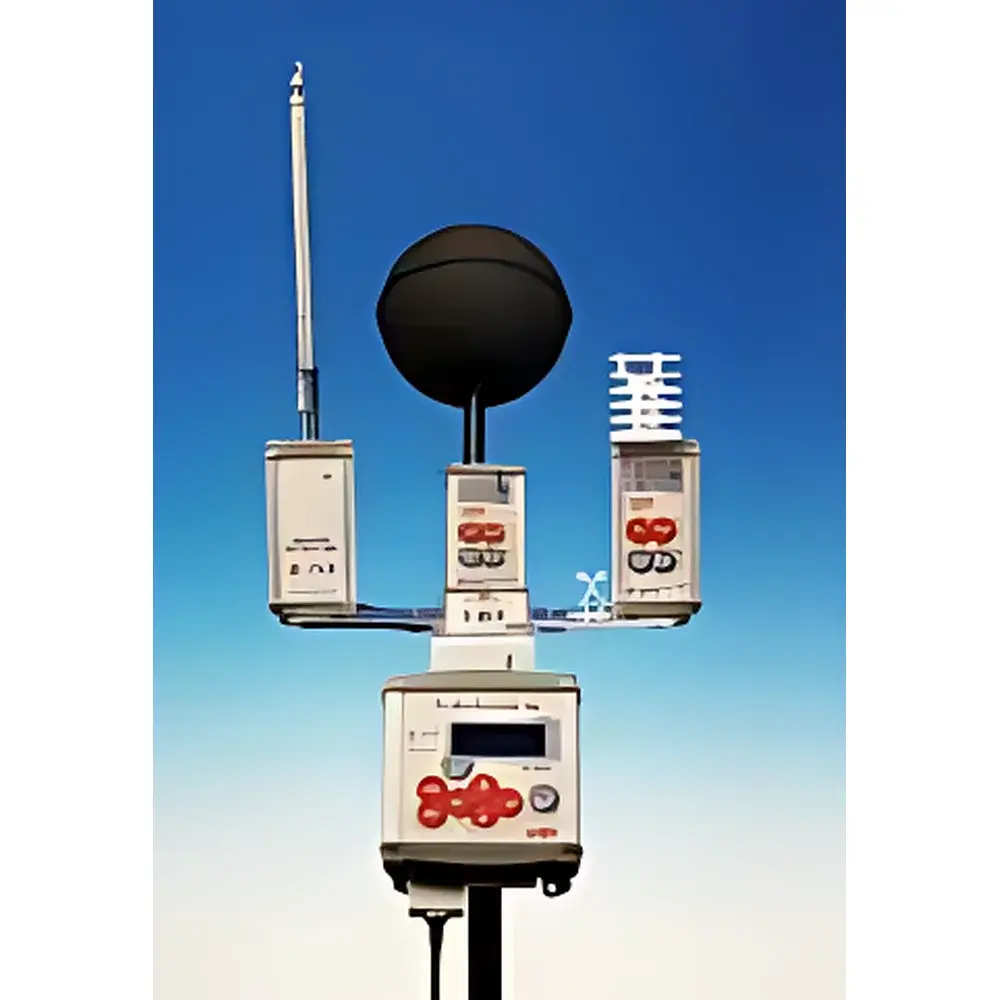
Lsi R-Log 7730 Thermal Comfort Monitoring System
| Brand | Lsi (LSI-LASTEM) |
|---|---|
| Origin | Italy |
| Model | R-Log 7730 |
| Sensor Compliance | ISO 7726, ISO 7730 |
| Wireless Data Logger Memory | 2 MB |
| Channels | 5 |
| Battery | 1.2 A Li-ion |
| Interface | Mini-DIN, RS232 |
| Operating Temperature Range | −30 °C to +70 °C |
| Black Globe Temperature Range | −20 °C to +60 °C |
| Accuracy (Globe Temp) | ±0.5 °C (5–45 °C), ±1 °C (outside range) |
| Response Time (Globe) | 30 s |
| Dry/Wet-Bulb Temp Range | −20 °C to +60 °C |
| RH Range | 0–100% |
| RH Accuracy | ±2% (10–90% RH, 25 °C) |
| RH Response Time | 8 s |
| Hot-Wire Anemometer Range | 0.01–20 m/s |
| Turbulence Intensity (TU) Range | 0–100% |
| TU & Va Accuracy | ±5 cm/s (0–0.5 m/s), ±10 cm/s (0.5–1.5 m/s), ±4% (>1.5 m/s) |
Overview
The Lsi R-Log 7730 Thermal Comfort Monitoring System is a field-deployable, ISO-compliant environmental measurement platform engineered for quantitative assessment of human thermal comfort in built environments. Based on the fundamental principles of heat exchange between the human body and its surroundings—governed by convective, radiative, conductive, and evaporative mechanisms—the system implements the steady-state predictive model defined in ISO 7730, which calculates the Predicted Mean Vote (PMV) and Predicted Percentage of Dissatisfied (PPD) indices. It integrates direct physical measurements (black globe temperature, dry-bulb and wet-bulb temperatures, relative humidity, air velocity, and turbulence intensity) with algorithmic derivation of secondary thermal parameters—including mean radiant temperature (Tr), partial water vapor pressure (Pa), local air temperature (TO), turbulence intensity (TU), and draft risk (DR)—all traceable to ISO 7726 sensor performance specifications. Designed for laboratory validation, field audits, HVAC commissioning, and post-occupancy evaluation, the R-Log 7730 supports both static and dynamic thermal environment analysis, including transient conditions induced by occupancy patterns, solar gain, or HVAC cycling.
Key Features
- Modular, expandable architecture supporting over 70 plug-and-play sensor types—including net radiation, floor/ankle temperature differentials, IAQ (CO₂, VOCs), noise, and illuminance modules.
- Wireless, battery-powered data logger with 2 MB internal memory, automatic sensor recognition, and five analog input channels via Mini-DIN interface.
- Dedicated wireless sensors calibrated per ISO 7726: black globe thermometer (Pt100, ±0.5 °C accuracy in 5–45 °C range), mechanically ventilated psychrometer (±2% RH, 8 s response), and hot-wire anemometer (0.01–20 m/s, ±5 cm/s at low velocities).
- Real-time onboard display of raw and derived thermal indices, with configurable averaging modes (Min/Ave/Max/StdDev/Instantaneous).
- Integrated lithium-ion power system (1.2 A capacity) enabling >24 hours of continuous operation under typical field conditions.
- RS232 serial interface for direct connection to external PCs or industrial controllers during long-term monitoring deployments.
Sample Compatibility & Compliance
The R-Log 7730 is validated for use across diverse indoor and semi-outdoor environments—including office buildings, hospitals, educational facilities, transportation hubs, and industrial workspaces. Its sensor suite conforms to ISO 7726:1998 for physical parameter measurement uncertainty and spatial resolution, ensuring metrological traceability for PMV-PPD computation per ISO 7730:2005. The system meets requirements for GLP-aligned environmental monitoring protocols and supports audit-ready data integrity through time-stamped, tamper-evident logging. Optional IAQ and noise modules enable concurrent compliance verification against EN 16798-1 (Energy performance of buildings) and ISO 16835 (Occupant thermal comfort surveys). All firmware and software adhere to IEC 62443 cybersecurity guidelines for industrial control systems.
Software & Data Management
The included ISO-authorized analysis software provides full implementation of ISO 7730 equations with preloaded thermophysiological constants. Users may dynamically adjust metabolic rate (1–4 met) and clothing insulation (0.0–4.0 clo) to simulate occupant-specific scenarios—critical for research into adaptive thermal models or PPE-related studies. The software enables real-time streaming visualization, synchronized multi-sensor time-series plotting, and automated generation of customizable PDF reports. Templates include ISO 7730 compliance summaries, thermal injury risk assessments (e.g., cold stress, heat strain), and HVAC performance diagnostics. All report outputs embed raw sensor values, computed indices, statistical summaries, and annotated charts. Audit trails record user actions, parameter modifications, and calibration events—supporting 21 CFR Part 11 compliance when configured with electronic signature workflows.
Applications
- Post-occupancy evaluation (POE) of building thermal performance against ASHRAE Standard 55 and EN 15251 criteria.
- Validation of CFD-simulated thermal environments in architectural design review cycles.
- Occupational health assessments for workplaces exposed to extreme ambient conditions (e.g., foundries, refrigerated warehouses, outdoor construction).
- Textile and personal protective equipment (PPE) testing—monitoring microclimate between garment layers and skin surface under controlled activity protocols.
- Dynamic thermal comfort modeling during occupancy transitions, solar loading events, or HVAC fault detection.
- Integration into Building Management Systems (BMS) for demand-controlled ventilation based on real-time PMV feedback.
- Academic and clinical research into thermal alliesthesia, age-related thermoregulatory decline, and neurobehavioral responses to thermal stress.
FAQ
Does the R-Log 7730 support real-time PMV-PPD calculation onboard?
Yes—the embedded processor performs ISO 7730-compliant calculations continuously using live sensor inputs; results are displayed locally and transmitted wirelessly.
Can the system operate unattended for extended periods?
With fully charged batteries and default sampling intervals (e.g., 1-minute logging), the logger sustains >72 hours of autonomous operation; external power options extend this indefinitely.
Is software validation documentation available for regulated environments?
Upon request, Lsi provides IQ/OQ documentation packages, software verification reports, and traceable calibration certificates aligned with ISO/IEC 17025-accredited laboratories.
How are sensor calibrations maintained across the modular ecosystem?
Each sensor carries a unique ID with factory calibration coefficients stored in non-volatile memory; the software applies correction algorithms automatically upon detection.
What export formats does the analysis software support?
CSV, Excel (.xlsx), XML, and PDF—structured for import into statistical platforms (R, Python pandas), BIM tools (Revit, ArchiCAD), and enterprise EHS databases.







